
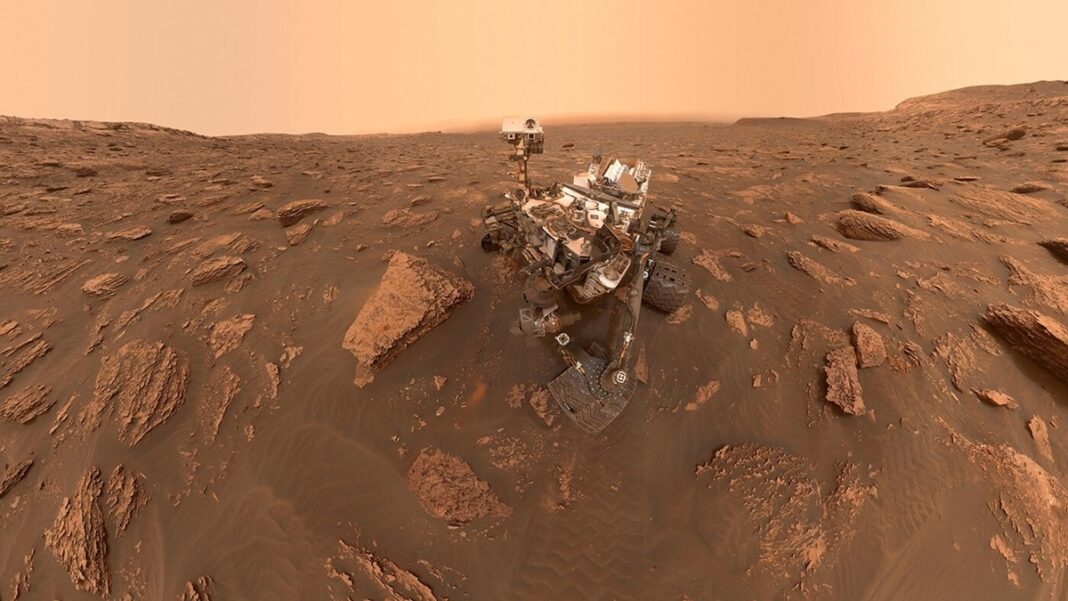
For decades, scientists have wondered whether Mars ever harboured life. A new discovery by Nasa’s Curiosity rover may not answer that question outright, but it has brought us closer than ever before.
A rock sample drilled from the Martian surface back in 2020 has just yielded the most diverse collection of organic molecules ever found on the Red Planet. This refers to carbon-containing compounds, the very building blocks of life.
Of the 21 such molecules identified, seven had never been detected on Mars before.
The findings, published in the journal Nature Communications, took years of painstaking laboratory analysis to confirm.
WHAT DID CURIOSITY ACTUALLY FIND ON MARS?
The sample, nicknamed Mary Anning 3, was collected from a region of Mount Sharp that was once covered by ancient lakes and streams.
This area is rich in clay minerals, which are exceptionally good at trapping and preserving organic molecules over billions of years, even in the harsh, radiation-battered environment of Mars.
Among the newly identified molecules is a nitrogen heterocycle, which is a ring-shaped structure made of carbon and nitrogen atoms.
This kind of molecule is considered a chemical forerunner to RNA and DNA, the genetic material found in every living thing on Earth. It has never been confirmed on the Martian surface before.
Another notable find was benzothiophene, a molecule containing carbon and sulphur that has previously been spotted inside ancient meteorites thought to have carried the seeds of chemistry across the early solar system.
CURIOSITY NOT ALONE IN DISCOVERING SIGNS OF LIFE ON MARS
Nasa’s Perseverance rover had identified what could be the strongest hints yet of past life on Mars, a breakthrough that energised
planetary science and revived the search for ancient extraterrestrial organisms.
The finding came from a rock sample nicknamed “Sapphire Canyon,” collected in July 2024 from the Cheyava Falls formation inside Jezero Crater, a site scientists believed had once held flowing water more than three billion years ago.
Scientists spotted unusual “leopard spot” textures along with mineral patterns known as biosignatures within the mudstones of Cheyava Falls. Biosignatures are chemical or structural traces that can be linked to biological activity, although they can also form through non-living processes.
On Earth, similar features are often associated with microbes in watery environments, raising the possibility that ancient microbial life may once have existed in these Martian rocks.
DOES THIS MEAN THERE WAS LIFE ON MARS?
Not necessarily. Scientists are careful to point out that organic molecules can form through purely geological processes, without any involvement of living organisms. But their presence, and their remarkable preservation, confirm that ancient Mars had the right chemical conditions to support life.
These discoveries were made using a miniaturised laboratory inside Curiosity’s belly called Sample Analysis at Mars, or SAM, which heats rock powder and analyses the gases released.
The results will now help shape future Mars missions, and the search for life beyond Earth continues.


