A Nasa spacecraft flying closer to the Sun has made a surprising discovery about how solar storms are born, and the findings could change the way scientists predict space weather that affects life on Earth.
AN UNEXPECTED DISCOVERY
The spacecraft observed a Sun-directed jet of particles made of protons and heavy ions, heavy ions, which are atoms that have lost or gained electrons.
But unexpectedly, analysis of the data revealed that protons and ions were accelerated in different ways.

Existing theories expected both types of particles to be launched the same way, but the new data showed protons spread out broadly, like light from a torch, while heavier ions appeared more narrowly focused, almost like a beam.
The findings, published in the Astrophysical Journal, will help scientists refine theoretical models of magnetic reconnection to better understand how solar storms are powered. In other words, the Sun still has secrets, and we just got a little closer to uncovering them.
WHAT IS PARKER SOLAR PROBE?
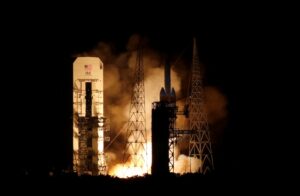
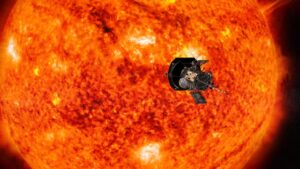
Nasa’s Parker Solar Probe, launched in August 2018, is a groundbreaking spacecraft designed to study the Sun closer than any mission in history.

It regularly swoops through the Sun’s outer atmosphere called the corona, enduring temperatures exceeding a million degrees Celsius and travelling at speeds of up to 6,90,000 kilometres per hour, making it the fastest human-made object ever built.
The spacecraft is protected by a cutting-edge carbon heat shield just 11.5 centimetres thick. The probe collects data on solar wind, magnetic fields, and energetic particles to help scientists understand how solar storms form and how to better predict space weather events that can disrupt satellites, power grids, and communications on Earth.
WHAT DID PARKER SOLAR PROBE FIND?
While the Parker Solar Probe studies the Sun’s corona, this particular observation was made in the solar wind, where a magnetic reconnection event was directly measured.
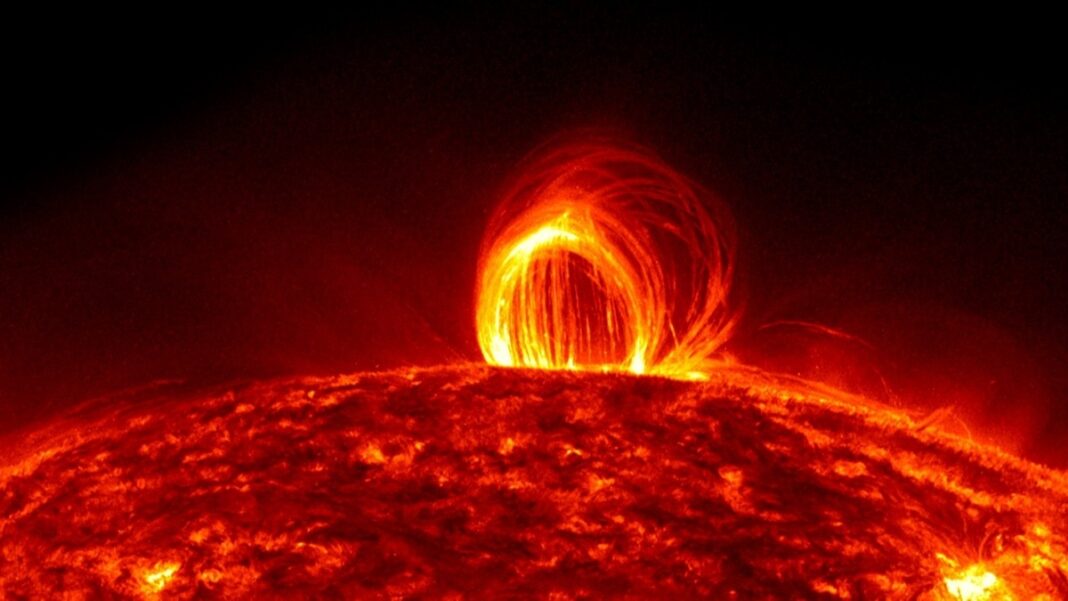
Magnetic reconnection is a process where the Sun’s magnetic field lines snap and reconnect, releasing energy that hurls charged particles into space.
Before a solar storm races across space and impacts technology on Earth, it starts with an explosive process on the Sun known as magnetic reconnection.
In simple terms, imagine two rubber bands crossed over each other. When they snap apart, they release a burst of energy.
The Sun does something similar with its magnetic field lines.

When these lines cross and snap, they explosively hurl particles outward at enormous speeds. Those particles can eventually reach Earth and disrupt satellites, power grids, and communication systems.
On a 2022 solar flyby, the Parker Solar Probe passed between the Sun and the site of one of these magnetic reconnection events in the solar wind, which is the constant stream of particles and magnetic fields pouring out from the Sun.
This gave scientists a rare front-row seat to measure the event directly. Improved prediction could help protect satellites, GPS systems, and power infrastructure from geomagnetic storms.