
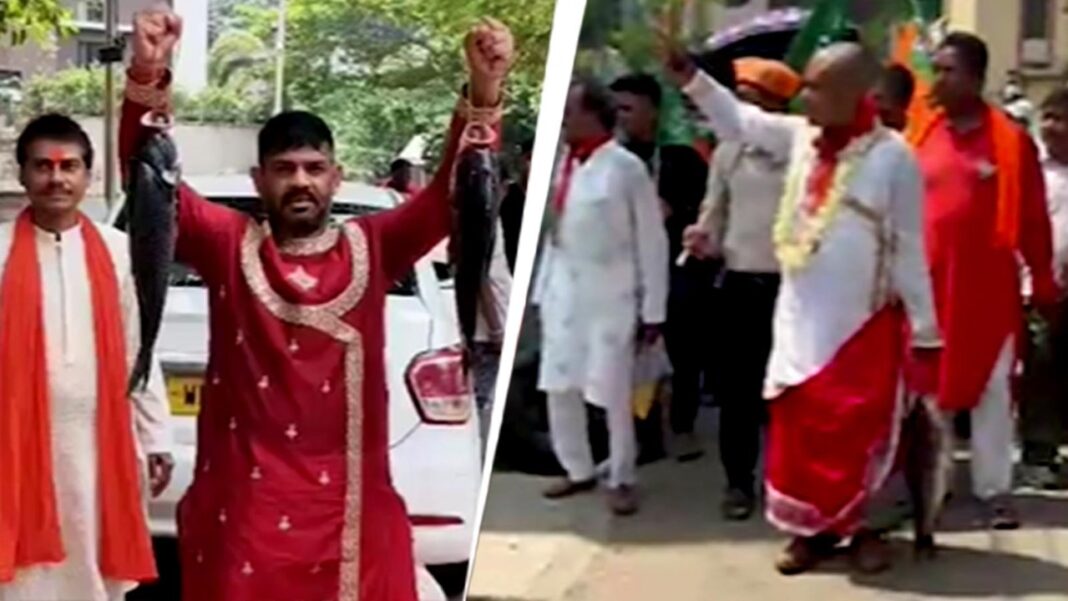
As part of a major tactic to woo voters ahead of the 2026 polls, Bengal BJP leaders Rakesh Singh and lawyer-politician Koustav Bagchi were seen celebrating Poila Baisakh (the first day of the Bengali New Year) in Bengali attire, with fish in hand. Bengal will go to the two-phased assembly election on April 23 and 29.
Singh, the BJP candidate from the Kolkata Port constituency against Kolkata’s Mayor and TMC heavyweight Firhad Hakim, was seen dressed in a red kurta and white dhoti as he took out his campaign rally during the early hours of Wednesday. Surrounded by the party workers, he showed the fish multiple times to express his rootedness in the Bengali identity and culture.
Bagchi, on the other hand, was seen visiting door-to-door in the Barrackpore assembly constituency, where he is locked in a hornet’s nest with the sitting MLA and the filmmaker-politician Raj Chakrabarty. Bagchi, who was wearing a white kurta and a red dhoti, was also seen holding a fish during his mass-connect programme. His supporters accompanied him by chanting his name and playing drums.
This is not the first time BJP candidates have used a fish in their campaign rallies. Sharadwat Mukhopadhyay, a newcomer in the state politics who is taking on another TMC heavyweight, Sujit Bose, in Biddhannagar assembly constituency, is a trend setter in this rmatter. He was the first one to use a fish during his campaigning in the assembly constituency.
WHY SO ‘FISHY?’
The use of fish by several BJP leaders in campaigning is nothing but a newfound tactic of the party to win the hearts (and votes) of people who are known for their habit of eating fish on a daily basis.
It has a backstory. The ruling Trinamool Congress, over the years, has tried to paint a narrative of the BJP being a party of outsiders, not respectful to the culture, language, and dietary preferences of Bengal.
From the Chief Minister, Mamata Banerjee, to the party’s national general secretary, Abhishek Banerjee, criticised the BJP for the alleged ban on non-vegetarian food like meat and fish in states where they are in power.
During the 2024 Lok Sabha polls, Abhishek Banerjee heavily criticised Narendra Modi for his remarks about opposition leaders like Rahul Gandhi and RJD’s Tejaswi Yadav showcasing a ‘Mughal mentality’ by eating non-vegetarian food during the holy month of Sawan.
Speaking at a rally in Cooch Behar, Banerjee said that the Prime Minister had no knowledge of the culture and eating habits of people across the country. He also said that the rituals of Durga Puja and Kali Puja are incomplete without the inclusion of fish and meat in many Bengali households.
TIME TO DEFY NARRATIVE
For the BJP, this election is not just about winning but also about breaking the ‘outsider’ narrative, and fish is an integral part of it.
With more than 65 per cent weekly consumption, as per a joint survey conducted by the Indian Council of Agricultural Research (ICAR), Ministry of Agriculture and Farmers’ Welfare, Government of India, and WorldFish, Bengal has one of the largest fish-eating populations in the state. And the BJP knows it.
During his visit to the state, Union Minister Amit Shah said that the BJP would not ban fish and other non-vegetarian food in the state. He also slammed Mamata Banerjee for spreading a ‘false narrative’ that the BJP will not let Bengalis eat non-vegetarian food.
Prime Minister Narendra Modi also intensified his attacks on the Trinamool Congress for failing to feed enough fish to the people. He said that the BJP-ruled states like Bihar and Assam used to import fish; however, they are now self-sufficient and produce fish on their own. Bengal will also follow the same path if the BJP is voted to power.
Going beyond kitchens, fish has become a key talking point in this year’s assembly election. It acts as the focal point of the Bengali asmita (Bengali identity). Will the BJP be able to cash in on it?
Elections 2026 | West Bengal Election | West Bengal Election Constituencies | West Bengal Election Schedule


