
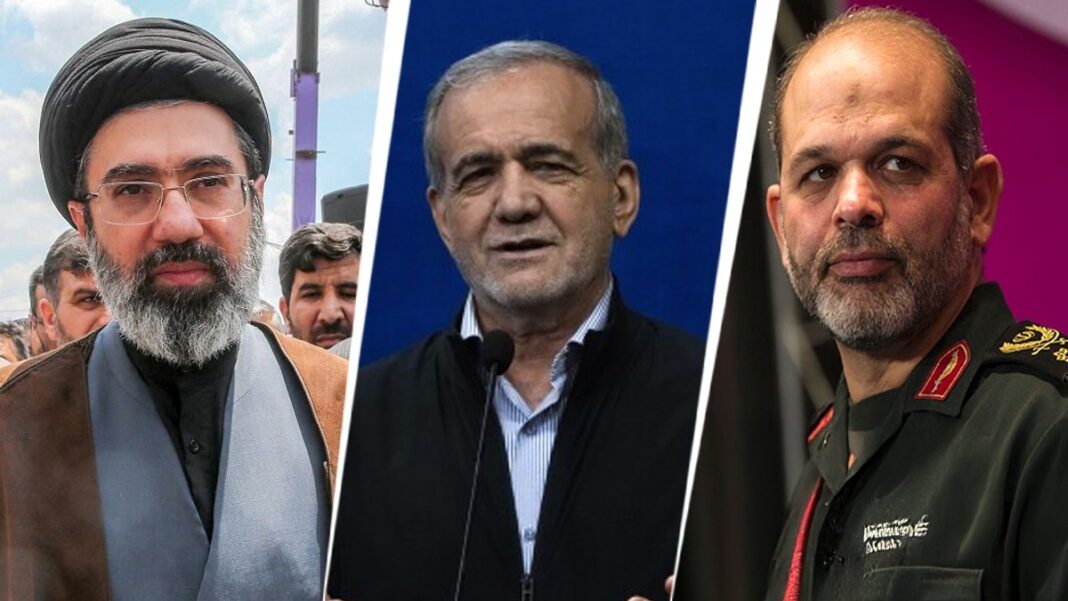
Fresh divisions within Iran’s leadership appear to have stalled plans of sending a negotiating team to Islamabad for talks with the US to end the eight-week-old conflict, raising new questions over who holds the real authority in Tehran.
According to a report by Iran International on Thursday, an Iranian delegation prepared to travel to Islamabad for talks with the US was blocked at the final stage due to internal disagreements between allies of President Masoud Pezeshkian and figures linked to the office of Supreme Leader Mojtaba Khamenei.
Sources cited in the Iran International report said the delegation was ready to depart when a message from Khamenei’s inner circle ruled out any discussion on nuclear issues and criticised the Iranian Foreign Ministry over previous negotiations. Under those conditions, Foreign Minister Abbas Araghchi is said to have argued that attending talks would be meaningless and unlikely to produce progress.
The cancellation came amid speculation that a US team led by Vice President JD Vance could travel to Islamabad for renewed discussions, before his visit was put on hold. US President Donald Trump has, meanwhile, extended the ceasefire period with Iran, saying more time was needed for Tehran to formulate a response.
Even Trump acknowledged growing divisions within Iran, saying the country was struggling to determine its leadership amid infighting between hardliners and moderates.
“Iran is having a very hard time figuring out who their leader is! They just don’t know! The infighting between the ‘hardliners,’ who have been losing badly on the battlefield, and the ‘moderates,’ who are not very moderate at all (but gaining respect!), is crazy!” he wrote on Truth Social on Thursday.
The uncertainty over a fresh round of peace talks has renewed scrutiny over the balance of power inside Iran. While Trump earlier described the Iranian government as “seriously fractured,” recent developments suggest a different picture – one in which authority may be consolidating around a military-security establishment rather than splintering.
WHO IS CALLING THE SHOTS?
The developments point to growing influence within a tightly coordinated network involving the Islamic Revolutionary Guard Corps, the Supreme National Security Council and senior political figures aligned with Iran’s security apparatus. Recent attention has focused on IRGC chief Ahmad Vahidi and security official Mohammad Bagher Zolghadr as influential players shaping Tehran’s direction.
For instance, after an initial round of talks in Islamabad, Araghchi had indicated that the Strait of Hormuz would remain open and hinted at flexibility on issues including nuclear enrichment and regional alliances. But those remarks were later overshadowed by criticism from state-backed media, which argued they gave Trump political leverage.
But soon after, Iran’s armed forces announced that the Strait of Hormuz would again be closed, citing the continued US naval presence in the region. The move came after the first round of peace talks, which went on for 21 hours, ended in a stalemate earlier this month.
The firing on two India-flagged ships last week also exposed a widening crack in Iran’s power structure.
WE ARE ONE NATION: PEZESHKIAN
Amid reports of internal rifts, President Pezeshkian struck a defiant and unifying tone, rejecting factional labels and calling for complete alignment with the top leadership.
“In Iran there are no hardliners or moderates. We are all Iranians and revolutionaries,” he said in a post on X, adding that with “ironclad unity of nation and state and obedience to the Supreme Leader, we will make the aggressor regret.”
He underscored the message with a slogan of cohesion and resolve: “One God, one nation, one leader, one path; victory for Iran, dearer than life.”
NO IRANIAN DELEGATION IN ISLAMABAD
Meanwhile, Iran’s state broadcaster, the Islamic Republic of Iran Broadcasting, also denied that any delegation had travelled to Islamabad for peace talks, dismissing reports of a planned visit.
Before announcing a ceasefire extension, Trump repeated warnings that Iranian energy infrastructure could be targeted if negotiations fail. He also referenced Operation Midnight Hammer, claiming it had caused the “complete and total obliteration” of Iranian nuclear-related facilities. He also said that the US naval blockade on the Strait of Hormuz would continue.
Iranian officials pushed back strongly against the rhetoric. Parliament Speaker Mohammad Bagher Ghalibaf accused Washington of attempting to turn negotiations into an act of surrender. In a post on X, he said Iran would not negotiate under pressure and warned that Tehran had prepared “new cards on the battlefield.”
As uncertainty surrounds the next round of talks in Islamabad, it highlights competing power centres shaping Iran’s decisions and the difficulty of reviving negotiations amid military pressure, political messaging and regional tensions.


