
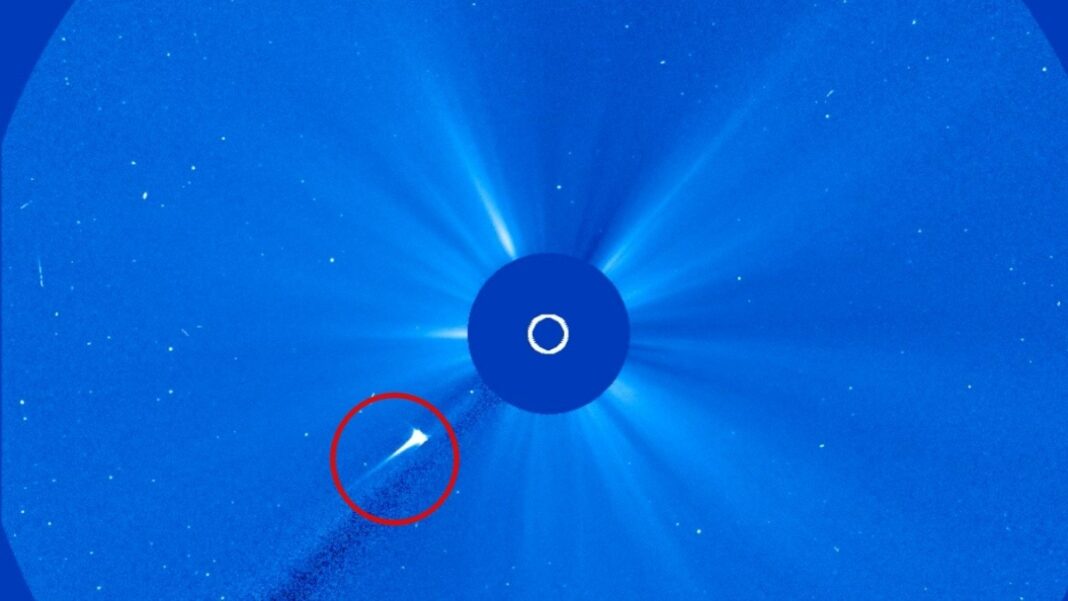
A rare celestial event unfolded earlier this month as multiple spacecraft from Nasa and its partners captured the dramatic demise of a comet that ventured too close to the Sun.
On April 4, comet C/2026 A1 (MAPS) made a fiery plunge toward the Sun, passing at a distance roughly twice that between the Earth and the Moon. Scientists and skywatchers had been closely tracking the object, waiting to see whether it would survive the intense heat of its close approach. It did not.
Observations from SOHO, a joint mission of Nasa and the European Space Agency, showed the comet approaching the Sun seemingly intact. However, after passing behind the spacecraft’s coronagraph, which blocks out the Sun’s bright disk, only a cloud of dust emerged on the other side.
“The comet was clearly destroyed, likely several hours before its closest approach to the Sun,” said Karl Battams of the US Naval Research Laboratory, who leads SOHO’s coronagraph instrument.
Additional views from STEREO provided a different perspective, revealing that the comet did not plunge straight in but instead curved around the Sun before breaking apart. Meanwhile, Nasa’s PUNCH tracked the comet in the days leading up to its final encounter.
Together, these spacecraft form part of Nasa’s heliophysics fleet, designed to study the Sun from multiple vantage points. Their combined observations allowed scientists to reconstruct the comet’s final moments in unprecedented detail.
Comet MAPS belonged to the Kreutz family of “sungrazing” comets, fragments of a much larger comet that broke apart centuries ago and now follow similar paths that bring them extremely close to the Sun. Such comets often do not survive these encounters due to extreme temperatures and gravitational forces.
Studying these dramatic breakups offers scientists valuable insights into the composition and structure of comets, which are considered remnants from the early solar system.
Understanding how they disintegrate under solar stress can help researchers learn more about the building blocks of planets.
The event highlights not only the violent environment near the Sun but also the growing capability of space-based observatories to capture fleeting cosmic phenomena from multiple angles, turning a comet’s destruction into a scientific opportunity.


