
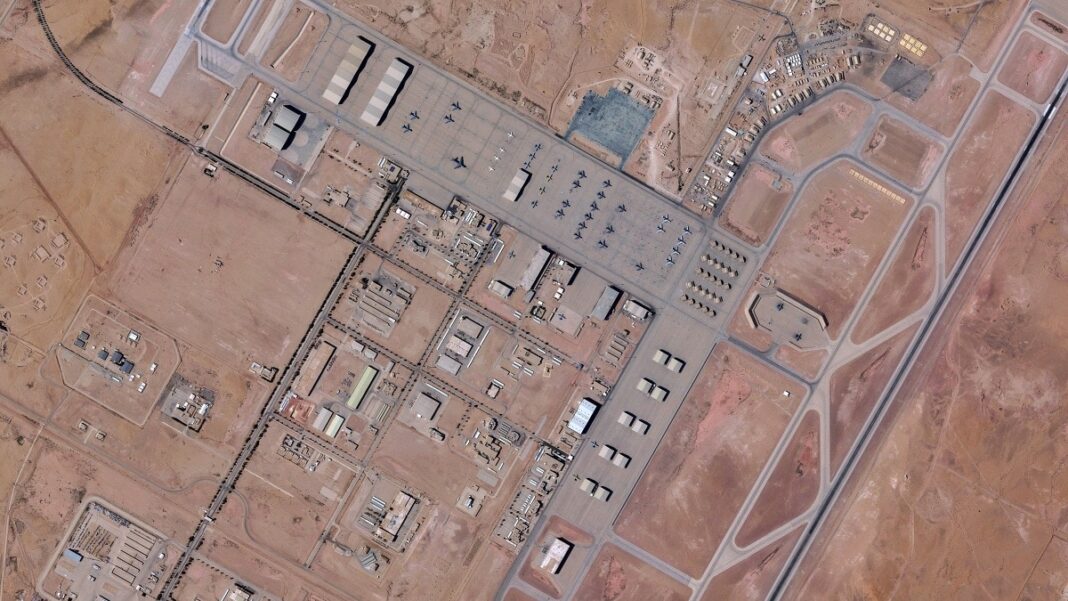
A Chinese Earth observation satellite made repeated daylight passes over key US military bases in West Asia ahead of the March 2026 strikes by Iran, according to an independent analysis by Indian space experts that supports earlier reporting by the Financial Times.
Documents reviewed by the Financial Times indicated that the satellite acquired by Iran was developed and launched by Earth Eye Co, a Chinese company that provides “in-orbit delivery” services, where satellites are transferred to international clients after being placed in orbit.
As part of the arrangement, Iran’s Islamic Revolutionary Guard Corps (IRGC) was also given access to commercial ground stations operated by Emposat, a Beijing-based firm that offers satellite control and data services.
Ashwin Prasad Rao, a Space Power Analyst at The Takshashila Institution, along with Aditya Ramanathan, analysed orbital data of the satellite identified as TEE-01B. Their findings suggest the satellite’s trajectory was consistent with regular surveillance opportunities over multiple US-linked sites in the region.
The analysis drew on publicly available datasets, including orbital information from the US Space Force’s Space-Track database, the widely used SGP4 orbit propagation model, and NASA’s planetary data to determine daylight conditions during satellite passes.
According to the researchers, TEE-01B made at least one daylight pass over each of the cited locations every day during the period analysed. These locations included Prince Sultan Air Base in Saudi Arabia, Camp Buehring and Ali Al Salem Air Base in Kuwait, Camp Lemonnier in Djibouti, and Duqm Airport in Oman.
For Prince Sultan Air Base, the site reportedly struck on March 14, the satellite passed overhead on March 13, 14, and 15 at elevations ranging from 58 to 82 degrees, indicating near-direct overhead positioning and optimal imaging conditions.
Such high elevation angles reduce distortion and improve image clarity for Earth observation sensors.
Over a longer timeframe, the satellite completed dozens of passes over each site, with some locations seeing up to nearly 50 passes. The analysts noted that the satellite’s ground track allowed it to sweep across multiple Gulf-region sites within just a few minutes during each orbit.
However, the researchers cautioned that orbital analysis alone cannot confirm whether the satellite was actively used for surveillance or whether any imagery was shared with actors involved in the strikes.
“Orbital data proves possibility, not intent,” Rao noted in a post on X, emphasising that verifying actual usage would require access to tasking records or the satellite imagery itself.
The findings nonetheless highlight how open-source intelligence tools and publicly accessible space data can be used to independently assess geopolitical claims involving space-based surveillance.
As competition in space intensifies and Earth observation capabilities expand, such analyses are becoming increasingly important in understanding how satellites may


