A chance morning observation in the Arizona desert has led to a discovery that has never been seen before in the insect world.
Scientists have stumbled upon a remarkable first, discovering a species of ant voluntarily lining up to be groomed and cleaned by another, much smaller ant species.
The behaviour, observed in the desert of southeastern Arizona, was published in the journal Ecology and Evolution and has been described as entirely new to science.
The discovery was made by Mark Moffett, an entomologist, a scientist who studies insects. Moffett is also a research associate at the Smithsonian’s National Museum of Natural History.
He spotted the unusual interaction one morning while having coffee at a research station in Arizona’s Chiricahua Mountains.

WHAT ARE ANTS DOING?
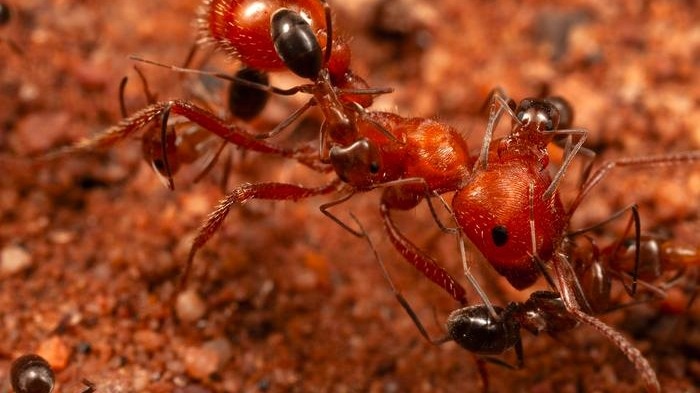
Moffett noticed large harvester ants standing unusually still near the tiny nests of cone ants, a far smaller species. Harvest ants are a kind of common red desert ant known for collecting seeds.
At first, he assumed the two groups were fighting, but a closer look through his camera revealed something surprising.
The cone ants were crawling all over the larger ants, licking and nibbling their bodies clean, even between their open, serrated jaws.
Over several days, Moffett documented at least 90 such interactions.
The harvester ants would walk up to a cone ant nest, stand tall and still, and wait. Within about a minute, cone ants would emerge and begin grooming them, sometimes up to five at a time. When finished, the harvester ant would shake them off and go about her day.

NATURE’S WASH
The behaviour closely mirrors what happens in the ocean, where large fish, sometimes even sharks, swim to designated spots called “cleaning stations,” where smaller fish and shrimp eat parasites and dead skin off them.
Scientists call these smaller helpers “cleaner fish.” This is the first time anything similar has been recorded in the insect world.
Moffett believes the cone ants are likely feeding on tiny food particles clinging to the harvester ants’ bodies. The harvester ants, in return, may be getting cleaned in hard-to-reach spots that their other similar ants cannot access.
Future research will look at whether this relationship reduces infections or improves health for either species.
“All kinds of amazing discoveries are still there to be made outside of the lab,” Moffett said. “Finding new species and behaviours in nature often requires us to pay close attention to the small things—including the ants.”