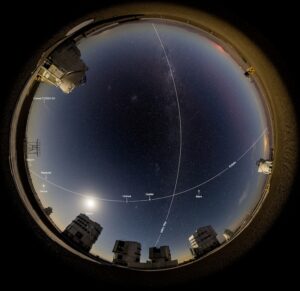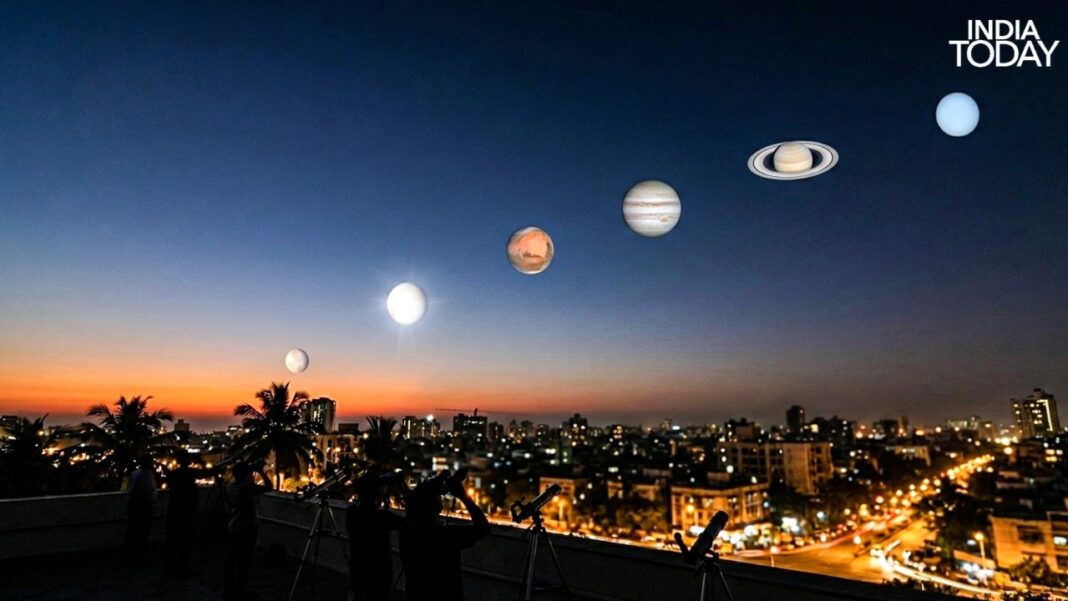
Four planets, including Mercury, Mars, Saturn, and Neptune, are gathering in the sky this week, appearing clustered together in what astronomers call a planetary alignment.
The line-up is worth watching from around April 16 to 23, with the best mornings to view the alignment being on April 18 to 20.
On April 20, Saturn, Mars, and Mercury will appear so close together that you could cover all three with three fingers held at arm’s length.

WHAT IS PLANETARY ALIGNMENT?
A planetary alignment is when several planets appear bunched together in the same part of the sky at the same time.
It happens because all the planets in our solar system travel around the Sun on roughly the same flat plane. When several planets happen to be on the same side of the Sun at once, they look crowded into one corner of the sky when we look up from Earth.
The planets aren’t actually lined up in space but only appear that way as seen from Earth. In reality, they are still millions of kilometres apart from each other. And despite what many believe, these events are completely harmless and have no effect on Earth.
This week, Mercury, Mars, and Saturn are bright enough to see with the naked eye under clear skies. Neptune, which is the faintest of the four, will need binoculars or a small telescope to be spotted.

WILL THE PLANETARY ALIGNMENT BE VISIBLE FROM INDIA?
The spectacle will be visible from India with only some effort. Keep in mind that the viewing conditions will vary significantly across the country.
To view the spectacle, one should start looking about 30 minutes before local sunrise, putting the ideal window roughly between 5:00 am and 5:50 am IST.
Kolkata, being more east than other major cities, will see the sun earliest, followed by cities like Chennai, Bhopal, and Delhi, with Mumbai among the last.
Mercury will be the brightest and easiest to spot. Saturn sits lower in the sky and is more likely to disappear into the morning glow near the horizon.

Southern Indian cities like Bengaluru, Hyderabad, Chennai, Kochi will have a marginally better view than northern cities like Delhi, Lucknow, or Chandigarh, simply because they sit closer to the equator and the planets will appear slightly higher above the horizon from there.
April is also a good month for clear skies across most of India, before the monsoon clouds roll in from June, so conditions should generally be favourable for skywatching, barring any local dust or haze.
If a 5 am alarm feels like too much, the evening of April 18 offers an easier reward.
On that evening, a crescent Moon will appear right next to the brilliantly bright Venus in the western sky just after sunset. So all you need to do is step outside around 7:30 pm IST, look west, and you cannot miss it.