
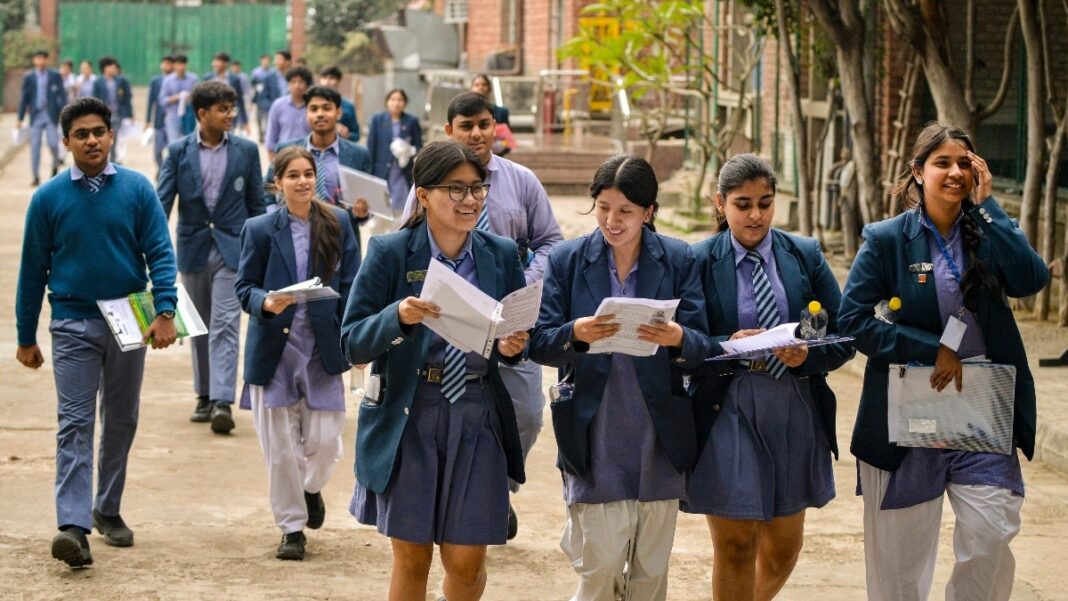
The Central Board of Secondary Education (CBSE) has announced the Class 10 results for 2026 on April 15, with an overall pass percentage of 93.70%. While the majority of students are celebrating their scores, the Board has also outlined a structured post-result redressal process for those who wish to challenge their marks.
Under the revised dual-exam system, students can apply for photocopies of answer sheets, verification of marks, and re-evaluation, but only after the second phase of board exams concludes.
WHAT HAS CHANGED UNDER THE DUAL-EXAM SYSTEM?
Earlier, CBSE used to release Class 10 and Class 12 results together in May, followed by a quick window for re-evaluation and verification. However, with the introduction of two board examination cycles, the timeline has shifted.
Now, all post-result grievance mechanisms, including rechecking and re-evaluation, will begin only after the second exam cycle, which is expected to start in mid-May 2026. This ensures that students also have the option to improve their scores before opting for re-evaluation.
STEP-BY-STEP: CBSE RE-EVALAUTION PROCESS EXPLAINED
CBSE has designed a three-stage review system, and students must follow the sequence strictly:
1. Accessing answer sheets
The first step is to obtain a scanned copy of the evaluated answer sheet. This helps students understand how marks were awarded.
- Apply through the official CBSE portal
- Select subjects for which copies are needed
- Pay the required fee online
- Download the scanned answer sheet once released
This step is compulsory before moving to further stages.
2. Verification of Marks
After reviewing the answer sheet, students can request verification if they suspect discrepancies.
This stage includes:
- Recalculation of total marks
- Checking for unanswered but evaluated questions
- Verifying correct entry of marks
- Identifying any calculation errors
CBSE has clarified that this step only addresses technical or totaling errors, and the outcome is final for such corrections.
3. Re-evaluation
If concerns persist, students can apply for re-evaluation of specific answers.
- Requests must be question-specific
- Evaluation is done by independent examiners
- It is not a full paper recheck
- Revised marks (if any) will be final and binding
- Applications will open after the second board exams conclude
- The entire process will be conducted online only
- CBSE will release separate notifications for each stage
- Deadlines will be strictly enforced
- Schools will assist students with the application process
No offline requests will be accepted under any circumstance.
SECOND EXAM OPTION AND COMPARTMENT DETAILS
In addition to re-evaluation, CBSE has also provided an improvement pathway through the second board exam.
- Students unhappy with their scores can reappear
- Those in the compartment category (approx. 1.47 lakh students) can also apply
- The List of Candidates (LOC) submission window opened on April 16, 2026, and will remain active for five days only
- Performance Highlights from CBSE Class 10 Results 2026
- Pass percentage: 93.70%
- Students scoring 95% and above: 55,368
- High achievers (above 90%): Over 2.75 lakh
- Students in compartment category: Around 1.47 lakh
Top-performing regions:
| Region | Pass Percentage |
|---|---|
| Trivandrum | 99.79% |
| Vijayawada | 99.79% |
| Chennai | 99.58% |
| Bengaluru | 98.91% |
| Delhi West | 97.45% |
| Delhi East | 97.33% |
Southern regions continue to dominate, with Trivandrum maintaining its top position consistently over recent years, followed by strong performances from Chennai and Bengaluru.
With nearly 24.7 lakh students appearing and over 1.63 crore answer sheets evaluated, CBSE has emphasised that its digital, multi-layered review system is designed to ensure fairness and accuracy at scale.
Even with a high overall success rate, the Board maintains that students have full access to a transparent and systematic grievance redressal mechanism, allowing them to confidently challenge their results if needed.
As the academic cycle moves into its second phase, this structured process acts as a crucial bridge between initial results and final certification under CBSE’s evolving examination framework.


