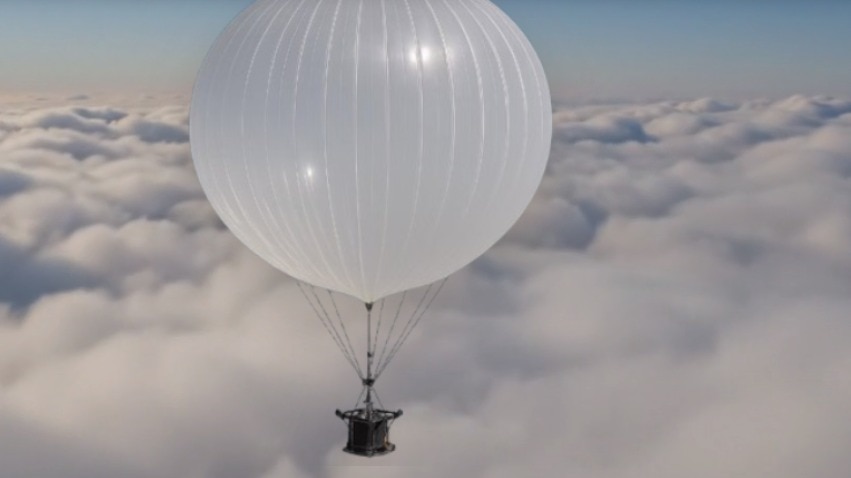
Imagine a massive helium-filled balloon but not the kind you tie to a birthday cake, but an engineered aircraft. It floats 20 to 40 kilometres above the Earth, in the zone called “near space”.
That zone of flight is too high for conventional aircraft, which top out around 12 kilometres, but too low for satellites, which orbit hundreds of kilometres above. For decades, this atmospheric layer has largely been ignored.
But now, a Vijayawada-based startup called Red Balloon Aerospace wants to change that.
The company is preparing to launch India’s first indigenous Super Pressure Balloon (SPB) from Andhra Pradesh later this year.
Unlike a regular weather balloon that expands and eventually bursts, a super pressure balloon maintains a fixed, pressurised shape at high altitude, allowing it to stay aloft for extended periods.

This mission will carry a high-resolution camera capable of capturing images at 25 to 75 centimetre resolution, along with other sensors, and is designed to fly for up to 24 hours.
“Between the ground and space, there’s an entire domain that’s been underutilised. While satellites cost tens of millions of dollars and take years to deploy, we can put platforms overhead in weeks at a fraction of that cost and crucially, they are fully recoverable for repair, upgrade, and redeployment,” said Dr C V S Kiran, co-founder and CEO of Red Balloon Aerospace.
WHY DOES IT MATTER?
The potential applications of a persistent, high-altitude balloon are not discussed as much but are of great use.
Because it can hover over a vast area for hours or days at a stretch, a single platform can deliver mobile and internet connectivity to remote villages and tribal belts where building cell towers is either too expensive or physically impossible.
Furthermore, it can monitor pipelines, power grids, or coastlines spanning hundreds of kilometres in real time. In a disaster scenario, like during floods, cyclones, or industrial accidents, it can give authorities a continuous, bird’s-eye view across an entire state.

INDIA ENTERS GLOBAL RACE
Globally, nations and companies, most notably Google’s Loon project and the US military, have explored stratospheric balloons for years.
India, however, has largely been on the sidelines.
Red Balloon Aerospace, founded with the stated goal of building AI-powered stratospheric infrastructure, is looking to change that narrative.
The upcoming launch from Andhra Pradesh is described by the company as a critical technology validation milestone, a proof-of-concept that would clear the path for more ambitious missions.
If successful, it will demonstrate that India has the indigenous capability to build, launch, and operate sustained stratospheric platforms, joining a select group of countries that can do so.
“For India, this opens up connectivity for hundreds of millions in remote areas, real-time monitoring across millions of square kilometres, and sovereign capabilities we’ve never had before,” said Dr Kiran. “Globally, nations are realising that near space is strategic infrastructure, and India is no longer watching that race from the sidelines.”