
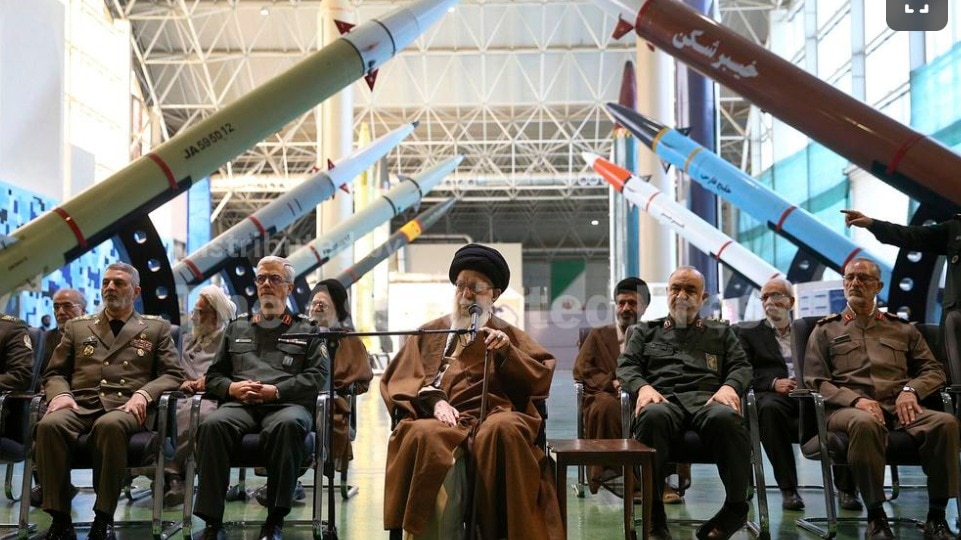
Iran’s Supreme Leader Ali Khamenei was reported killed in strikes carried out by the United States and Israel on Saturday, a development that — if confirmed — could shake the foundations of clerical rule in the Islamic Republic.
The political system he dominated for more than three decades was never designed to absorb a sudden removal under fire. The succession process exists on paper. Whether it works in crisis is another question.
WHO COULD SUCCEED KHAMENEI AS ‘SUPREME LEADER’?
According to Reuters, Iran’s constitution requires that the supreme leader be a cleric under the doctrine of vilayat-e faqih — the guardianship of the Islamic jurist. The principle holds that, until the return of the Shi’ite Muslim 12th Imam who disappeared in the ninth century, authority should rest with a senior religious scholar.
Under Khamenei and his predecessor, the founder of the Islamic Republic Ayatollah Ruhollah Khomeini, the supreme leader has the last say in all matters of state, but the system has never faced such a challenge before.
Khamenei’s sway has often been wielded through close advisers. But in the aftermath of Saturday’s strikes it is far from clear how many of those top figures have survived.
Khamenei, 86, was never publicly recorded as having named a successor and it’s not clear who might replace him if he is confirmed as dead.
Possible candidates previously mentioned by analysts include his son Mojtaba Khamenei and Hassan Khomeini, the grandson of the Islamic Republic’s founder. Other senior clerics have also been cited.
However, Reuters notes that no current figure carries Khamenei’s authority, and any successor may struggle to assert control over powerful institutions such as the Revolutionary Guards and senior clerical bodies.
WILL IRAN’S THEOCRACY PERSIST?
According to Reuters, Iran’s clerical establishment retains control over powerful institutions that shape nearly every layer of the political system.
At the center is the Assembly of Experts, a body of senior ayatollahs elected every eight years. The assembly is constitutionally tasked with appointing the supreme leader and, in theory, has the authority to question or dismiss him — though it has never exercised that power.
In practice, any decision on succession would likely be shaped by the most senior power brokers within the Islamic Republic before being formally endorsed by the assembly. With several top Revolutionary Guards figures reported killed, it remains unclear who would dominate that process.
The Guardian Council — half appointed by the supreme leader and half by the judiciary chief — can veto parliamentary legislation and disqualify candidates from elections. That authority has often been used to sideline critics of Ali Khamenei, Reuters reported.
Iran’s judiciary operates under Shi’ite interpretations of Islamic law, with the chief justice appointed by the supreme leader. The current head, Gholamhossein Mohseni Ejei, has faced Western sanctions over a 2009 crackdown on protesters.
Reuters also identified other influential clerics, including former judiciary chief Sadiq Larijani, Assembly of Experts member Mohsen Araki, and Tehran Friday prayer leader Ahmad Khatami, as potential players in any transition.
WHAT ROLE COULD THE REVOLUTIONARY GUARDS PLAY?
The Islamic Revolutionary Guards Corps (IRGC) operates outside the authority of Iran’s elected government and answers directly to the supreme leader — unlike the regular army, which falls under the Defence Ministry.
Three sources familiar with the matter told Reuters that IRGC commander Mohammed Pakpour was killed in Saturday’s strikes, a development that could reshape the internal balance of power.
Formed in the aftermath of the 1979 revolution, the Guards expanded their influence during the 1980–88 war with Iraq and have since evolved into the most powerful and best-equipped branch of Iran’s armed forces, Reuters reports.
Over decades, the IRGC entrenched itself in politics and business, extending its reach well beyond the battlefield. Its elite Quds Force spearheaded Iran’s regional strategy, backing allied Shi’ite groups across the Middle East. That strategy suffered major setbacks after the 2020 US killing of Quds Force commander Qassem Soleimani and Israel’s 2024 campaign against Hezbollah.
The Basij militia, under IRGC control, has frequently been deployed to suppress domestic protests.
Reuters notes that targeted Israeli strikes on senior Guards commanders have raised questions about possible intelligence penetration at the highest levels. Even so, the IRGC is widely expected to play a decisive role in shaping what comes next for the Islamic Republic.
WHY DOES IRAN HOLD ELECTIONS?
According to Reuters, Iran combines clerical oversight with elected institutions. Citizens vote for a president and parliament every four years, but ultimate authority rests with the supreme leader.
Iranians elect a president and a parliament to four-year terms. The president forms a government and manages day-to-day policy, though decisions must operate within boundaries set by the country’s unelected leadership, Reuters notes.
In the early years after the 1979 revolution, elections saw high participation. Over time, however, confidence in the system eroded. But Guardian Council restrictions on candidates, a much-disputed election outcome in 2009 and the supremacy of unelected parts of the state undermined faith in electoral politics.
President Masoud Pezeshkian, regarded as a relative moderate, was elected in 2024 after defeating a hardline rival. Israel said he was also targeted in Saturday’s strikes, though there was no confirmation later in the day regarding his status.
With inputs from Reuters


