
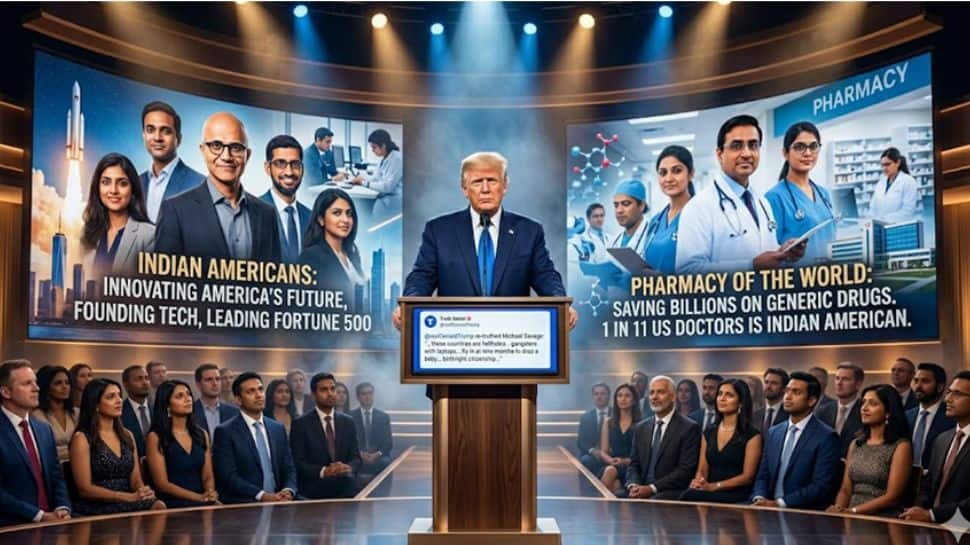
On April 22, 2026, President Donald Trump amplified on his Truth Social account a commentary by radio host Michael Savage that branded India and China as “hellholes” and accused Indian and Chinese immigrants of being “gangsters with laptops” who have supposedly damaged America more than every mafia family combined. The post endorsed the grotesque claim that women from these countries fly to the United States in the ninth month of pregnancy to “drop a baby” and harvest instant citizenship.
The timing is not accidental. Trump shared this letter a day after he falsely told CNBC that no other country offers birthright citizenship, a claim that collapses instantly, since roughly three dozen nations, including Canada, Mexico, and most of South America, grant automatic citizenship to children born on their soil. But the deeper question is this: why is the American President attacking the very people and the very country keeping his economy, his technology sector, his hospitals, and his pharmacy shelves functional?
The Engine Trump Is Insulting
Consider the architecture of modern American prosperity. Satya Nadella runs Microsoft. Sundar Pichai runs Alphabet. Arvind Krishna runs IBM. Shantanu Narayen runs Adobe. These are not symbolic appointments. According to the National Foundation for American Policy, Indian Americans, while comprising approximately 1.4% of the U.S. population, have founded roughly 8% of all technology startups and lead about 4% of Fortune 500 companies. Their businesses generate over $150 billion in annual revenue and employ more than 800,000 workers nationwide.
The tax contribution is equally striking. Indian Americans pay between 5% to 6% of all U.S. income taxes, which adds up to about $250 to $300 billion every year, way more than their population size would suggest. In healthcare, they constitute less than one percent of the country’s population, but they account for 9 percent of American doctors. In rural America, where domestic physicians refuse to practise, Indian doctors keep emergency rooms running.
The Pharmacy of America
The hypocrisy is sharpest in healthcare. India supplies nearly half of all generic prescription drugs used in the United States. In 2022, Indian pharmaceutical companies provided 47% of generic prescriptions filled in U.S. pharmacies, and Americans saved an estimated $219 billion on prescriptions in 2022, and $1.3 trillion over the past decade. When Trump announced a 100% tariff on branded pharma in 2025, he was forced to exempt generics because around 53 percent of patented drugs consumed in the US are manufactured abroad, and only 15 percent of APIs are produced domestically by volume. The American President can call India a hellhole, but his grandmother’s blood pressure pill is almost certainly made in Hyderabad.
The Mirror Trump Refuses to Face
If Trump truly wants to find a “hellhole on the planet,” he need not consult an atlas. Philadelphia’s Kensington neighbourhood, known as America’s largest open-air drug market, tells the story. Researchers documenting the area describe sidewalks littered with trash and used needles, people slumped in trance-like states, the air heavy with despair, all this just eight subway stops from where the Declaration of Independence was signed. The DEA’s own data confirms the scale. In 2023, Philadelphia had 1,315 overdose deaths, the second-highest number in the city’s history, with 83% involving fentanyl. Nationwide, synthetic opioids killed over one lakh Americans that year.
The Economic Self-Inflicted Wound
The sharper irony is that Trump’s policies are systematically weakening the economy he claims to champion. The US dollar has suffered one of its worst declines in a generation. NPR reported that the dollar’s value fell about 2% so far this year after already tumbling by nearly 10% last year, the biggest annual decline since 2017, driven in part by concerns about Trump’s unpredictable approach to economic policy, especially his use of tariffs and his frequent attacks against the Federal Reserve.
The debt picture is even starker. The gross national debt crossed the $39 trillion threshold on March 17, 2026. The debt was $34.5 trillion on March 15, 2024, an increase of $4.5 trillion in just two years, without any recession or major war. Fortune magazine noted that net interest payments will exceed $1 trillion in fiscal year 2026, nearly triple the $345 billion the government paid in 2020. In the first three months of the current fiscal year alone, net interest payments reached $270 billion, already surpassing the nation’s defense spending for the same period.
America is now spending more to service old debt than to defend its borders. That is not the mark of a rising empire.
Trump’s manufacturing promise has also collapsed. The Center for American Progress documented that manufacturing industry lost 77,000 jobs from April to December 2025.
Manufacturing employment fell sharply following “Liberation Day”, while his first year saw the weakest job growth outside of a recession since 2003, with only 181,000 jobs added for the full year, compared with almost 1.5 million in 2024.
India Rises as America Stumbles
Meanwhile, the country Trump insults continues to outpace the world. IMF data shows India is projected to grow at 6.5% in 2026, making it the fastest-growing major economy Upstox, while India will account for 17% of the world’s economic expansion in 2026, significantly surpassing the United States at 9.9%. Even on fiscal discipline, the contrast is painful. Indian public debt sits far below American levels, and New Delhi has diversified its partnerships through a historic EU trade deal in January 2026 that opens European markets to Indian textiles, leather, pharma and gems.
The Real Target
This attack is not really on India. India is 12,000 kilometres away and cannot be deported. The attack is on immigrants inside America who have outperformed native-born Americans in exactly the sectors Trump’s voters feel they have lost. When a leader blames the immigrant for a working-class decline engineered by decades of deindustrialisation and his own tariff wars, it is the oldest playbook in political history. It is also the surest sign of a superpower uncertain of its own trajectory.
The dollar is weakening. The debt is ballooning. The Supreme Court appears poised to strike down his birthright citizenship order. And India, the supposed hellhole, is the fastest-growing major economy on Earth. The mirror in 2026 is pitiless. And the reflection looking back is not wearing a sari. It is wearing a red tie.
(The views expressed by the author are his own.)


