
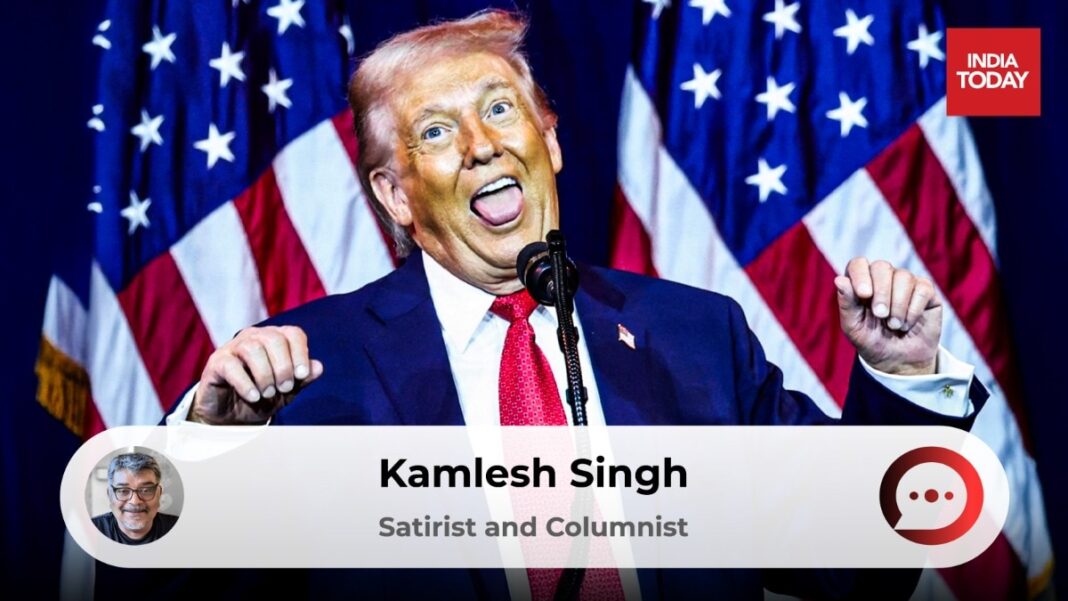
US President Donald Trump just placed India and China in the basket he has labelled hellholes. Imagine the chutzpah of saying this at a time when he has single-handedly turned the whole world into a “hell.” The world waits for someone in the Land of the Free to free them from one man. Donald J Trump!
Political scientists, chaps who study places like Somalia in the 1990s or Yemen at any time, list the classic symptoms of a failed state: erosion of legitimate authority, inability to project power coherently, factionalised elites tearing at each other, crumbling public trust in institutions, and the failure to deliver basic political goods. America is not in the middle of a civil war or economic collapse. But the political and institutional rot is on full display.
Start with the constitutional machinery. In a functioning democracy, Congress, courts, and the Constitution are meant to act as sentinels of public conscience, politely but firmly saying: not without our nod. Operation Epic Fury, the airstrikes that took out Ali Khamenei and kicked off a two-month-and-counting scrap with Iran, was launched without a formal declaration of war or Congressional approval. Trump gave the order from Air Force One. Goals unmet. The Iranian nuclear programme is still ticking. Regime change stopped at Ayatollah change. Hezbollah and Houthis are still firing. The constitutional machinery, meant to save the republic from humiliation, hasn’t kicked in.
Next, factionalised elites and a cracking cabinet: textbook symptom of state frailty. Since the war kicked off in late February, at least five high-ranking officials have bolted or been shown the door: Navy Secretary John Phelan ousted amid tensions with Defence Secretary Pete Hegseth; Attorney General Pam Bondi removed; Labor Secretary Lori Chavez-DeRemer resigned under a cloud; Homeland Security’s Kristi Noem gone; and a purge of over a dozen generals and admirals, including top brass like Army Chief Randy George. Defence structure exits at jet speed in the middle of a war that could be WWII. Nothing says “stable administration” like a revolving door in the Situation Room. Trump’s A Team is in disarray. His B Team has decided to play musical chairs during a fire drill. Who’s next?
Then comes the inability to interact with other states as a full member of the international community. Humiliating world leaders with tariffs, threats, and Twitter tantrums, Trump’s signature style has borne fruit. NATO allies, those who rushed to join America’s disastrous adventures, have drawn a firm red line: “Not our war.” Europe is united against joining the Iran fray, refusing troops, airspace, or even enthusiastic handshakes. Major partners like Britain, France, and Germany have snubbed pleas for help, citing Trump’s bullying as the final straw. Traditional allies now view America as more of a threat than a partner. Trump’s “go-it-alone” grandiose gobbledegook has left the US isolated, begging for support while China chuckles from the sidelines and Russia rejoices.
Economic might and robust internal security aside, America, albeit temporarily, ticks enough boxes to qualify as a failed state in the political theatre of the absurd.
The constitutional mechanisms, those vaunted checks and balances, have failed to rein in the maverick in the Oval and spare the nation this self-inflicted humiliation. It is not full collapse. No Mad Max anarchy on Pennsylvania Avenue, but a vivid snapshot of institutional impotence, elite infighting, and diminished global clout. Almost a failed state, albeit temporarily.
The “temporary” bit is key; midterms or the next cycle might reboot the system like a critical software update. But at this moment of high drama, the symptoms are there, smirking in the mirror. Even superpowers can trip over their own shoelaces when the guardrails rust. The land that lectured the world on democracy and governance is now providing a masterclass in how not to do it.
The United States Constitution is a magnificent document. Carefully worded, brilliantly conceived, and, as it turns out, utterly helpless against a man who goes by the handle @realDonaldTrump. The Founding Fathers, for all their genius, apparently forgot to include a clause that read: “In the event of an unhinged reality TV host and realtor ascending to the most powerful office on Earth, here is what you do.” They simply didn’t plan for this. The checks and balances they so lovingly designed are keeping no check on a man seemingly off-balance. The world did not vote for this. Americans did. Yet, the world pays the price.
One imagines the Iranian foreign ministry refreshing Twitter, now X, to find out what the American position is, since that appears to be where policy is made. The diplomacy, if it can be called that, is being conducted through Pakistan. Pakistan. A country that occupies a distinctive position in the global imagination: the nation most reliably described as a terrorist proxy state by the Americans themselves, chosen to mediate between America and Iran, another country the Americans themselves describe as a terrorism proxy state. You have to admire the symmetry. This Trumpian love for Pakistan derailed US-India ties that four successive Presidents had worked hard to put on track. The First Family and Friends’ crypto interests made US policy tilt towards Pakistan. Personal interest above national interest.
Trump’s claims that Iran had agreed to provisions that Iranians said had not even been finalised. Tehran walked out of the negotiations to end a war that the world fears would push them into economic recession. Some Trump administration officials, reportedly, privately acknowledged his comments had been counterproductive. They were, naturally, powerless to stop him from posting again the following morning.
Iran rejected the second round of talks. The Iranian ambassador to Pakistan, in a moment of rare literary flair, paraphrased Jane Austen, tweeting that it was “a truth universally acknowledged” that a civilisation of substance will not negotiate under threat and force. The mullahs are quoting Pride and Prejudice. The American president is posting in capitals. Who, precisely, looks unhinged?
Trump’s response to European hesitation was what it always is: spectacular pique. He told the UK and France, countries that couldn’t access jet fuel because of the closed strait, to go “TAKE IT” themselves from the Strait of Hormuz and warned that “the USA won’t be there to help you anymore.” This is the foreign policy of a man who has watched too many action films. The US-Arab coalition, once a working geopolitical arrangement, is in tatters because the President is constitutionally incapable of not saying the quiet part loudly on the internet.
His Cabinet is doing its own version of a slow-motion collapse when its war strategy is collapsing. The War Room has a revolving door, with generals and admirals leaving the situation room because he appointed a Fox News presenter his Secretary of War.
What exactly is the provision for a president whose judgement is, to put it generously, erratic? The Constitution has three routes. Impeachment. The House impeaches by simple majority, the Senate convicts by two-thirds. Tried twice with Trump. Failed twice. An impeachment without a compliant Senate is theatre, not remedy.
Elections. The mechanism the framers most trusted. Fixed schedule. Wars and crises do not keep to election calendars. The midterms loom in November, and Democrats are favoured to reclaim the House, but that simply changes who controls the microphone, not who controls the nuclear codes.
The third route, the one people reach for when the situation turns genuinely alarming, is the 25th Amendment. Ratified in 1967 after Kennedy’s assassination concentrated minds on the horror of a suddenly incapacitated presidency, Section 4 allows the Vice President, together with a majority of the Cabinet, to issue a written declaration that the President is unable to discharge his duties, upon which the Vice President immediately assumes the powers of the office as Acting President. It sounds tidy. It is not. The President can simply write back to Congress declaring that no inability exists, and he resumes his powers immediately. Unless the Vice President and Cabinet persist within four days, Congress has 21 days to decide who is right, and it takes a two-thirds vote of both houses to sustain removal over the President’s objection. Two-thirds. In a country this polarised. With a Republican Congress that has shown no appetite whatsoever for confronting this President.
There is a deeper problem. The 25th Amendment was designed for continuity, not correction. The concern was not unfitness or irresponsibility. It was inability. An unmanned helm, not a reckless helmsman. Senator Birch Bayh, its prime mover, explained in 1965 that the purpose was to ensure there will be a President at all times, not to adjudicate whether the President was wise, temperate, or in possession of basic diplomatic instincts. The amendment was never designed to rewrite an election.
Erratic temperament, limited attention span, out-of-control ego, and grandiose pronouncements were all there for voters to assess. They still voted him in for a second time.
The 25th Amendment is an entirely different remedy from impeachment, which exists to remove a healthy president who has committed grave offences. Courts will not intervene in questions of presidential fitness. The military will not move against a civilian commander, and constitutionally, should not. The international community has no standing. The world, which bears the consequences of every impulsive post and every theatrical threat, has no vote, no veto, and no recourse.
The Constitution, that magnificent, helpless document, waits patiently for the humiliation to end.
The world waits less patiently.
(Views expressed in the piece are those of the author)


