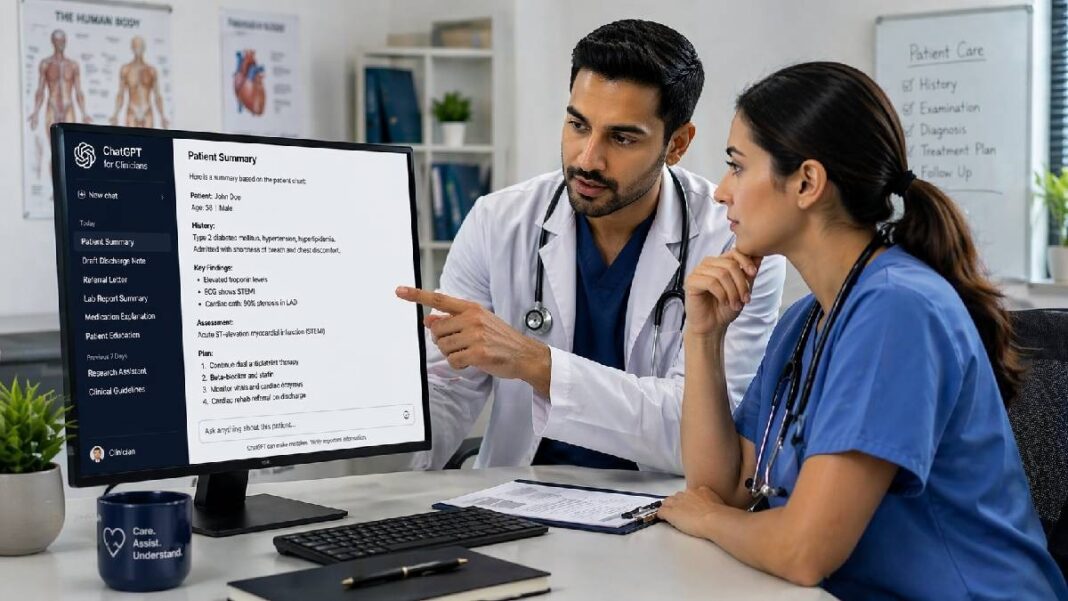
We have been to hospitals at least once in our lifetime and every hospital offers a similar scene – healthcare professionals, including nurses, doctors, and physician assistants, struggle with documents, which include patient history, referral letters, and lab report summaries. Now, AI is coming to help healthcare professionals with paperwork. AI companies, until now, have been cautious about two topics—politics, for obvious reasons, and medicine, because it involves the health of users. While AI companies are still providing health-related advice to users with caution, OpenAI has announced its latest ChatGPT for Clinicians. The new tool is targeted at clinicians, and the company claims it will help in clinical tasks like documentation and medical research.
OpenAI says the model will help clinicians “move faster through administrative work like medical research and documentation, and get time back for patient care.” The tool will not replace clinicians, but aims to support them. It can generate drafts that doctors can review, edit, and approve before they become part of official records.
A shift from experimental to practical AI
The launch of OpenAI Clinical is also significant in a sense that it signals a broader shift: AI is moving from experimental use to practical, everyday applications. Instead of focusing only on diagnosis or research, companies are now targeting workflow problems—like paperwork—that directly affect how healthcare is delivered.
Users react to the new tool
Users on the internet have shown a positive outlook towards the tool, while agreeing that doctors are burdened with administrative work, which involves tasks like referral letters, prior authorisations, and patient explanation documents. The tool could also help them in clinical research.
“According to a 2026 survey by the American Medical Association, physician use of AI is now at an all-time high, with 72% of physicians reporting they now use AI in clinical practice, up from 48% last year,” OpenAI said in a blog post.
An X user, while raising privacy issues, appreciated the tool:
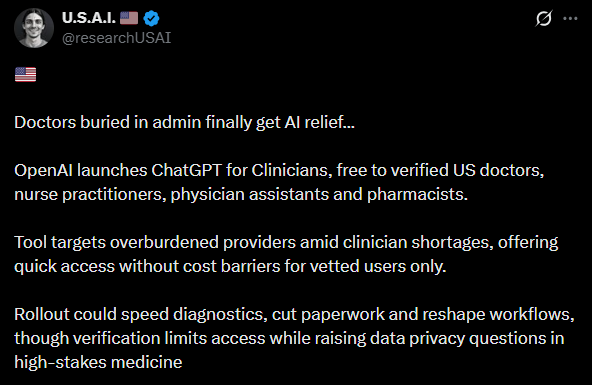
“Doctors buried in admin finally get AI relief. OpenAI launches ChatGPT for Clinicians, free to verified US doctors, nurse practitioners, physician assistants and pharmacists. Tool targets overburdened providers amid clinician shortages, offering quick access without cost barriers for vetted users only. Rollout could speed diagnostics, cut paperwork and reshape workflows, though verification limits access while raising data privacy questions in high-stakes medicine.”
Benchmark and performance claims
OpenAI has also released HealthBench Professional, an open benchmark for real clinician chat across care consult, writing and documentation, and medical research. The company says ChatGPT for Clinicians scored 59.0 in overall score, while Claude Opus 4.7 was at 47. The result shows that the model has outperformed other models in the competition.