Back on Earth, still in space: Astronaut’s brain takes months to readjust

Astronauts returning from space struggle with something surprisingly simple: holding a glass of water. New research explains why, and the answer lies deep inside the brain.

A study published in JNeurosci by Philippe Lefevre and colleagues at Universite catholique de Louvain, Belgium, and Ikerbasque, Spain, has revealed that the brain does not simply forget gravity when astronauts leave Earth.
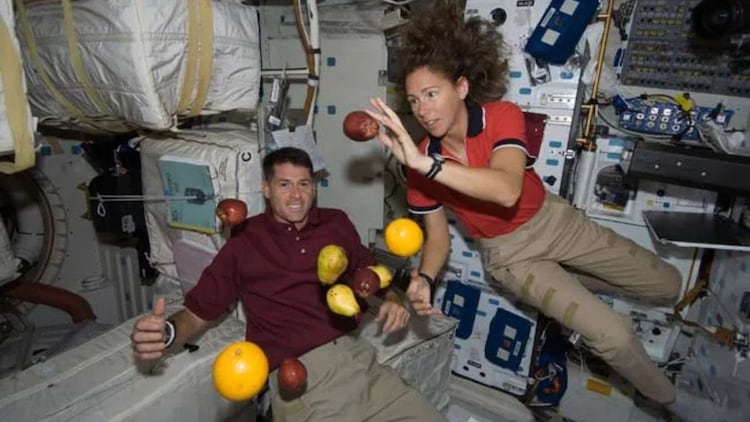
Your brain does not forget gravity easily. Even after months in space, astronauts grip things too hard because the brain keeps expecting objects to fall. New research explains this fascinating quirk of human neuroscience. (Photo: Nasa)

Your brain does not forget gravity easily. Even after months in space, astronauts grip things too hard because the brain keeps expecting objects to fall. New research explains this fascinating quirk of human neuroscience. (Photo: Nasa)

Instead, it holds on to the memory of gravity for months, sometimes long after the body has floated weightlessly through space.

WHY DO ASTRONAUTS STRUGGLE TO HOLD OBJECTS IN SPACE?

On Earth, gripping an object is second nature. You hold your coffee mug tightly enough so it does not slip.

But in space, the rules change completely. When you let go of an object without moving it, it simply floats because gravity is not pulling it down.

However, the moment you move that object in any direction, something called inertia kicks in.
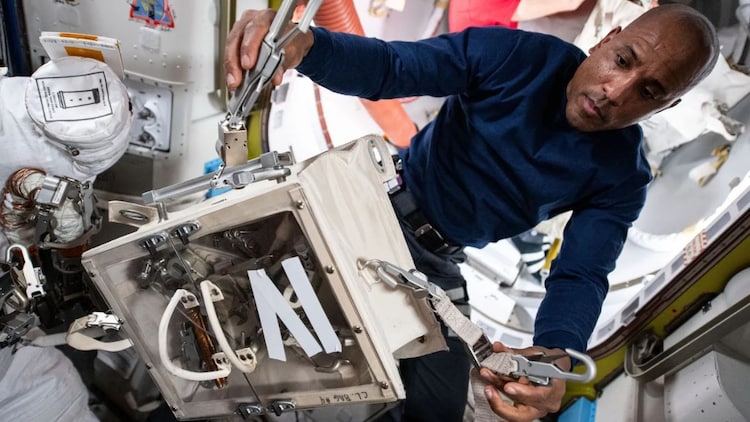
Nasa astronaut Victor Glover handles equipment aboard the Orion spacecraft during the Artemis 2 mission. New research shows the brain keeps expecting gravity even in weightlessness, causing astronauts to over-grip objects. (Photo: Nasa)

Nasa astronaut Victor Glover handles equipment aboard the Orion spacecraft during the Artemis 2 mission. New research shows the brain keeps expecting gravity even in weightlessness, causing astronauts to over-grip objects. (Photo: Nasa)

Inertia is the tendency of an object to keep moving in the direction it was pushed. So if an astronaut moves an object upward and loosens their grip slightly, the object drifts away.

The researchers found that astronauts in space were gripping objects far more tightly than necessary.

Their brains, still wired for Earth’s gravity, kept predicting that objects would fall and be overcorrected as a result.

WHAT HAPPENS WHEN ASTRONAUTS RETURN TO EARTH?

The reverse problem occurred when astronauts came back home.

Initially, their brains made incorrect predictions about how much force was needed to hold and move objects under gravity.

Over time, they gradually adjusted, but the transition was not instant.
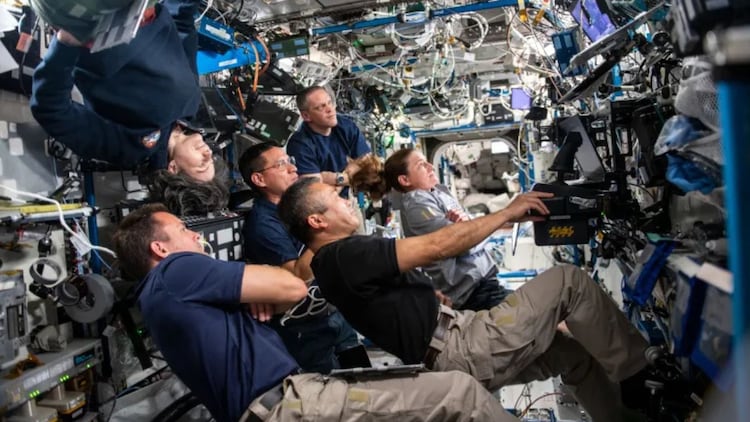
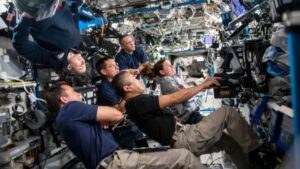
Expedition 68 crew members gather in the International Space Station’s Destiny laboratory module to participate in an evening conference with station mission controllers (Photo: Nasa)

Expedition 68 crew members gather in the International Space Station’s Destiny laboratory module to participate in an evening conference with station mission controllers (Photo: Nasa)

The researchers concluded that the brain adapts to new gravitational environments slowly, and that grip control is governed largely by the brain’s predictions about the risk of dropping something.

The study took nearly 20 years to complete, accounting for coordination with space agencies and data analysis, a testament to just how painstaking space neuroscience research truly is.
Latest

No relief: Heatwaves to get worse in North India, storms to hit the East on Friday

Temperatures across northwest and central India are likely to climb a further 2–3C before any relief arrives.

Nasa captures stunning pic of Moon and Earth from Mars. See the pale blue crescent

Nasa’s HiRISE camera aboard the Mars Reconnaissance Orbiter captured Earth and its Moon from 142 million kilometres away.

Indian startup to send giant balloon to edge of space. What will it do?

Red Balloon Aerospace will launch India's first indigenous Super Pressure Balloon from Andhra Pradesh in the coming weeks, targeting an altitude where satellite

Why India is betting on E85 instead of 100% ethanol: The science explained

India moves forward with ethanol blending regulations amid global oil tensions

Earth glows alone in darkness: Christina Koch captures stunning earthshine video

At that distance, far beyond the altitude of the International Space Station, the planet appears as a luminous marble, its atmosphere glowing faintly against th

Topics

Farewell Grandma: New Zealand great Suzie Bates to retire after Women’s T20 World Cup

New Zealand legend Suzie Bates has announced that she will retire from international cricket after the Women’s T20 World Cup in June and July, bringing an end

Trump rules out nuclear strike, says Iran ‘running out of time’

Addressing reporters at the White House, Trump said there was no justification for deploying nuclear arms. He maintained that Iran had already been “decimated

Healthy UK mother plans assisted dying in Switzerland, says she is unable to cope after son’s death

A 56-year-old woman from England has said she plans to undergo assisted dying in Switzerland following years of grief after her son’s death.

Do Shardul Thakur qualify as a concussion sub when Mitchell Santner didn’t get hit on head in MI vs CSK? Rules explained

Mumbai Indians' Shardul Thakur being named as a concussion replacement for Mitchell Santner has caused controversy in IPL 2026.

Ritchie allows HR on first big league pitch, then leads Braves over Nats 7-2 for 8th win in 9 games

Ritchie allows HR on first big league pitch, then leads Braves over Nats 7-2 for 8th win in 9 games

Musk sounds cautious tone on robotaxis amid slower-than-expected rollout 

TESLA-ROBOTAXI/ (PIX):Musk sounds cautious tone on robotaxis amid slower-than-expected rollout 

Targets marked: Israel signals major Iran strike, awaits US green light

Israel says it is ready to resume war on Iran, with targets identified, but is awaiting US approval, as tensions rise and regional risks grow amid stalled diplo

Mass shooting at Mall of Louisiana leaves 10 injured, police lock down building

Authorities said the violence was not random. According to Morse, the incident began when two groups got into an argument near the food court, which escalated i
spot_img

Related Articles

Popular Categories

spot_imgspot_img