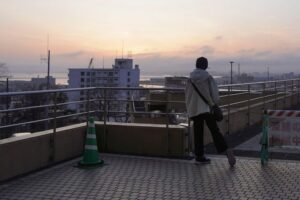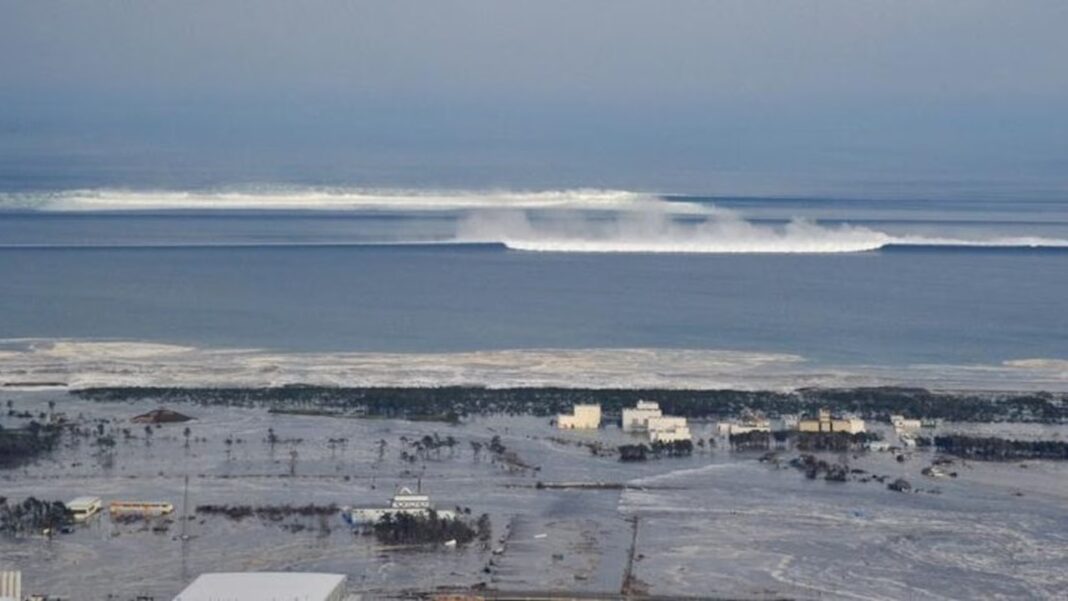
Tsunami waves crashed into ports along Japan’s northeastern coastline on Monday, April 20, after a powerful earthquake shook the region, triggering mass evacuations and invoking the trauma of the 2011 disaster that killed nearly 20,000 people.
A 7.7-magnitude earthquake struck at 1:23 pm IST off the coast of Iwate Prefecture on Japan’s Pacific coast, prompting the Japan Meteorological Agency (JMA) to issue a
Japan’s disaster management agency issued evacuation orders for nearly 1.72 lakh people across five prefectures, while 200 power outages were reported across the impacted areas.
The highest wave recorded so far struck Kuji Port in Iwate Prefecture, measuring about over 2.6 feet. No injuries or damage to homes had been recorded as of Monday evening, though the situation was still being assessed.
HOW IS A TSUNAMI CAUSED?
To understand what’s happening in Japan, it helps to know what a tsunami actually is, and it’s not quite what most people picture.
A tsunami is not a single giant crashing wave.
Unlike ordinary ocean waves, tsunamis carry an enormous volume of water and arrive as a sustained flood rather than a dramatic crashing wave, which makes them deceptively dangerous.
Furthermore, tsunamis begin deep underwater.
When an earthquake strikes beneath the ocean floor, it can cause the seabed to suddenly shift, either lurching upward or dropping downward.
That violent movement displaces an enormous column of water sitting above it, sending energy rippling outward in all directions across the ocean surface.
In open water, these waves are barely noticeable, sometimes just 30 centimetres high, and can travel at the speed of a jet aircraft. But as they approach shallower coastlines, the ocean floor slows them down and the waves are forced upward, growing dramatically in height before making landfall.
WHY IS JAPAN VULNERABLE?
Today’s tsunami was born from that exact process.
The earthquake struck at a depth of just 19 kilometres off Iwate Prefecture. In other words, it was shallow enough that the seafloor displacement was significant, pushing large volumes of water toward the coast within minutes of the tremor.
The JMA warned that the first tsunami waves could reach parts of the northern coastline almost immediately, urging residents to evacuate to high ground without delay.

Officials warned that even a wave just 30 centimetres high carries enough force to knock a person off their feet, sweeping along debris like fallen trees and overturned cars.
A retreating wave is equally lethal, pulling people off land and
Japan’s deeply indented coastline, shaped like a series of narrow bays, compounds the danger further, funnelling incoming water into smaller spaces where wave heights amplify sharply. It is the geography that turned a deadly earthquake in 2011 into one of the worst disasters in modern history, and one that keeps millions on edge again today.