
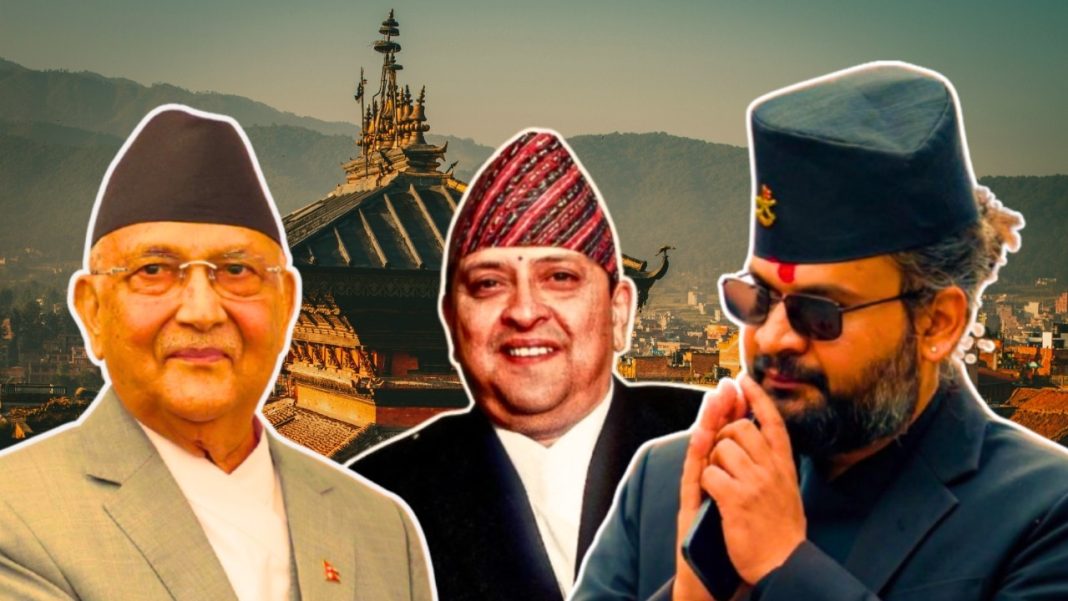
On Valentine’s Day, February 14, thousands gathered outside Kathmandu’s Tribhuvan International Airport. Not for their loved ones flying in, but to welcome Nepal’s former king Gyanendra Shah. The gathering, despite prohibitory orders, was a show of strength by pro-monarchy supporters in a nation still recovering from the aftershocks of the September 2025 Gen Z-led protests that toppled the government of KP Sharma Oli.
After Bangladesh, Nepal, another of India’s immediate neighbours, is heading into high-stakes polls on March 5.
Days later on February 18, the 78-year-old Shah dropped an eight-minute video message. On the eve of Democracy Day, invoking Lord Pashupatinath, he questioned whether elections should proceed before Nepal resolves its crisis. He argued that “it would be more appropriate to first resolve the nation’s pressing problems before proceeding with the upcoming elections”. He said Nepal was trapped in an “unusual whirlwind of distress”.
The March 5 general elections will see the people of Nepal choosing their next government, the first since the September 2025 Gen Z-led protests that toppled the government of Prime Minister Oli. The unrest, triggered initially by a brief social media ban, spiralled into anger over corruption, inequality and political deadlock. More than 70 people were killed and over 100 injured, according to Kathmandu-based newspapers. An interim administration led by Prime Minister Sila Khaki has been overseeing the transition and the upcoming polls. The Election Commission said the polls are being held in “special conditions”.
The contest pits old guard heavyweights against an indomitable youth wave. A 35-year-old rapper, who became Kathmandu’s mayor, Balen Shah, has emerged as the face of that churn in Nepal. At rallies, he walks towards the edge of the stage and rings a ghanti (bell), with a rock star-like feel. He’s speaking of accountability, clean governance and breaking the cartel of established parties. Balen Shah, now the face of the reformist and pro-monarchist Rastriya Swatantra Party, is directly challenging former PM Oli for the Jhapa seat. Oli is the leader of the Communist Party of Nepal (Unified Marxist–Leninist) or (CPN-UML).
At this critical juncture, resentment among the Nepali youth is rising, new entrants crowding the field, and Oli restricted largely to campaigning in Jhapa after last year’s turmoil. There’s also the Nepali Congress, led by the old guard’s Sher Bahadur Deuba, a former PM, and the reformist, youth-leaning face of the party, 49-year-old Gagan Thapa.
The former king’s intervention has raised a few questions. Is his speech a moral appeal for stability, or a political signal amid a fractured field at the time of transition?
Let’s take a look at how things got here in Nepal.
HOW SEPTEMBER 2025 NEPAL GEN Z PROTESTS HIT A PAUSE
In September 2025, Nepal saw massive Gen Z-led protests after the government of KP Sharma Oli banned 26 social media platforms on September 4, citing concerns over unregistered sites and misinformation. The move triggered immediate backlash from young Nepalis, many of whom relied on digital platforms for livelihood, expression and activism. The opposition to the ban expanded into broader anger over corruption, inequality, nepotism and economic stagnation in Nepal. They held the Oli government accountable for this state of Nepal. They circulated reels showing the children of officials and politicians living privileged lives abroad while ordinary Nepalis struggled with daily hardship.
By September 8, protests had intensified in Kathmandu and other cities. Demonstrators breached barricades near Parliament, leading to clashes with security forces. Police fired tear gas and live rounds, according to reports. At least 70 people were killed and more than 300 injured. Curfews were imposed in parts of Kathmandu, and the army was deployed to secure sensitive locations, including the airport.
Under mounting pressure, the government lifted the social media ban late on September 8, but protests continued. Protesters thrashed a former PM and beat up some ministers on the streets and set the Supreme Court and the Parliament on fire. The agitation only slowed after Oli resigned. A new administration under Sushila Karki took office on September 14. Karki, the BHU-educated former jurist, declared those killed as martyrs and promised reforms.
The administration led by Karki, de-escalated immediate tensions. The movement hit a pause.
A judicial commission summoned Oli and officials for an enquiry into the atrocities. Oli questioned the commission’s legitimacy and impartiality. He refused to appear. By January 2026, the interim administration shifted to preparing for March elections.
WHO ARE THE BIG PLAYERS IN NEPAL’S MARCH 5 ELECTIONS?
Nearly 1 crore 90 lakh voters are registered for the March 5 polls, of which around 8 lakh are first-time voters, according to Nepal’s Election Commission. Close to 3,500 candidates are contesting across 165 parliamentary constituencies. Thirty-three percent of seats are reserved for women. The traditional heavyweights, the Deuba-led Nepali Congress and the Oli-led CPN-UML, are not the central ones in the race.
Oli, once the dominant force, is now fighting from a defensive position. The unrest weakened his authority. Unlike previous elections, when Oli travelled extensively across the country, headlining mass rallies and projecting himself as a nationwide vote catcher, this time, the four-time prime minister is largely confined to his home turf, Jhapa 5, reported The Kathmandu Post.
Ex-rapper Balen Shah, resigned as Kathmandu mayor last week. He had challenged Oli at Jhapa 5. Oli has had little room to campaign beyond his own constituency or canvass for CPN-UML candidates elsewhere, added the Kathmandu-based English daily.
Balen Shah, in contrast, is positioning himself as the face of systemic reform. The generational contrast is clear. A 35-year-old former rapper challenging an entrenched veteran in his own bastion.
SO, WHERE DOES NEPAL’S MONARCHY FIT INTO THIS POLL BATTLE?
Nepal was officially a Hindu kingdom until 2008, ruled by the Shah dynasty. The monarchy was regarded as a symbol of national unity and protector of the faith.
After a decade-long Maoist insurgency and the 2006 People’s Movement forced King Gyanendra to relinquish absolute power. The first Constituent Assembly formally abolished the monarchy in 2008 and declared Nepal a secular federal democratic republic.
Gyanendra Shah was the last reigning king. He succeeded his brother King Birendra after the 2001 royal palace massacre, and remains the central figure in the present-day pro-monarchy protests.
The idea of restoring the monarchy retains limited but visible support in some quarters of Nepal and resurfaces during periods of political instability. Monarchist forces such as the Rastriya Prajatantra Party, Durga Prasai’s campaign, and small Gen Z factions disillusioned with corruption and revolving door governments, frame the crown as a symbol of order and stability.
During Nepal’s September 2025 Gen Z protests, talk of restoring the monarchy resurfaced. Some saw the former king as a symbol of stability. Hundreds gathered to greet him on his birthday amid the unrest, reported The Himalayan Times.
While Balen Shah has backed the republican system, he has been described as having monarchist tendencies by Nepalese sociologist Pranab Kharel, noted a December report in The Himalayan Times.
WHAT DID NEPAL’S FORMER KING GYANENDRA SAY?
In the address on February 18, Gyanendra paid tribute to King Tribhuvan and the martyrs of democracy, then jumped to the present.
“While periodic elections for the selection of representatives are a natural process in a democratic system,” he said, and added that “the prevailing public sentiment at this time is that it would be more appropriate to first resolve the nation’s pressing problems before proceeding with the upcoming elections”. He called for “forging a national consensus and a broad understanding that includes everyone, and then proceeding to the polls”.
The phrasing was careful. He did not reject elections. Yet the timing is conspicuous.
An analysis piece in the Kathmandu-based English daily Republica noted that the former king’s appeal lands amid detentions of figures accused of anti-election activities, including Durga Prasai, Rishi Kattel and Dharmendra Bastola. This makes the call for “no elections without consensus” sound less abstract and more interventionist.
The piece noted that placing outcome over process risks sidelining constitutional timelines, adding that in a democracy, “process is not a formality; it is the safeguard of legitimacy”.
Nepal’s 2015 Constitution sets clear electoral timelines and vests sovereignty in the people. Gyanendra’s formulation of “consensus first, elections next” has raised constitutional and political questions. Gyanendra closed his speech with “Jai Nepal” and a call to adopt “the good and positive aspects of any system”. The speech was a broad canvas without being solution-oriented. But weeks before a high-stakes vote on March 5, the speech demands an important reading and raises questions.
Nepal heads to polls with a young electorate, a splintered old guard, and a rising anti-old guard wave challenging the status quo. The ballot will test whether Balen Shah converts the youth’s anger into votes, whether Oli survives at Jhapa, and whether Gyanendra’s shock intervention shifts any mood at all.
(with inputs from Meenal Sharma)


