
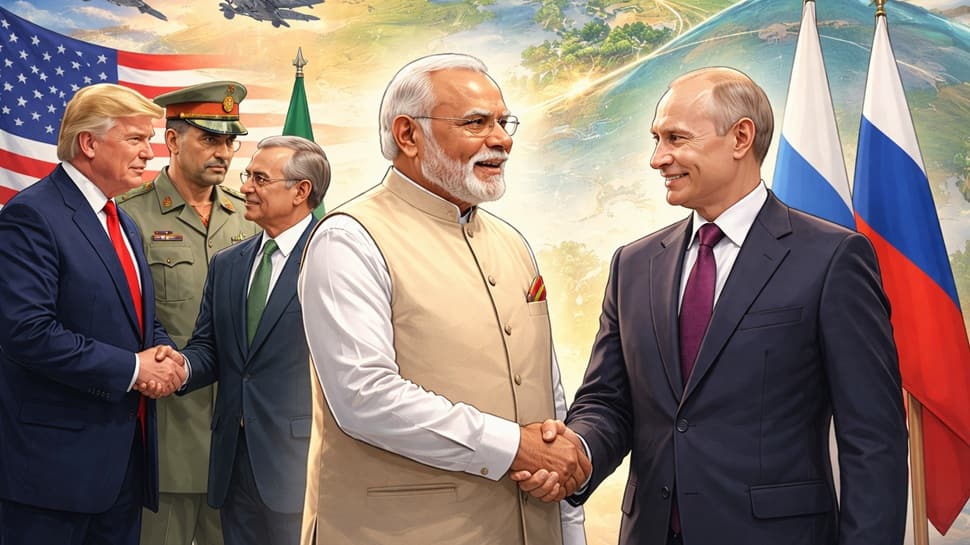
Under President Donald Trump, the United States is increasingly leaning towards Pakistan. Be it Iran peace negotiations or America’s pro-Pakistan stand post Operation Sindoor, the message has been clear for India. The United States has recently also conveyed to New Delhi that it won’t unilaterally support India in case of a conflict with Pakistan. Now, a fresh set of remarks from Washington has reignited an old strategic question in New Delhi: when the United States leans towards Pakistan, how should India respond?
“The Pakistanis have been incredible mediators throughout this process, and we really appreciate their friendship and their efforts to bring this deal to a close,” US Treasury Secretary Scott Bessent said, referring to ongoing negotiations linked to an Iran ceasefire. The sentiment was echoed more emphatically by US President Donald Trump, who noted, “I compliment the people of Pakistan on their leadership. The Prime Minister and the Field Marshal are great people and they are close to Iran and they are trying to work something out and I think they are being very successful at doing it.”
For Indian policymakers, such praise is not just diplomatic rhetoric—it signals a tactical recalibration in Washington’s regional playbook. Pakistan, once again, appears to be positioning itself as a useful intermediary in West Asia, a role that the US has historically encouraged when it suits its immediate interests.
This has triggered sharp reactions among sections of India’s strategic community. Foreign policy expert Navroop Singh wrote on X, “Indo-US Relationship has been permanently damaged! The Pivot to Pakistan is visible, India should increase its engagement with Russia for whatever be the costs.” His comment captures a growing unease—that India’s long investment in ties with Washington may be vulnerable to sudden geopolitical swings.
Yet, this view is far from universal. A more measured school of thought argues that the current phase may be transient, tied to the remaining tenure of the Trump administration. Proponents of this approach point out that the structural drivers of the India-US partnership—trade, technology, China’s rise, and Indo-Pacific security—remain intact. From this perspective, overcorrecting towards Moscow could prove strategically limiting, especially when Russia’s global economic and technological weight is no longer what it once was.
Understanding the renewed US-Pakistan engagement also requires stripping it down to its essentials. The US-Pakistan relationship has always been transactional. Washington needs a military-capable Islamic partner in the region—one that can facilitate backchannel diplomacy, host strategic assets, and advance US objectives when required. Pakistan, on the other hand, is seeking both financial inflows and international legitimacy. Its current leadership under Field Marshal Asim Munir appears keen to leverage this moment to rebuild its global standing and unlock support from Gulf economies.
For India, the challenge lies in navigating this fluid landscape without reacting impulsively. Major (Retired) Manik M Jolly, SM, offers a pragmatic view, “We shouldn’t try too hard, as I think is the case. Let this play out. Let the dust settle down and let US and Pakistan again see each other in the light of the day, when this is over. India should focus on building rapport with Russia, Europe, Israel etc. We have the capability and brand to maintain good relations with all, now is the time not to change that.”
That, perhaps, is the core of India’s foreign policy dilemma—and its strength. Unlike in the Cold War era, New Delhi today is not bound to binary choices. It has the diplomatic space to engage Washington, deepen ties with Moscow, and simultaneously expand partnerships across Europe, West Asia and beyond.
The real question, then, is not whether India should ‘shift’ towards Russia, but whether it can sustain a multi-aligned strategy in an increasingly transactional world order. For now, the answer appears to lie in patience rather than pivot—waiting out tactical shifts while preserving long-term strategic autonomy.


