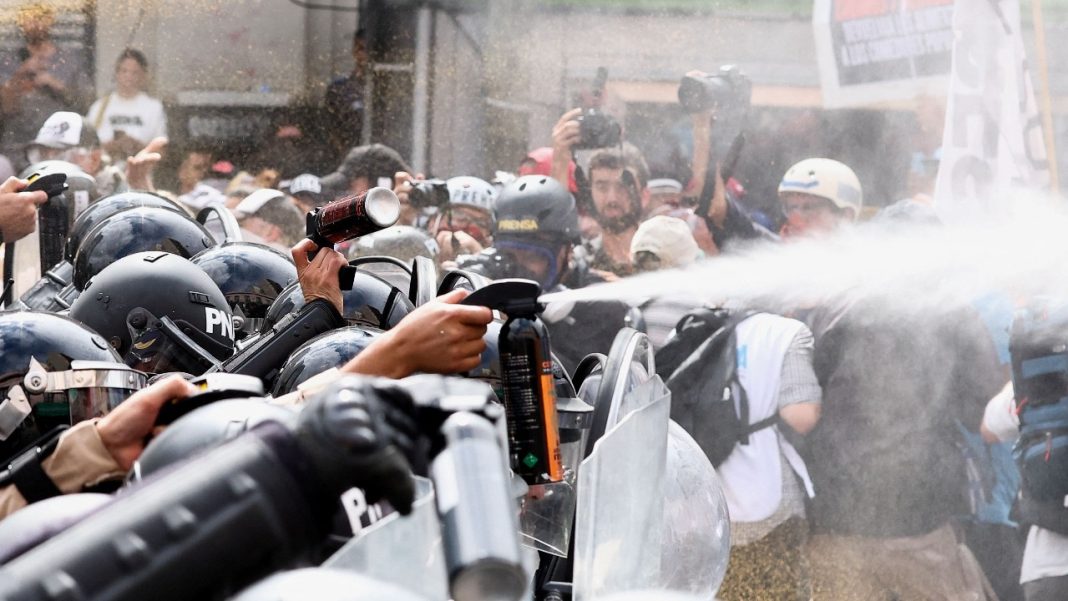
Tear gas and pepper spray are more harmful than you think. Here’s why

Tear gas and pepper spray are common tools in crowd control, but mounting evidence shows they can cause health problems that linger long after the initial burning and tears.

The impacts vary and are alarming, ranging from damage not just to the sensory organs but also reproductive health and the heart.

WHAT ARE PEPPER SPRAY AND TEAR GAS MADE OF?

Tear gas usually refers to chemicals like CS (2-chlorobenzalmalononitrile), the most common today, often fired from exploding canisters or mixed into water cannons.

Pepper spray typically contains oleoresin capsicum (OC) and capsaicin, compounds extracted from chilli peppers, or synthetic versions like Pelargonic Acid Vanillyl Amide (PAVA), a human-made chemical mimicking capsaicin.

These irritants are banned in warfare under international treaties but permitted for law enforcement in certain countries.

India is one of those countries. There are many instances where tear gas or pepper spray is used in the nation. The latter is often used for self-defence, while the former has been used to break up public protests across the nation.

Police use teargas and water canon to disperse protestors in Chandigarh, Punjab. (Photo: Reuters)

Police use teargas and water cannons to disperse protestors in Chandigarh, Punjab. (Photo: Reuters)

HOW DO PEPPER SPRAY, TEAR GAS AFFECT THE BODY?

Both pepper spray and tear gas trigger intense pain by activating nerves in the eyes, skin, and airways, causing overwhelming coughing, tears, and mucus.

The function is to incapacitate the target as soon as possible.

Furthermore, there is no antidote.

Health guidelines, however, advise moving to fresh air, washing skin with soap and water, and rinsing eyes until clear. The overwhelming symptoms usually fade in about 30 minutes, but severe or indoor exposure can prolong effects.

Children face higher risks if exposed to either of the two, because of thinner skin, smaller airways, and lower height where gas accumulates and easily attacks the nerves.

A man assists his daughter after being sprayed with tear gas. (Photo: Reuters)

A man assists his daughter after being sprayed with tear gas. (Photo: Reuters)

WHAT ARE THE LONG-TERM HEALTH IMPACTS?

Long-term impacts remain understudied, with no large systematic research.

Much evidence comes from anecdotal reports and smaller studies.

A 2014 study of over 6,000 US Army recruits showed odds of acute respiratory illness, like bronchitis or sinusitis, more than doubled after CS exposure in training. Higher doses increased risk, and later work led the military to limit concentrations.

CS can damage eye and airway linings, potentially causing fluid in lungs, infections, or lasting issues after repeated exposure.

A security officer uses pepper spray through a cloud of tear gas in Oregon, US. (Photo: Reuters)

A security officer uses pepper spray through a cloud of tear gas in Oregon, US. (Photo: Reuters)

Vulnerable groups, mostly the elderly, smokers, and asthmatics, face greater danger.

Similar studies have found other adverse effects like heart abnormalities causing delayed electrical impulses and reduced blood flow. Many victims also reported headaches, eye issues, skin problems, high blood pressure, or trauma.

Reproductive effects have also been reported.

A 2023 survey of over 1,200 individuals exposed to these gases found 83 percent experienced uterine cramping, breast tenderness, or irregular bleeding, with higher risk after multiple exposures. Ten of 19 pregnant respondents reported miscarriages, roughly double expected rates.

Police officers spray tear gas at demonstrators in Turkey. (Photo: Reuters)

Police officers spray tear gas at demonstrators in Turkey. (Photo: Reuters)

The reality remains that deeper and more long-term research is needed on the use of these weapons that do more than just stun the target. There are consequences over a period of time that warrant a rethinking about whether alternatives exist.


Latest

Back on Earth, still in space: Astronaut’s brain takes months to readjust

Astronauts grip objects too tightly in space because their brains are still anticipating Earth's gravity, a new study has found. Researchers say the brain adapt

No relief: Heatwaves to get worse in North India, storms to hit the East on Friday

Temperatures across northwest and central India are likely to climb a further 2–3C before any relief arrives.

Nasa captures stunning pic of Moon and Earth from Mars. See the pale blue crescent

Nasa’s HiRISE camera aboard the Mars Reconnaissance Orbiter captured Earth and its Moon from 142 million kilometres away.

Indian startup to send giant balloon to edge of space. What will it do?

Red Balloon Aerospace will launch India's first indigenous Super Pressure Balloon from Andhra Pradesh in the coming weeks, targeting an altitude where satellite

Why India is betting on E85 instead of 100% ethanol: The science explained

India moves forward with ethanol blending regulations amid global oil tensions

Topics

America right now is a failed state, well almost

Donald Trump News: Economic might and robust internal security aside, Trump's America ticks enough boxes to qualify as a failed state in the political theatre o

THE Asia Rankings 2026: 128 Indian universities ranked, none in top 40; China rules

India continues to strengthen its position in global higher education, with more universities appearing in the latest Times Higher Education World University Ra

HCLTech, TCS, Infosys: Why are IT stocks falling again?

Fresh pressure on IT shares as demand concerns and foreign selling unsettle investors

Bhooth Bangla box office collection day 7: Akshay Kumar’s horror-comedy eyes Rs 100 cr in India, crosses Rs 135 cr worldwide

Bhooth Bangla brings back Bollywood’s iconic actor-director duo, Akshay Kumar and Priyadarshan, after 14 years.

Farewell Grandma: New Zealand great Suzie Bates to retire after Women’s T20 World Cup

New Zealand legend Suzie Bates has announced that she will retire from international cricket after the Women’s T20 World Cup in June and July, bringing an end

Trump rules out nuclear strike, says Iran ‘running out of time’

Addressing reporters at the White House, Trump said there was no justification for deploying nuclear arms. He maintained that Iran had already been “decimated

Healthy UK mother plans assisted dying in Switzerland, says she is unable to cope after son’s death

A 56-year-old woman from England has said she plans to undergo assisted dying in Switzerland following years of grief after her son’s death.

Do Shardul Thakur qualify as a concussion sub when Mitchell Santner didn’t get hit on head in MI vs CSK? Rules explained

Mumbai Indians' Shardul Thakur being named as a concussion replacement for Mitchell Santner has caused controversy in IPL 2026.
spot_img

Related Articles

Popular Categories

spot_imgspot_img