
Annular solar eclipse today: Will the ring of fire be visible in India?

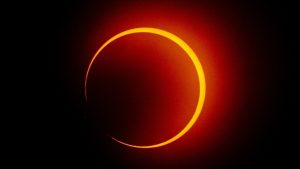
Skywatchers in several parts of the world are set to witness the first solar eclipse of 2026, an annular “ring of fire” event that will dim the Sun.

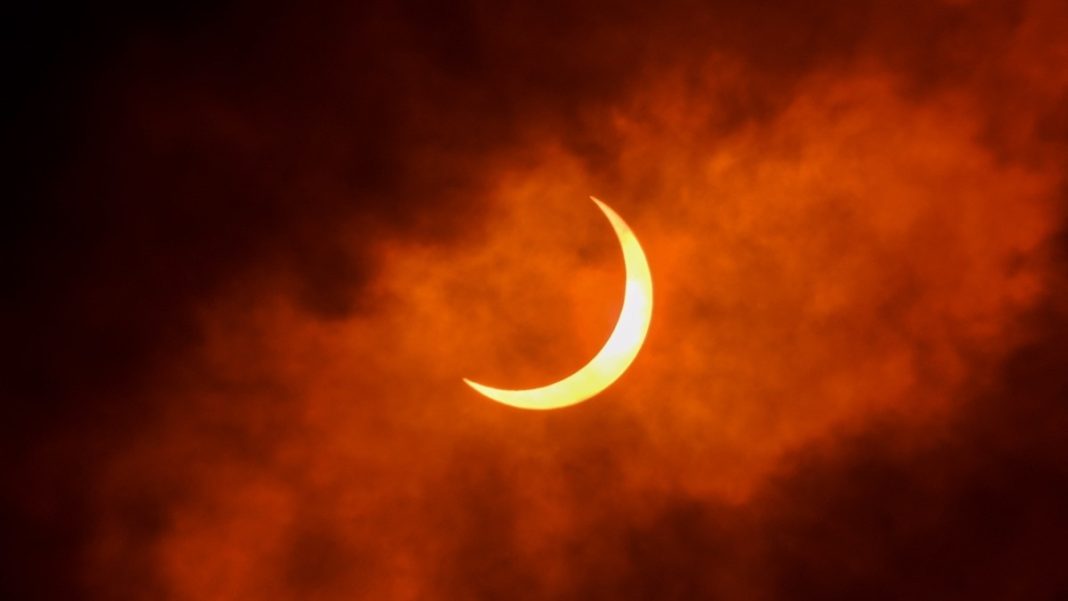
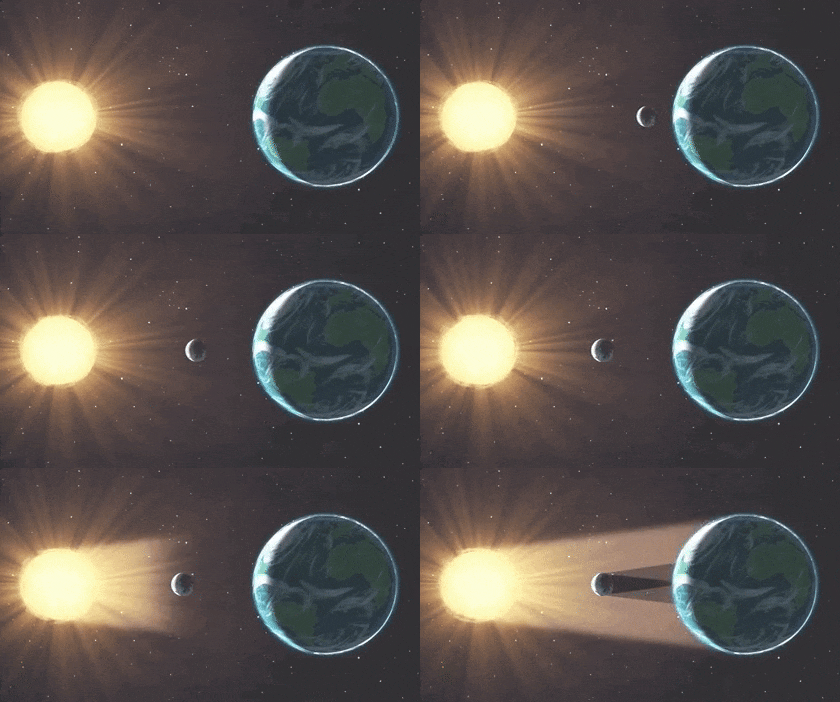
An annular solar eclipse occurs when the Moon passes between Earth and the Sun but appears slightly smaller than the Sun in the sky. This happens because the Moon travels in an elliptical orbit and is sometimes farther from Earth.

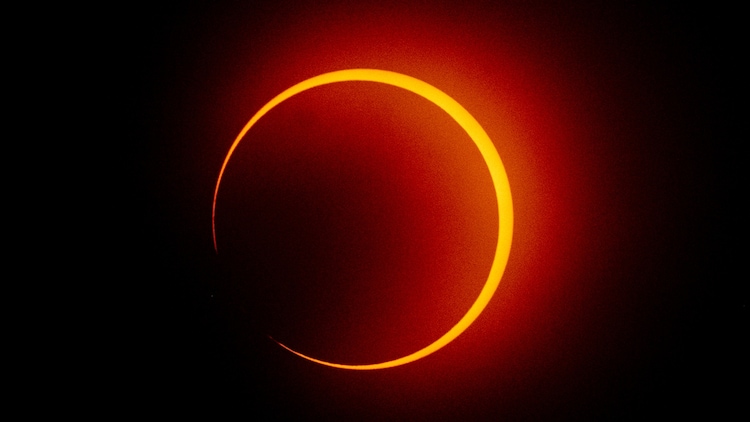
During this eclipse, the Moon will be near apogee, its farthest point from Earth, making its apparent diameter about 97 per cent of the Sun’s size. As a result, instead of completely blocking sunlight, the Moon will leave a bright ring of the Sun visible around its edges, creating the dramatic “ring of fire” effect.
Solar eclipse

The eclipse will unfold over several hours. The partial phase will begin at 3:27 PM IST, followed by the start of annularity at 5:14 PM IST over Antarctica.

The eclipse will reach its maximum at 5:43 PM IST, when about 92.7 per cent of the Sun will be obscured, and will end at 7:58 PM IST. At locations such as Antarctica’s Concordia research station, the annular phase will last just over two minutes.

WHERE WILL ANNULAR SOLAR ECLIPSE BE VISIBLE?

The path of annularity is extremely narrow and crosses only parts of Antarctica.

A wider region will experience a partial eclipse, including the southern tips of Chile and Argentina, parts of South Africa, Mozambique, and Madagascar, and several islands in the Indian Ocean.

Scientists estimate that about 176 million people worldwide, roughly 2 perc ent of the global population, will be able to see at least a partial eclipse, though in many places the Sun will appear only slightly dimmed.

WILL THE ANNULAR SOLAR ECLIPSE BE VISIBLE IN INDIA?

In India, the eclipse will not be visible, as the Sun will set before the event begins in the country.
Solar eclipse

The path of annularity is extremely narrow. (Photo: Getty)

However, astronomy organisations and platforms such as TimeandDate are expected to provide live coverage, allowing viewers to observe the phenomenon virtually.

Experts advise never looking directly at the Sun without ISO 12312-2 certified eclipse glasses, as even a partial or annular eclipse can cause serious eye damage.

The eclipse is part of Saros cycle 121 and will be followed by a total lunar eclipse on March 3, 2026, giving skywatchers another opportunity to observe a major astronomical event soon after.
Latest

North to sizzle in heatwave, northeast to experience thunderous Wednesday

Temperatures across northwest and central India are expected to climb by another 3–5C before finally dipping towards the end of the month. But before that, he

Plants not just feel, they can hear the rain too, confirms new research

MIT scientists have discovered that rice seeds can sense the sound of rain and germinate up to 40 per cent faster as a result. The study reveals how sound waves

2026 could see a super El Nino and record-breaking global temperatures

La Niño is one of the phases of the El Niño–Southern Oscillation (ENSO) – a natural climate phenomenon. It usually occurs in the Pacific Ocean, influencin

Astronaut on Space Station captures rare comet flying over Earth. See pic

Nasa astronaut Chris Williams was photographing the Lyrid meteor shower from the Cupola aboard the International Space Station when he accidentally spotted a be

Dead zone in Akashganga: The region where Milky Way galaxy stops making new suns

Scientists have identified the precise edge of the Milky Way's star-forming disc by studying the ages of over 1,00,000 stars. The boundary sits roughly 35,000 t

Topics

Why the Iran conflict is taking a more dangerous turn

Stalled talks, ship seizures and nuclear disputes sharpen the Trump-Iran standoff

UP Board 12th Result 2026 today: Check last 5 years pass percentage trends

UP Board Class 12 results show steady improvement in student performance

JEE Advanced 2026 registration begins. Check direct link, eligibility and last date

The Indian Institute of Technology Roorkee has announced the registration schedule for JEE Advanced 2026. Eligible candidates can apply online from April 23 to

Karnataka SSLC Result 2026 declared: Direct link to check Class 10 scorecards, pass percentage here

Karnataka SSLC Result 2026 has been declared by the Karnataka School Examination and Assessment Board (KSEAB). Students who appeared for the Karnataka Class 10

CBSE Class 10 second board exam datesheet out for May 2026, check full schedule

The Central Board of Secondary Education (CBSE) has released the official datesheet for the Class 10 second board examinations 2026. The exams will be conducted

Karnataka SSLC Result 2026: 5 alternative ways to check scorecards

Karnataka SSLC Result 2026 will be released today at 12 pm for Class 10 students. Here are all the alternative ways to check your result quickly and without has

UP Board 10th, 12th Result 2026: Here’s how to download marksheet on DigiLocker

UP Board Results 2026 will be declared at 4 pm today for Class 10 and 12 students. Here’s a simple guide to download your marksheet via DigiLocker instantly.

Dr Reddy’s jumps nearly 7% as Sensex falls: Why is the pharma stock rising?

Shares of Dr Reddy’s Laboratories surged sharply on Thursday, bucking a weak broader market and emerging as one of the top gainers on the Nifty 50.
spot_img

Related Articles

Popular Categories

spot_imgspot_img

