
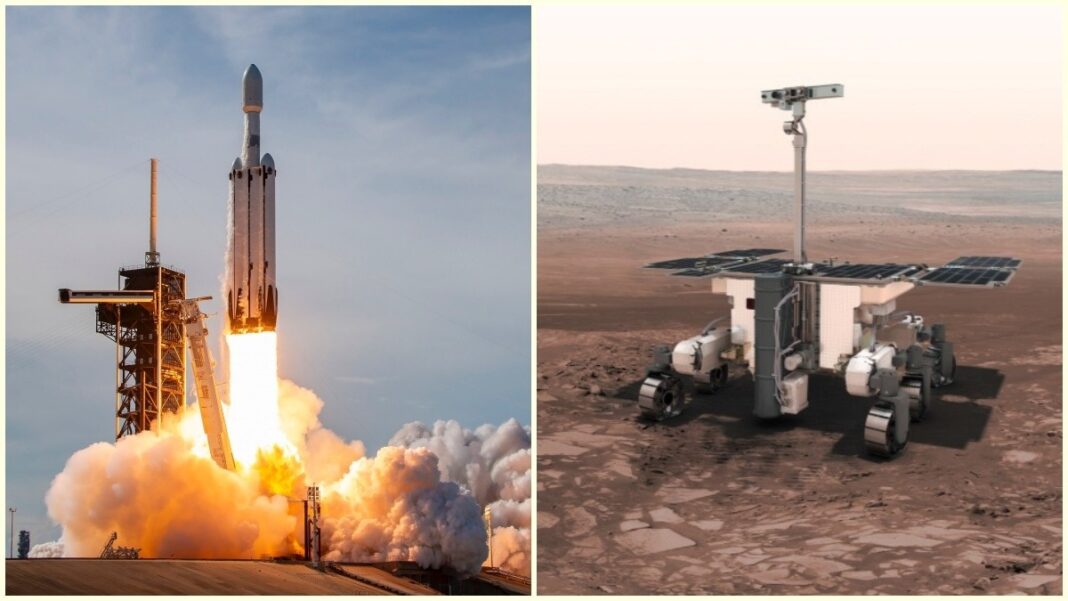
Elon Musk’s SpaceX will launch the Rosalind Franklin to Mars in late 2028. The rover will hitch a ride to the Red Planet aboard the company’s Falcon Heavy rocket.
Meanwhile, Nasa has cleared a major milestone for one of the most ambitious Mars missions of the decade, approving the implementation phase of the Rosalind Franklin Support and Augmentation (ROSA) project.
The move strengthens collaboration between Nasa and the European Space Agency on the long-awaited Rosalind Franklin rover, which had been derailed due to the Russia-Ukraine war.
The mission, led by ESA, represents a significant step forward in the search for life beyond Earth. Unlike previous Mars rovers, Rosalind Franklin will drill beneath the planet’s surface, up to two meters deep, to look for signs of past or present microbial life.
Scientists believe that subsurface samples may hold preserved organic material shielded from harsh radiation on the Martian surface.
Under the ROSA project, Nasa will provide critical support elements to ensure mission success. These include launch services, braking engines for the lander platform, and radioisotope heater units that will help keep the rover’s internal systems warm in Mars’ extreme cold.
Nasa will also contribute advanced electronics and a sophisticated mass spectrometer, a key component of the Mars Organic Molecule Analyzer instrument.
This instrument will analyze soil samples collected at the rover’s landing site, Oxia Planum, a region believed to have once contained water and clay-rich deposits.
The partnership between Nasa and ESA was formalized through a Memorandum of Understanding signed in early 2024, expanding Nasa’s role in the ExoMars program after earlier mission delays. The ROSA project has since cleared key technical reviews, including its Preliminary Design Review, signaling that development is on track.
Nasa has selected SpaceX to provide launch services using Falcon Heavy, one of the most powerful operational rockets in the world. The launch will take place from Launch Complex 39A at Kennedy Space Center, a historic site that has supported missions from Apollo to modern deep-space exploration.
The contract for the mission was awarded under the agency’s Launch Services II framework. The launch window is currently targeted for no earlier than late 2028.
With its unique ability to probe beneath the Martian surface, the Rosalind Franklin rover could redefine humanity’s understanding of life beyond Earth, marking a new chapter in international space exploration.


