
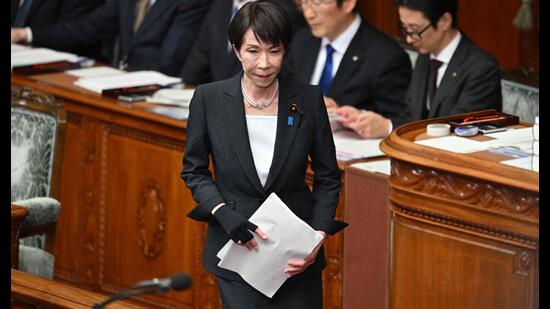
Japan has resoundingly elected as its first-ever female prime minister, an iron-willed conservative with a fondness for heavy metal and fast cars. Sanae Takaichi’s sudden ascent and colourful personality may astonish observers, but it ought not to surprise Indians aware of the paeans their forefathers sang for Japan. To them, Japan was admirable for being conservative when possible and radical when necessary. But in this remarkable dualism, they also noticed a wrinkle that deserves our to be remembered.
When the “makers” of modern India came of age in the latter half of the 19th century, they initially sought to learn from Italy and Germany, the other latecomers to nation-building. Romantics rehearsed Mazzini’s orations and statesmen avidly followed Bismarck’s moves. But then, slowly, news filtered in of the great changes afoot in Japan. And so, as soon as steamship routes permitted Indians to travel to North America via Japan, the curious took advantage of the opening. One of the earliest voyagers was Swami Vivekananda, who was stunned by what he discovered. The Japanese, he wrote to his associates in July 1893, were “bent upon making everything they want in their own country”— including rifles and naval ships — while his own countrymen were a “race of dotards” debating the “untouchableness” of food and chasing after “thirty-rupee clerkships”. “Come, see these people, and then go and hide your faces in shame,” he fumed.
Initially, Indians believed that the Japanese owed their “unexampled” rise to their “intense craving” for “useful knowledge”. Pointing to the droves of students being dispatched to America and the teachers being imported from there, they praised Japan’s willingness to “emulate the West”. Again and again, they cited the famous Meiji-era dictum: “We do not say that whatever is Japanese is good, but that whatever is good shall be Japanese”.
Then came the Russo-Japanese War. Almost overnight, Indians decided that Japan owed her victory to patriotism, which had unified the country in purpose and action. Now it became commonplace to quote the Meiji diplomat Suematsu Kencho, who attributed her military and industrial achievements to the fact that “the Japanese never forget that the individual must unconditionally step into the background whenever the common weal is in question”. The effect of the example was electric: Droves entered movements like the Arya Samaj, and newspapers and periodicals were flooded with letters and poems extolling Japan. As “VS” wrote to The Arya:
Glorious Japan! Thou hast in thee,
Combined the arts of war, and peace,
And reared a soul sublime and great;
Wherefore ‘Thou land of the rising sun!’
In truth, thou art a sun to us
But then, as the British began cracking down on Indians who tried to follow Japan’s example by championing swadeshi, our forefathers arrived at the conclusion that Japan owed its success to the fact that it had an “independent political existence”. “Liberty is the best educator”, they began to say. Little wonder, then, that the Native States, which enjoyed greater freedom in the economic domain, were the ones to forge the deepest links with Japan.
The “pioneering” Indian students in Japan came from Gwalior, and it was only after their “silk turbans” and “studiousness” had warmed Japanese hearts that numbers followed from Bengal and Madras. It is no accident that Jamsetji Tata, who voyaged to Japan alongside Vivekananda, opened his silk farms and the Tata Research Institute in Mysore, or that M Visvesvaraya, who visited Japan in 1898, went on to serve in Hyderabad and Mysore. The maharajas were drawn to Japan because it showed what a progressive monarchy could accomplish.
The Gaekwads led the way, eager to adopt Japan’s technical prowess. None endeared themselves more than Sriram Chandra of Mayurbhanj, who candidly announced at a dinner hosted by the famed statesman Okuma Shigenobu that “he would like to be born a Japanese at the next birth”.
This universal admiration was not fated to last. Soon enough, Indians began to feel uneasy about what Japan’s knowledge, patriotism, and liberty were coming to mean in practice. We associate this worry with Rabindranath Tagore, who, when he visited Japan in 1916, excoriated his hosts for annexing Taiwan and Korea (to which proponents of “Japanism”, such as the ultranationalist Mitsui Koshi sarcastically replied that Indians such as Tagore had “a tendency to try to escape from the actualities of life”).
But the truth is that, long before Tagore set foot in Japan, Indians living there had begun to warn that the Japanese were only “half-serious” followers of the Buddha whose pride in their land went “to an excess”. Initially, they dwelled on Japan’s “want of sympathy toward Chinese students” flocking to Tokyo. Then there were more ominous signs. In a letter published in The Dawn in the wake of the Russo-Japanese War, an Indian student recounted asking “young Japanese” how their “small country” could possibly compete with the West. “Why, we will make it as large as the British Empire”, they replied, a statement that understandably left their interlocutor horrified. Eventually, the flame came closer. By 1919, Japan had become India’s second-largest trading partner, having undercut European manufacturers. This sharply increased the number of Japanese residing in India. Unfortunately, this meant, as a worried Japanese businessman wrote to the Indo-Japanese Association, that Indians realised their “brother Asians” were quite ready “to take after the British people in their contemptuous attitude towards Indians”.
The praises and cautions voiced by generations past are worth recalling because Japan is once more at a moment where it must confront necessity. Previously, it was the arrival of America; now it is the ceaseless rise of China. Fearing diminishment, Japan is moving in the direction of rearmament, in every sense of the word. The spectacular election of Takaichi (and before that, of her lamented mentor, Shinzo Abe) is but a sign of this churn.
Will this fateful moment lead to peace or to conflagration in Asia?
It depends on Japan’s answer to the question that our forefathers asked a century ago: Can it lead without descending into chauvinism? The question is important because India seems unable to rise to the moment. We remain the “vain talkers” that Vivekananda feared we were, unwilling to “awaken ourselves to the necessity of the present times.” And so, what is to become of Asia in the coming decade will depend greatly on whether the Japanese, the “singular people” we have long admired, can revive themselves without being carried to that “excess” we once feared.
Rahul Sagar is Global Network associate professor at NYU Abu Dhabi. His recent books include The Progressive Maharaja and To Raise A Fallen People. The views expressed are personal


