
Recently, one night, I scrolled through Instagram so relentlessly that I likely scraped the bottom of the algorithmic barrel. The reels stopped making sense. I wondered, “Does Instagram really think I will love a video of an Artificial Intelligence (AI)-generated frog rapping in Punjabi at three in the morning?” It turns out social media, too, can experience cognitive overload. In machine learning terms, the signal-to-noise ratio drops. The model’s confidence in predicting what you want weakens.
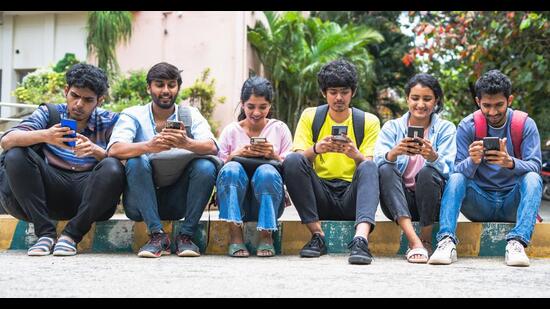
How did we get here — exhausting even the systems designed to control us? Recognising social media’s hold over young minds, the Karnataka government is planning to ban smartphones for students under the age of 16 years; the Union IT minister and the Economic Survey have both spoken about the need to restrict youngsters’ access to social media.
I was well into my 30s when social media descended upon us. I shudder to think of being born into it. There was not enough time, and perhaps not enough will, to conduct fundamental research into its long-term impact before it took grip. We gave a loaded gun to our children, and now act surprised when they harm themselves with it.
Last year, as principal of Mayo College, I banned smartphones on campus. It was the only decision that received a standing ovation from parents. I remember standing at that parents’ meeting, uncertain if we were overreaching — but when that ovation came, I knew I had struck a chord. Was this corrective or preventive? That is difficult to say because even in a fully residential school, children are not with us every single day of all 12 months — nor should they be. In my conversations with parents, my concern is clear: You are happy with this decision, but the moment your child steps off campus during vacations, you might hand the phone back.
The modalities took time to figure out. Our students were never really allowed daily usage, but a stance had to be taken and usage severely restricted. The goal? Our boys must look up, around, and within.
We ensured parents could reach their children via basic feature phones with calling only — no internet. Even these phones were deposited with housemasters. Laptops and tablets followed the same protocol. For internet access needed for competitions or projects, our state-of-the-art computer and AI labs sufficed, with cyber supervision.
We did this because the problem lies in their impressionable, vulnerable minds when they enter the online world without blinkers. Jonathan Haidt, the American social psychologist and author of The Anxious Generation, is a prominent voice on the issue. Since 2010, time spent daily with friends has declined steeply. More teenagers sleep fewer than seven hours nightly. Fewer report having close friends. These shifts did not occur among adults over 30, and have affected girls more than boys. Internal reports from social media companies show they knew their products could harm teenage mental health, particularly for girls, yet continued designs promoting addictive usage. A 2022 study in American Economic Review found that Facebook access increased depression and anxiety among college students while reducing real-world social interactions — evidence that the harms are not anecdotal but measurable and severe.
Six months into the smartphone-free environment for students, we have not yet fully understood the move’s effectiveness through quantifiable data. But the shift is palpable. There has been no cyberbullying incident. Our children are not spewing venom in comment sections or through “finstas” (fake social media accounts). They are not grabbing phones for perfect selfies with medals and teeth. Person-to-person contact is irreplaceable. Look at the pandemic years’ impact on children’s confidence, learning, and social skills. Machines can assist; they cannot be a substitute for human presence. One of our Class 7 boys, otherwise well-read for his age, cannot spell basic words because his formative years were spent typing essays during Covid where the autocorrect feature impacted his word formation. Controlling smartphone usage isn’t about preventing just the obvious harms but also these seemingly innocuous demons.
Even in our dining hall, teachers dining with students have been instructed not to use phones except for emergencies. Within a boarding school, the trust between student and teacher runs deep. When they trust you, they unwittingly want to be you — from the trainers you wear to your moral compass.
Across the world, educators and policymakers are increasingly questioning unfettered smartphone access for children, and a growing number of schools are exploring similar measures. It gives me reassurance that what felt like a bold, lonely decision is part of a much larger conversation.
We decided to make Mayo a smartphone-free campus because we went back to our core principle: Is it good for the boys? We know technology is essential. Our boys learn coding, use laptops, engage with digital tools, and connect with the world. We are not turning away from the future. But we also know this: Access to smartphones at a young age can mean constant distraction instead of deep focus and social media anxiety at the cost of genuine friendship. It deludes us into thinking we have been able to form connections with distant strangers. But what really happens is that this illusion comes at the cost of connecting to the boy sitting next to you, your friends, and family.
In a smartphone-free campus, our children cultivate the ability to talk without the conversation happening via screens. They play without pausing for a selfie. They can also be fully present — in the classroom, on the sports field, or even in the common room in their respective boarding Houses. There is nothing better than seeing our fields filled with boys playing with their friends on a Sunday morning, instead of indulging in social media pettiness. This is not anti-technology. This is pro-childhood. We want our boys to master technology, not be mastered by it.
Saurav Sinha is principal, Mayo College. The views expressed are personal


