A sarkari chair without a white towel is like a police jeep without a siren, technically possible but somehow incomplete.
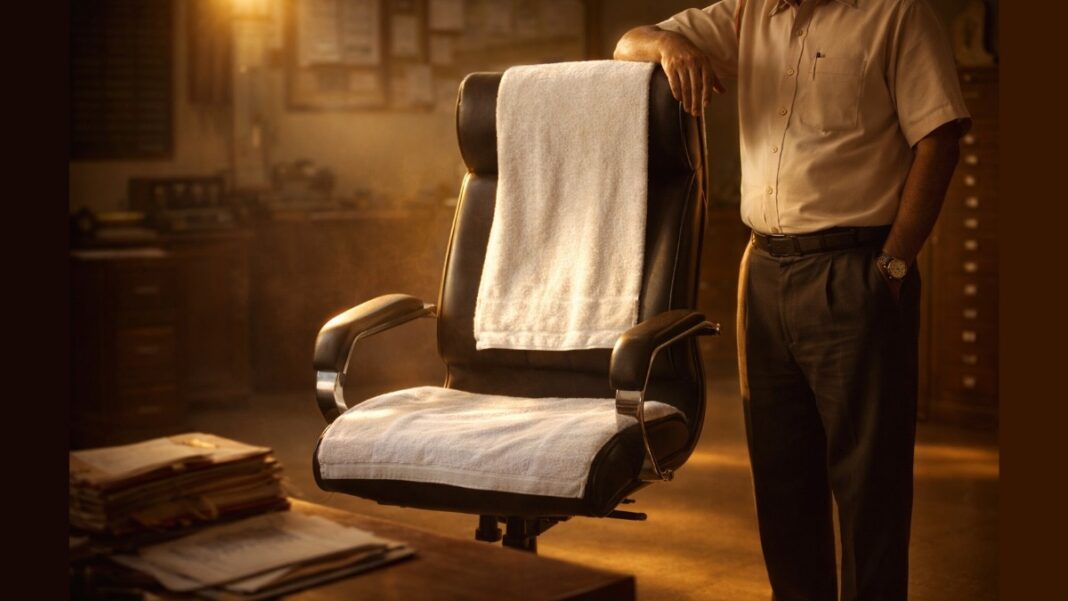
Walk into many government offices in India and you may still find the same familiar scene — steel almirahs, stacked files, a humming fan, and in the centre, the senior officer’s revolving chair dressed in a neat, white towel.
We have been seeing it for so long, that few of us might have wondered why this is even a thing.
There is no single officially documented origin for the practice, but historians, retired officials and common explanations usually trace it to a mix of old climate needs, hygiene habits and colonial-era office hierarchy.
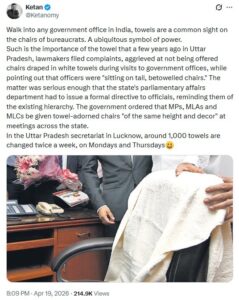
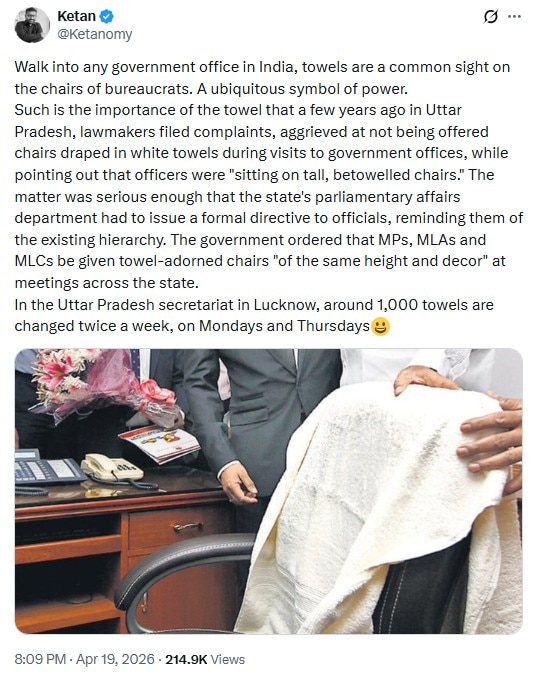
Social media recently rediscovered the phenomenon when X user Ketan (@Ketanomy) wrote that towels on bureaucrats’ chairs are “a ubiquitous symbol of power”. He also recalled reports from Uttar Pradesh where lawmakers complained after not being offered towel-covered chairs while officials sat on “tall, betowelled chairs”.
That sentence alone explains everything. The white towel on a high-backed government chair is not just fabric. It is rank.
HOW THE WHITE TOWEL LIKELY STARTED
Long before air conditioners, climate-controlled offices and ergonomic furniture, India’s summers were brutal. Officers often travelled in heat and dust, sometimes by horse, carriage, train or long road journeys. By the time they reached office, sweat and grime came along too.
A towel on the chair solved several problems at once.
It could wipe the face and neck. It protected upholstery. It absorbed sweat. It was easy to wash and replace. In a country where many people also used hair oil daily, it kept chair backs cleaner.
What began as practical office management slowly picked up a second purpose.
WHEN UTILITY BECAME STATUS
In colonial bureaucracy, rank mattered deeply. Everything signalled hierarchy — from table size to room location, distance from the entrance to quality of furniture, and of course who waited outside whose door.
The white towel slipped into that culture perfectly.
Soon, the senior-most person had the betowelled chair. Visitors got ordinary seating. Junior staff got simpler chairs. If an important guest arrived, another towelled chair might suddenly appear.
That is how objects become symbols.
THE BRITISH LEFT, THE TOWEL STAYED
Former bureaucrat Gurdeep Singh Sappal (@gurdeepsappal) summed it up in an X post memorably: “British left, horses were sent away, but towels stayed!”
He argued that the towel belongs to a larger ecosystem of visible hierarchy, where even table size and ink colour once reflected rank.
That sounds comic, but anyone who has entered an old government office knows there is truth in it.
WHY WHITE?
White suggests cleanliness, order and formality. It shows stains quickly, so it must be changed often. A crisp white towel also makes the chair look distinct, almost ceremonial.
And in government offices, appearance often communicates authority before words do.
WHY IT STILL EXISTS
Modern India has digital files, sleek offices and startup culture. Yet many administrative habits survive because systems copy themselves. New officers inherit old rooms, old furniture and old rituals.
So the towel remains.
Sometimes for hygiene. Sometimes for habit. Sometimes because no one wants to be the first officer whose chair looks less important than the last one.
The white towel on the babu chair may look funny, even harmless. But it reveals something deeper. In many offices, authority is still declared by furniture long before it is proved by performance.