
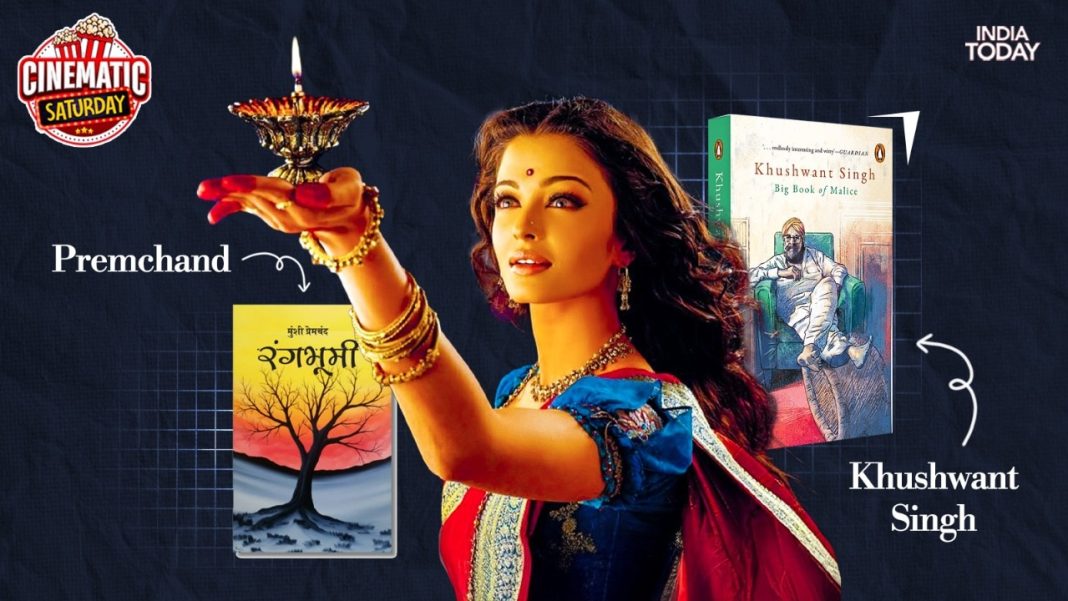
“Kaun kambakht bardaasht karne ko peeta hai?” (What cursed soul drinks to tolerate life?)
When Devdas whispers that line, the glass in his hand is only a prop. What truly engulfs him is longing thick as monsoon air, pride sharp as broken crystal, a love too vast for his own tongue. Long before arc lights burned against his face in Sanjay Leela Bhansali’s 2002 version of the film, Sarat Chandra Chattopadhyay had breathed him onto the page, fragile and furious in equal measure.
Years later, the Shah Rukh Khan-starrer Devdas of 2002 didn’t just show a man falling apart. It made a spectacle of it. It wrapped his loneliness in grandeur and turned a self-destructive lover into something epic, almost larger than life.
And you can’t help wondering, without getting overly sentimental about it: How many more characters like Devdas are still gathering dust on our bookshelves, just waiting for someone to bring them to life?
India is not a country short of stories. We are a country built on them. From village realism to urban alienation, from Partition’s open wounds to feminist rebellion, Indian literature has explored every mood this nation has known. Yet, if you look at the average Hindi film line-up of any decade, adaptations from Indian novels are surprisingly few. Sequels thrive. Remakes flourish. Star vehicles arrive with clockwork precision. The great Indian novel, however, remains where it began – on the bookshelf. After all this, Bollywood rues the dearth of good stories to tell.
The numbers tell a story
In Hollywood and the UK, book adaptations form a substantial portion of mainstream releases. Studios treat novels as tested blueprints. A popular book comes with readers who are already emotionally invested, like Wuthering Heights and The Housemaid. It offers narrative structure, layered characters and built-in conversation. Industry research consistently shows that adaptations tend to perform strongly at the global box office.
In contrast, only a small fraction of Hindi cinema adapts literary works. The industry’s instinct is different. It backs what has already worked on screen, instead of hunting for fresh stories. A South Indian hit becomes a Hindi remake. A franchise expands. A formula repeats itself because it once delivered.
Independent film journalist Jaideep Pandey, said, “I believe Bollywood has increasingly leaned towards spectacle and scale because the economics of the industry reward visibility and box-office security. In that process, layered storytelling rooted in literature has not disappeared, but it has certainly moved away from the centre of mainstream filmmaking.”
“At the same time, films like M.S. Dhoni: The Untold Story, Parmanu: The Story of Pokhran, Pink, Article 15, Raid, Chhaava and Raazi show that audiences continue to respond to layered, issue-driven narratives. I believe the industry today reflects a more balanced space, where purely commercial, formula-driven cinema is no longer as dominant as it once was,” he added.
It is a minor shift in emphasis, but it is capable of changing everything if sustained.
We once read differently
There was a time when literature and cinema in India spoke to each other more naturally. Filmmakers such as Bimal Roy and Guru Dutt looked to writers like Premchand and Sarat Chandra for material that was emotionally and socially grounded. Stories travelled from page to screen.
Later, there were flashes of that spirit. Pinjar confronted Partition through the lens of Amrita Pritam’s writing. Omkara proved that Shakespearean text could be reinterpreted as a tale of the Hindi heartland and feel urgent, even dangerous.
Over the past two decades, the most visible adaptation wave came through the bestsellers of Chetan Bhagat. Films like 3 Idiots and 2 States showed that readers would indeed buy tickets if a book was narrated well on screen. Yet that momentum did not open the floodgates to deeper mining of regional or classical literature. It remained a moment, not a movement.
“Cinema has become fast food”
When we asked Anil Sharma, director of Gadar 2, why Bollywood is not digging deep enough into literary gold, his response was candid and tinged with regret. “It is a very sad situation,” he said. “There should always be films around literature. But nowadays, people have lost interest in reading. They are not reading at all. And these new filmmakers — they usually have no idea about literature. They mostly look at the West, or Korean films, or regional cinema, mainly the South,” he said.
“Cinema has become like fast food. These days, movies seek that 30-second reel clip for it to go viral. During script readings they don’t sit and think about the depth of the film. They get excited about snippets,” Sharma added.
It is a sharp image. Stories trimmed to fit vertical screens. Emotional arcs reduced to moments engineered to be shared.
And yet, Sharma is not entirely pessimistic. “That is the trend, but I am sure it will change soon. Sooner or later, the depth of stories will come back to theatres. Maybe then we’ll see more literature on the big screen,” he said.
The broken bridge
The most striking irony is the fact that regional film industries within India frequently adapt literature with far greater ease. Bengali, Malayalam and Tamil cinema continue to draw from novels and short stories. Bollywood, instead of going back to the original text, sometimes waits for a successful regional film and then remakes it.
The bridge between publishing houses and production houses in Mumbai remains fragile. There are a few literary scouts in the Hindi film industry, and almost no structured partnerships between the two creative worlds. Few systematic efforts are made to track what is being written in regional languages.
And yet, the shelves are heavy. Dalit autobiographies like Joothan by Omprakash Valmiki that demand reckoning. Tamil historical epics like Ponniyin Selvan by Kalki Krishnamurthy that could rival any global saga. Urdu short stories like Khol Do by Saadat Hasan Manto that dissect hypocrisy with brutal clarity. There are contemporary thrillers like Serious Men by Manu Joseph, too, which understand the Indian city in ways cinema has barely touched.
Devdas did not become immortal because he was safe. He endured because he was flawed, obsessive and painfully human. Literature gives us such characters in abundance. Cinema has the power to bring them alive for the millions.
The question is not whether the gold exists or not. It does. The question is whether Bollywood is willing to bend down, dig, and read.


