
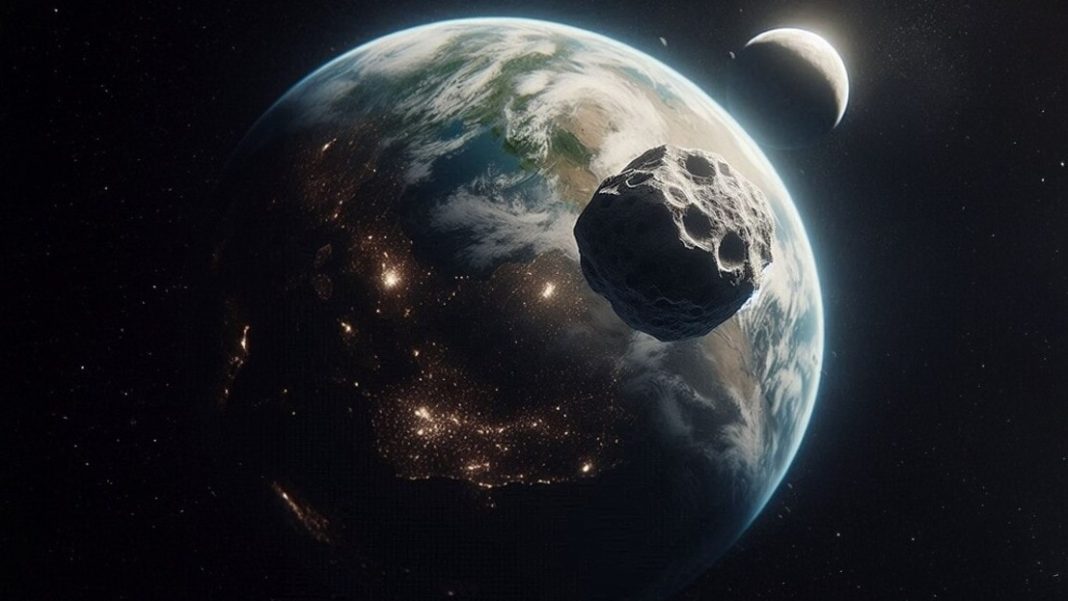
An asteroid could hit Moon: James Webb Telescope begins to keep a close eye

An asteroid is speeding toward Earth, and although scientists say it will pass at a safe distance, calculations suggest a very small possibility of it striking the Moon.

To stay prepared, Nasa’s James Webb Space Telescope is closely monitoring the object.

Dubbed 2024 YR4, the observations will help scientists refine its path, improve prediction models, and better understand the asteroid’s trajectory as it moves through space.

WHAT IS THE ASTEROID THAT IS HEADING TOWARDS THE MOON?

In late December 2024, astronomers in Chile spotted 2024 YR4.

At first, it sparked mild concern because its path suggested a tiny chance of hitting Earth on December 22, 2032. But after months of careful tracking with telescopes worldwide, scientists confirmed it poses no danger to our planet at all.

The latest calculations, however, provided an unexpected possibility.

This 53 to 67 metre asteroid has a slim, 4.1 per cent, chance of striking the Moon on the same date in 2032.

That’s roughly one in 24 odds, low enough that no one is losing sleep, but high enough to excite scientists.

A rendering of James Webb Space Telescope in space near Earth. (Photo: Reuters)

A rendering of James Webb Space Telescope in space near Earth. (Photo: Reuters)

WHAT WILL JAMES WEBB TELESCOPE DO?

To sharpen predictions, Nasa’s James Webb Space Telescope (JWST), the most powerful infrared observatory ever built, is stepping in.

On February 17 and again on February 26, 2026, JWST will point its golden mirrors and sensitive instruments at the faint, distant asteroid.

These observations, including detailed spectroscopy, will measure its exact position and path.

Spectroscopy is the scientific study of how matter interacts with, absorbs, or emits electromagnetic radiation. It is used to learn more about a material’s composition and structure.

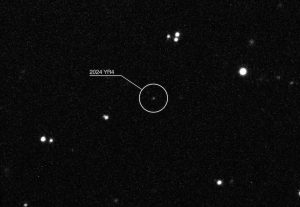
An image of the asteroid 2024 YR4 taken by the European Southern Observatory's Very Large Telescope. (Photo: Reuters)

An image of 2024 YR4 captured by the European Southern Observatory’s Very Large Telescope. (Photo: Reuters)

Through this process, JWST will provide insights far more precisely than ground telescopes can manage now, as the rock is too far away for most Earth-based instruments.

Every observation made by the JWST will help improve our ability to track thousands of near-Earth objects and, if needed one day, nudge aside a truly dangerous one.

After these JWST snapshots, experts will update the odds, and we’ll know a little more about our neighbourhood in space.

WHAT WILL HAPPEN IF THE ASTEROID HITS MOON?

A lunar impact would be a rare natural experiment.

The crash could carve a crater up to two kilometres wide, send up a bright flash visible from Earth, and spray rocky debris into space.

Some fragments might even reach our atmosphere as a short-lived meteor shower.

Satellites will be tracking the development, and spacecraft on the surface could get significant seismic readings, while the composition of the debris material could reveal the asteroid’s properties.

Think of it as a free sample from deep space delivered right to our cosmic backyard.

Whether the asteroid misses or makes a spectacular lunar splash in 2032, humanity is watching with the help of one of its best creations.
Latest

North to sizzle in heatwave, northeast to experience thunderous Wednesday

Temperatures across northwest and central India are expected to climb by another 3–5C before finally dipping towards the end of the month. But before that, he

Plants not just feel, they can hear the rain too, confirms new research

MIT scientists have discovered that rice seeds can sense the sound of rain and germinate up to 40 per cent faster as a result. The study reveals how sound waves

2026 could see a super El Nino and record-breaking global temperatures

La Niño is one of the phases of the El Niño–Southern Oscillation (ENSO) – a natural climate phenomenon. It usually occurs in the Pacific Ocean, influencin

Astronaut on Space Station captures rare comet flying over Earth. See pic

Nasa astronaut Chris Williams was photographing the Lyrid meteor shower from the Cupola aboard the International Space Station when he accidentally spotted a be

Dead zone in Akashganga: The region where Milky Way galaxy stops making new suns

Scientists have identified the precise edge of the Milky Way's star-forming disc by studying the ages of over 1,00,000 stars. The boundary sits roughly 35,000 t

Topics

UN experts raise alarm over forced conversions and marriages of minority girls in Pakistan

Experts mentioned that in 2025, around 75 per cent of the women and girls affected by forced conversion through marriage in Pakistan were Hindus, while 25 per c

India to host IAFS-IV on May 31; Jaishankar highlights stronger Africa ties

External Affairs Minister (EAM) S Jaishankar said that the development partnership and capacity-building initiatives between India and Africa are driven by Afr

Why the Iran conflict is taking a more dangerous turn

Stalled talks, ship seizures and nuclear disputes sharpen the Trump-Iran standoff

‘US spat on India’s face’: Former US Ambassador slams Trump administration for undermining ties with New Delhi

Speaking about the changing geo-political situation and dynamics of India-US ties, former US Ambassador Rahm Emanuel said that he would not have done what Trump

‘Jhal muri maine khaayi, jhal TMC ko lagi’: PM Modi’s dig at TMC in Nadia

PM Modi’s remark came after the Trinamool Congress (TMC) criticised his “jhal muri break” a day earlier. The Prime Minister had taken the break on April 1

Bengal assembly polls: Murshidabad tense after clash between supporters of TMC, Humayun Kabir

West Bengal assembly elections 2026: AUJP founder Humayun Kabir visited Nowda on Thursday morning in the aftermath of the bombing and promptly organised a sit-i

UP Board 12th Result 2026 today: Check last 5 years pass percentage trends

UP Board Class 12 results show steady improvement in student performance

JEE Advanced 2026 registration begins. Check direct link, eligibility and last date

The Indian Institute of Technology Roorkee has announced the registration schedule for JEE Advanced 2026. Eligible candidates can apply online from April 23 to
spot_img

Related Articles

Popular Categories

spot_imgspot_img

