
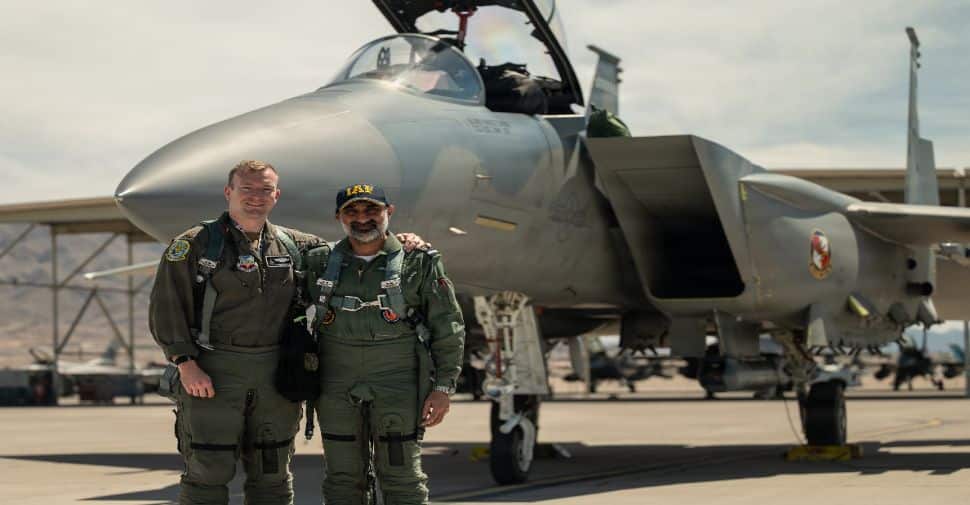
New Delhi: When India Air Force (IAF) Air Chief Marshal Amar Preet Singh climbed into the cockpit of a Boeing F-15EX Eagle II at Nevada’s Nellis Air Force Base for a familiarisation sortie, it led to speculation about whether India was exploring an American alternative to the Dassault Rafale.
The timing added to the curiosity. India is negotiating a major Rafale deal estimated between $35-40 billion. However, progress has hit a hurdle over source code access. France has refused to share Rafale’s software code, while India is seeking greater access to the technology under the Make in India initiative to reduce long-term dependence on foreign suppliers and strengthen domestic manufacturing.
Against this backdrop, the IAF chief’s flight in the F-15EX has raised questions about whether India is reconsidering its fighter jet options.
Routine visit, strategic message?
Visits between Indian and US Air Force officials are not unusual. These interactions usually involve interoperability, joint training, modernisation plans and Indo-Pacific security cooperation. But the sortie came under notice because of the ongoing negotiations involving fighter aircraft.
Writing in Eurasian Times, former IAF pilot Vijayendra K Thakur said that the visit may have been intended to show that the Air Force is not opposed to American aircraft.
He pointed out that during India’s earlier MMRCA procurement process, the United States had offered the F-16 and F-18 fighter jets. However, the IAF eventually selected the Rafale. The deal later stalled over technology transfer disagreements, and India instead signed a separate agreement in 2018 to acquire 36 Rafale jets.
How F-15EX entered into negotiations
After scrapping the MMRCA programme, India launched the Multi-Role Fighter Aircraft (MRFA) programme. The F-15EX joined the competition relatively late.
New Delhi first showed interest in October 2020, around the time the US Air Force awarded Boeing a contract worth roughly $1.2 billion to build the first eight F-15EX aircraft. These jets were meant to strengthen US Air Force capabilities.
At the time, a senior government official told Hindustan Times, “This possibility cannot be ruled out that F-15EX could be sold on a government-to-government basis.”
However, Boeing had not so far received permission to export the aircraft. On January 28, 2021, the US government granted Boeing a marketing license, allowing the company to offer the F-15EX Eagle II to India under the MRFA programme.
Why India did not move forward
According to Thakur, it is unclear whether Boeing’s proposal matched the requirements outlined in the Indian defence ministry’s April 6, 2018 Request for Information, especially on technology transfer.
He also said that Boeing never formally presented the aircraft for evaluation by the IAF. This raised questions about how serious the proposal actually was.
Rafale still India’s first choice
Despite the recent developments, the likelihood of India replacing Rafale with the F-15EX appears very low. The IAF has identified Rafale as its preferred platform.
Thakur believes the latest American pitch may be aimed at taking advantage of the Rafale source-code disagreement. However, he considers it unlikely that the IAF would move forward with such an offer.
Why F-15EX may not fit India’s future needs
Stealth fighters are India’s long-term requirement. The United States has not offered the F‑35 Lightning II, which many consider the next-generation option. Instead, the F-15EX is being offered.
Thakur described it as comparable in role to India’s existing Su‑30MKI. Buying the F-15EX would also require India to invest billions of dollars in missiles, logistics and a new operational ecosystem.
He also referred to reports that an American F-15-type aircraft was shot down during the Iran war. This has raised further questions about its operational effectiveness.
India’s priority: Upgrading existing fleet
Rather than acquiring another heavy fighter, India appears to be upgrading its present fleet. The IAF is working on integrating advanced BrahMos missile systems with the Su-30MKI.
The country is also developing hypersonic ballistic missile capabilities. The Air Force aims to deploy these weapons on its aircraft, strengthening strike capability and making interception extremely difficult.
What IAF chief’s flight really means
Singh’s familiarisation flight may have sparked debate, but it does not point to any change in India’s fighter jet plans. The Rafale is the choice, while India continues to prioritise technology access, indigenous capability and long-term strategic independence.
The sortie appears to be part of ongoing military engagement rather than a change in procurement direction. However, in defence deals, even a short flight can trigger long discussions.


