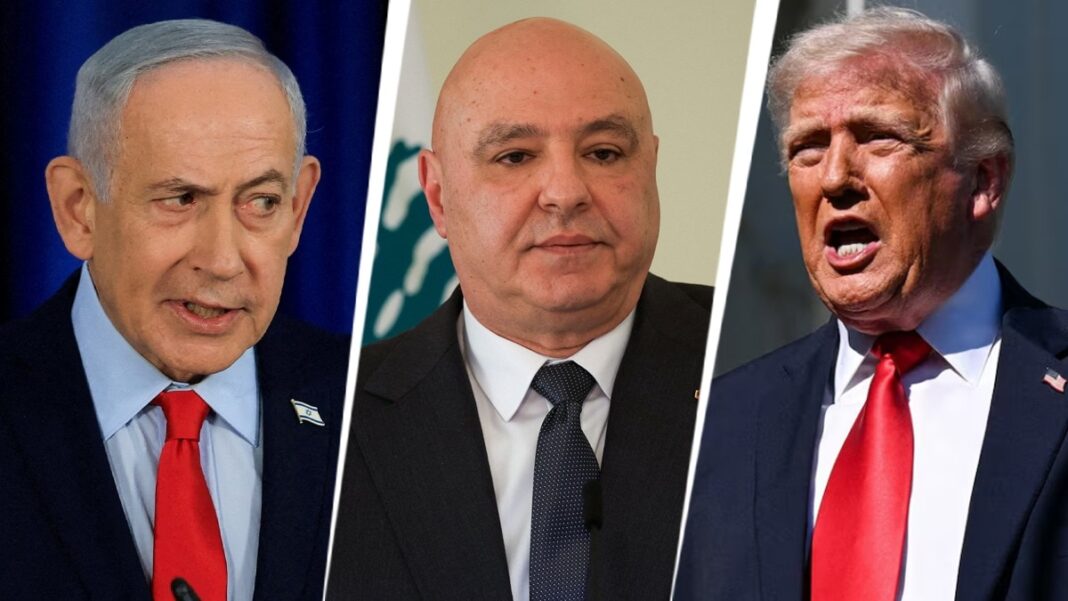
US President Donald Trump on Thursday announced that Israel and Lebanon have agreed to a 10-day ceasefire, marking a rare diplomatic breakthrough after weeks of escalating tensions along the border. The announcement followed what Trump described as “excellent conversations” with Lebanese President Joseph Aoun and Israeli Prime Minister Benjamin Netanyahu.
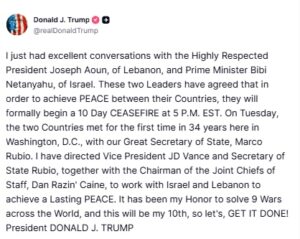
In a post on Truth Social, the US President said the ceasefire will begin at 5 PM EST (3:30 AM IST), framing it as a first step towards a peace process between the two sides. “It has been my Honor to solve 9 Wars across the World, and this will be my 10th, so let’s, GET IT DONE!”
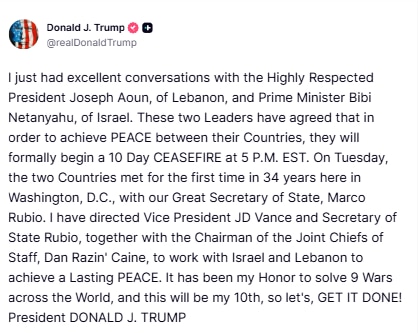
He revealed that representatives from Israel and Lebanon met earlier this week in Washington, their first such meeting in 34 years. The talks were held alongside US Secretary of State Marco Rubio.
“I just had excellent conversations with the Highly Respected President Joseph Aoun and Prime Minister Bibi Netanyahu,” Trump said, describing the discussions as a step toward achieving peace between their countries. The US President added that he has tasked Vice President JD Vance, Secretary Rubio, and Chairman of the Joint Chiefs of Staff Dan Caine with working alongside both nations to secure a more lasting settlement.
TRUMP INVITES ISRAEL, LEBANON FOR DIRECT TALKS
In a separate post, Trump said he plans to invite Netanyahu and Aoun to the White House for the first meaningful talks between Israel and Lebanon since 1983. “I will be inviting the Prime Minister of Israel, Bibi Netanyahu, and the President of Lebanon, Joseph Aoun, to the White House for the first meaningful talks between Israel and Lebanon since 1983,” he said, adding, “Both sides want to see PEACE, and I believe that will happen, quickly!”
The announcement came minutes after Lebanese President Joseph Aoun said he had spoken with US President Donald Trump, highlighting ongoing diplomatic efforts behind the scenes. In a post on X, he thanked Trump for his efforts to secure a ceasefire in Lebanon and push for lasting peace and stability in the region.
ISRAEL AGREES TO CEASEFIRE, BUT SETS CONDITION
Israeli Prime Minister Benjamin Netanyahu said he has agreed to a temporary 10-day ceasefire with Lebanon to give diplomacy a chance and move forward with the US President’s push for peace. In a video message, Netanyahu said any lasting agreement would have to include the dismantling of the Iran-backed Hezbollah group. He also made it clear that Israeli troops will remain in southern Lebanon despite the pause in fighting.
He further said that Trump had assured him of Washington’s continued hardline stance on Iran, including maintaining the blockade of the Strait of Hormuz and working towards dismantling Iran’s nuclear capabilities.
HEZBOLLAH SETS RED LINE
Hezbollah said that the presence of Israeli troops on Lebanese soil would give Lebanon and its people the right to resist, while stressing that any ceasefire must not allow Israel freedom of movement inside the country. In its first response to the proposed truce, the group signalled that its acceptance would depend on conditions on the ground. In a separate statement, Lebanese Parliament Speaker Nabih Berri urged civilians to delay returning to their towns and villages until the situation becomes clearer, calling for caution in line with the ceasefire terms.
Meanwhile, the US State Department said Israel and Lebanon will begin a 10-day ceasefire to allow space for negotiations towards a permanent peace arrangement. It added that the truce could be extended if both sides agree and progress is made.
Under the proposed framework, Lebanon’s government is expected to take steps to prevent Hezbollah and other non-state armed groups from carrying out attacks against Israel. The statement also emphasised that Lebanon’s security forces alone would be responsible for safeguarding the country’s sovereignty and national defence.
The ceasefire, if implemented as announced, would mark a pause in tensions between Israel and Lebanon, whose relations have remained hostile for decades. The latest round of major fighting erupted on March 2, when Iran-backed Hezbollah launched rockets, missiles, and drones toward a missile defense site near Haifa in northern Israel following joint US-Israeli attacks on Tehran. In response, Israel immediately launched attacks on Beirut suburbs and other targets, along with evacuation orders for dozens of villages in southern Lebanon and the Beqaa Valley.
The 10-day window is likely to act as a testing period, giving both sides space to gauge intent and explore the possibility of further talks. Much will depend on whether both sides avoid violations and keep communication channels open during this time.
With inputs from agencies