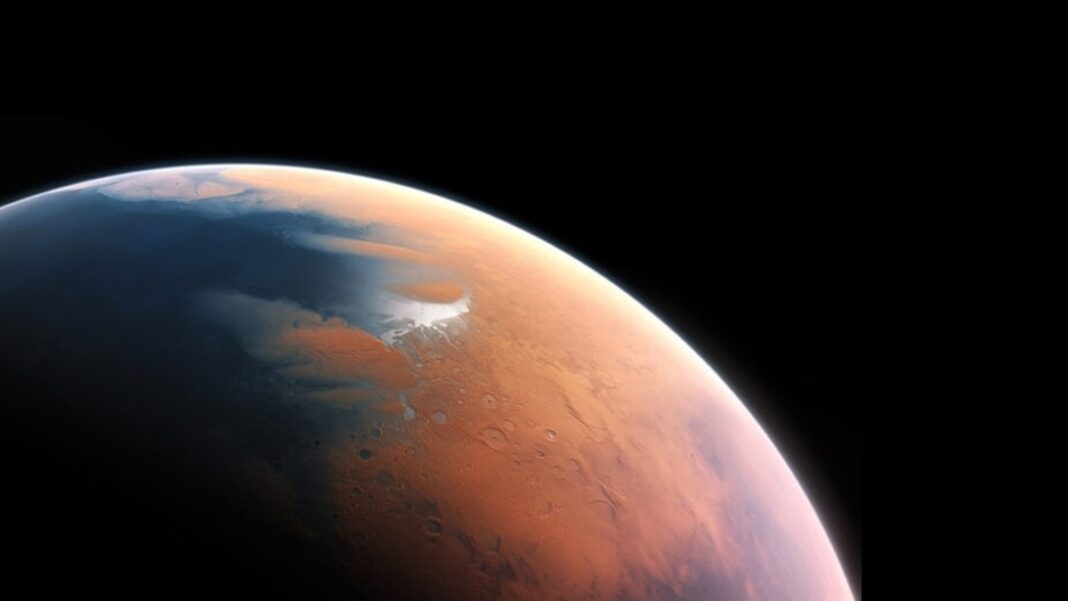
A newly identified geological feature on Mars may provide the strongest evidence yet that the Red Planet once hosted a vast, long-lived ocean.
Researchers from California Institute of Technology (Caltech) have discovered what they describe as a bathtub ring, a broad, flat band of terrain, that could mark the boundary of an ancient ocean covering nearly one-third of Mars’ surface.
The study, led by former Caltech postdoctoral scholar Abdallah Zaki and geology professor Michael Lamb, was published in the journal Nature. It adds a significant new piece to the ongoing debate about how much water once existed on Mars.
ANCIENT OCEAN ON MARS
Scientists have long known that Mars once had liquid water, but whether it formed only lakes and rivers or vast oceans has remained uncertain. Previous missions have spotted features resembling shorelines, but these were inconsistent in elevation, unlike Earth, where sea levels are relatively uniform.
This inconsistency has made it difficult to confirm the existence of a stable Martian ocean.
To tackle this, Zaki and Lamb turned to Earth for clues. Using computer simulations, they “removed” Earth’s oceans to identify lasting geological signatures. Their models revealed that the most persistent feature is the continental shelf, a wide, flat zone that encircles continents like a ring left behind after draining a bathtub.
Applying this insight to Mars, the team analysed topographic data collected by orbiting spacecraft. They discovered a similar band of terrain in the planet’s northern hemisphere.
This feature aligns with what would be expected from a long-standing ocean and spans a region large enough to have once held massive volumes of water.
Crucially, the researchers also found that ancient river deltas — sediment deposits formed where rivers meet larger bodies of water, appear to line up with this “bathtub ring.” This strengthens the argument that the feature marks a true ocean boundary rather than isolated water bodies.
According to the study, such a landform would take millions of years to develop, suggesting the ocean was stable and long-lived before disappearing billions of years ago. Over time, Mars’ surface has been heavily altered by wind, volcanic activity, and other processes, erasing many ancient features.
The findings not only reshape our understanding of Mars’ past but also point to promising targets for future exploration. Coastal sediments, like those on Earth, could potentially preserve signs of ancient life.
While more research is needed, including rover-based investigations, the discovery offers compelling new evidence that Mars may once have been far wetter, and possibly more habitable, than it is today.