
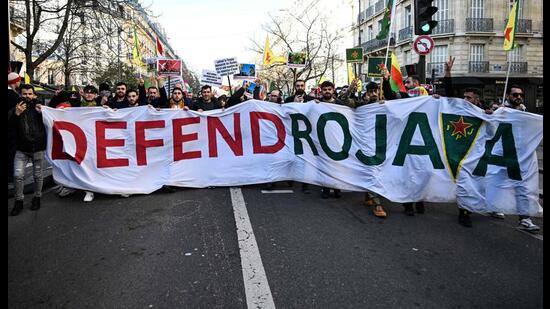
Rojava, the autonomous Kurdish-majority region in North and East Syria, faces its greatest existential crisis since its founding. Since early January, the Syrian army, in its attempt to bring Syria under centralised rule, has made rapid territorial gains into areas previously controlled by the Kurds. This has ramifications beyond the region: A globally relevant experiment in a democratic, feminist, and just society with worldwide lessons is under threat.
There is a temporary ceasefire and some progress in dialogue. But, the threat of renewed war lingers, and a collapse of the ceasefire could spell disaster for over 500,000 people trapped in Kobani since January with little aid, as Syrian government forces have already massacred minorities elsewhere in the country. As Kurdish fighters withdrew under the Syrian army’s onslaught, many extremist Islamic State (IS) prisoners escaped from the al-Shaddadi prison, not all of whom were recaptured. It may be recalled that the Kurds were instrumental in defeating ISIS.
Facing the Syrian army’s aggression, Rojava’s Kurdish-led administration called for general mobilisation. Taking up arms, universities in Rojava called for international solidarity: “We, the faculty, students, and staff of the Universities in Rojava/Northern and Eastern Syria, send you this message as we leave our classrooms to help defend our universities, our cities, and our revolution alongside the self-defence forces.”
People elsewhere despair in a world riven by injustice and violence — countries wilfully commit genocide, the colonial playbook has been dusted off, democracy is on the run, women and minority rights are in retreat, international bodies are dismantled, and already excruciating levels of inequality continue to rise. The climate crisis worsens, exacerbating other tragedies.
The situation in Rojava is also a threat to attempts to bring social, economic and ecological peace to the world. In the past fifteen years, Rojava has built a revolutionary society centred on women’s emancipation. Every institution in Rojava relies on power-sharing between men and women; the revolution has imbued women in Rojava with immense intellectual and personal confidence.
It has demonstrated the powerful possibility of direct democracy in which every settlement has a high degree of autonomy, and the practice of “democratic confederalism” enables coordination for actions needed over larger landscapes. Through frequent rotation, community-embedded education, and forums of accountability, representatives and delegates appointed by each local settlement to larger bodies of governance cannot concentrate power. Learning from their own historical experience of repression, the Kurds have sought to operationalise “never again” by trying to build protection for the cultures and rights of minority ethnicities such as the Assyrians and Arabs, though this faces enormous difficulty in actual practice due to historical animosities and discriminations.
Rojava has been built for growth in terms of genuine societal progression. The instrument of tekmil is designed to enable collective reflection through regular, mandatory community-wide meetings to resolve differences through reasoned dialogue. Constant processes of education and re-education in basic values and principles help build a solid foundation.
Living within the earth’s limits is being integrated into agriculture, forestry, water use and other practices. Community living is institutionalised for social and ecological reasons, binding survival to solidarity. In other parts of the Kurdish territory in neighbouring Turkey, Iran, and Iraq, there have been similar attempts, with varying degrees of success and failure.
Academic and policy frameworks such as “eco-socialism”, “just transitions” and “radical ecological democracy” outline pathways toward a more just and sustainable world. Yet, implementing such ideas at scale remains a challenge, especially amid resistance from entrenched political and economic elites.
Rojava not only embodies many of these ideas but pushes beyond them to construct a radically alternative society. Its experience contains universal lessons for humanity; it must sustain not just for its people, but to keep alive hope for a better world.
The ceasefire must endure. Countries must exert diplomatic pressure on Damascus and Ankara to cease their assault on Rojava. What is happening in Rojava is not distant or abstract, nor is it inevitable. It is a test of whether the world will defend a fragile, imperfect, but real attempt at a more just society before it is erased.
Chirag Dhara is a climate and sustainability scientist at Krea University, and Ashish Kothari is an environmental activist based in Pune. The views expressed are personal


