
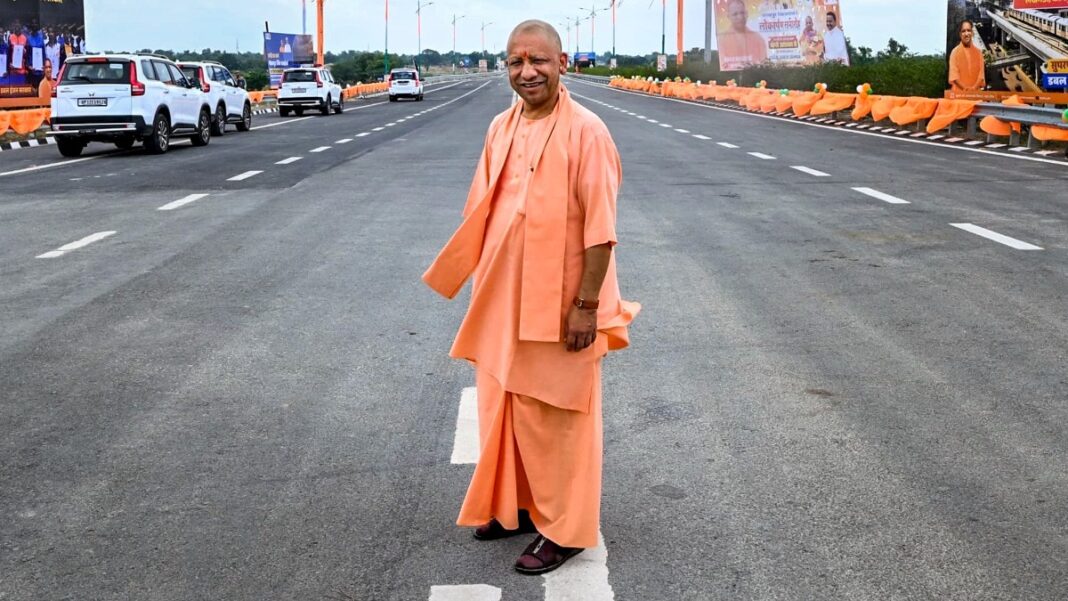
There was a time when Uttar Pradesh’s politics revolved around caste and religion. Over the past decade, however, the focus has shifted decisively to speed and roads. Today, the state can reasonably be described as an “expressway state.” Two leaders dominate this narrative: Akhilesh Yadav, who set a new benchmark with the Agra-Lucknow Expressway, and Yogi Adityanath, who expanded that model into a statewide network, pushing the benchmark much further. The inauguration of the Ganga Expressway is poised to mark another turning point.
Back in the 2012 Uttar Pradesh elections, the question of “expressway credit” was a key flashpoint between the two leaders. While Akhilesh highlighted projects like the Purvanchal Expressway as a Samajwadi initiative, Yogi later asserted his government’s role in executing such infrastructure. By the time the 2027 elections arrive, however, the landscape of expressways – and the politics around them – will have changed significantly.
The Ganga Expressway redraws Uttar Pradesh’s infrastructure map, posing a direct challenge to Akhilesh Yadav’s development claims. Its inauguration is expected to significantly boost Yogi Adityanath’s political momentum.
GNGA EXPRESSWAY: THE PROJECT THAT SHIFTS THE GAME
Stretching roughly 594 kilometres, the Ganga Expressway is more than just a concrete corridor—it is a flagship project that directly links western Uttar Pradesh to the eastern region. Running from Meerut to Prayagraj, it ranks among the longest expressways in the country.
Its defining feature lies in both scale and reach. While earlier expressways were largely concentrated around Lucknow and Agra, this project brings districts like Hapur, Bulandshahr, Amroha, Sambhal, Badaun, Shahjahanpur, Hardoi, Unnao, Rae Bareli and Pratapgarh into the development mainstream—areas long seen as neglected.
YOGI VS AKHILESH: THE WAR OF WORDS
The tussle over credit for expressways has been a recurring theme in UP politics. Akhilesh Yadav has often remarked at rallies, “It was on the expressways we built that the Chief Minister’s aircraft landed,” accusing the BJP of merely inaugurating projects initiated by his government.
Yogi Adityanath’s counter has been sharper. He has argued that earlier governments treated expressways as tools for “making money” and limited them to select districts, whereas his administration turned them into corruption-free “engines of growth” for the entire state.
The rhetoric intensified further when the Samajwadi Purvanchal Expressway was renamed simply as the Purvanchal Expressway. Yet, with the Ganga Expressway nearing completion in record time, the political consensus has shifted—suggesting that Akhilesh now has limited space left to claim dominance in expressway politics.
MAPPING CREDIT: WHO BUILT WHAT
- Understanding UP’s expressway network requires a closer look at contributions:
- Yamuna Expressway (165 km): Credited to Mayawati, who envisioned and executed the project connecting Noida to Agra.
- Agra-Lucknow Expressway (302 km): Akhilesh Yadav’s flagship project, completed in a record 22 months.
- Purvanchal Expressway (341 km): Built under Yogi Adityanath, connecting eastern UP to Lucknow.
- Bundelkhand Expressway (296 km): A Yogi government project linking backward Bundelkhand to Delhi.
- Ganga Expressway (594 km): Yogi’s largest project yet, surpassing all others in scale.
WHAT THE GANGA EXPRESSWAY CHANGES
The expressway is projected to be a major economic catalyst:
- Logistics and trade: Travel time between Meerut and Prayagraj will drop from 12–14 hours to about 6–7 hours, reducing transport costs.
- Industrial growth: Planned industrial corridors along the route are expected to generate jobs and curb migration.
- Agricultural gains: Farmers in districts like Shahjahanpur, Badaun and Hardoi will gain faster access to major markets.
- Emergency infrastructure: An airstrip near Shahjahanpur enables fighter jet landings during emergencies, adding a strategic dimension.
PROBLEMS ADDRESSED, AND CHALLENGES AHEAD
Expressways have transformed travel in UP, reducing congestion in city centres, improving vehicle efficiency and saving time. Connectivity has improved to the extent that distances once considered long are now routine—making same-day intercity travel feasible.
However, challenges remain. Stray cattle and high-speed accidents pose safety concerns, while the availability of quality way-side amenities needs expansion. Industrialisation along these corridors must accelerate to unlock their full economic potential, and last-mile connectivity through link roads must be strengthened to ensure rural access.
The Ganga Expressway has significantly strengthened Yogi Adityanath’s political position. While Akhilesh Yadav laid the foundation of expressway-led development, Yogi has expanded it into a statewide campaign. The debate is no longer just about credit; it is now about leveraging this infrastructure to push Uttar Pradesh toward its ambition of becoming a trillion-dollar economy.


