
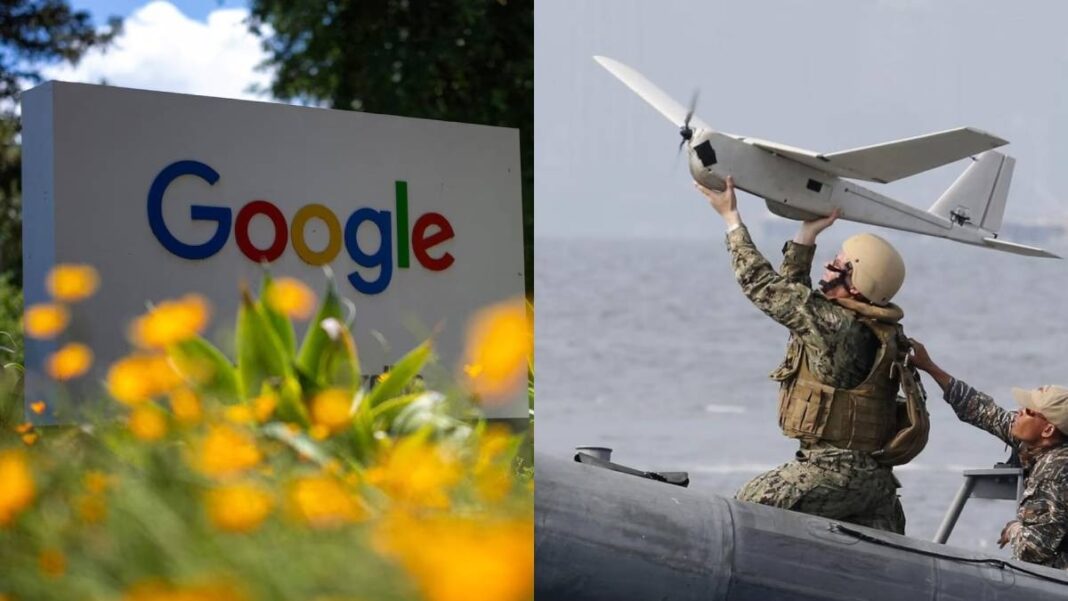
Recent wars, including the ongoing tensions between the United States and Iran, have highlighted the growing importance of drone swarms in modern warfare. In response, the U.S. Department of Defense announced a $100 million challenge to develop more advanced drones that can operate autonomously and even be controlled by voice. However, a recent report says that Google, which had initially shown interest in building the technology to control these drone swarms, has now withdrawn from the challenge.
A Bloomberg report said that the company decided to withdraw from the challenge following an internal ethics review. However, in records, Google cited a lack of “resourcing” behind the move.
The decision has divided Google workers into two groups. Some employees involved in the project expressed disappointment at the decision to withdraw from the contest, while hundreds of Google’s AI researchers raised broader objections to the company’s cutting-edge technology being used for classified military work.
What the Pentagon initiative involves
The Pentagon’s plan aims to let commanders control drone swarms using simple voice commands like “left,” which are then turned into digital instructions.
OpenAI, Palantir, and xAI are among the companies selected for the contest, which will run in stages over six months. Later stages will also focus on improving target tracking, information sharing, and the full process from launch to mission completion.
Anthropic, which was recently embroiled in a conflict with the Pentagon over the use of its AI tools for fully autonomous weapons systems, also participated in this contest but was not selected. The company, while participating, reasoned that it didn’t contravene its red lines.
Past protests and shifting policies
However, this is not the first time Google has faced internal opposition to a Pentagon project. Earlier in 2018, Google employees protested the company’s involvement in Project Maven, a Pentagon program that used AI to analyze drone footage and support military operations. The unrest eventually prompted the company to pledge not to make weapons and other potentially harmful technologies.
Since the Project Maven controversy, Google’s stance on working with the Pentagon has gradually changed. According to a report by The Information, Google and the Pentagon signed a new AI deal for “any lawful government purpose,” with no veto from Google over government decisions, including classified work.
Google’s position on AI and defense
A Google spokesperson told Bloomberg that the company updated its contract with the Pentagon and is only giving access to its AI models, not building custom ones for the military. The spokesperson said this is a “responsible approach” to supporting national security.
They also added that Google believes AI should not be used for mass surveillance or autonomous weapons without proper human oversight.
The deal was signed despite hundreds of Google AI researchers urging Sundar Pichai, CEO of Alphabet Inc., to avoid using the company’s AI systems for classified US defense missions, according to Bloomberg.


