
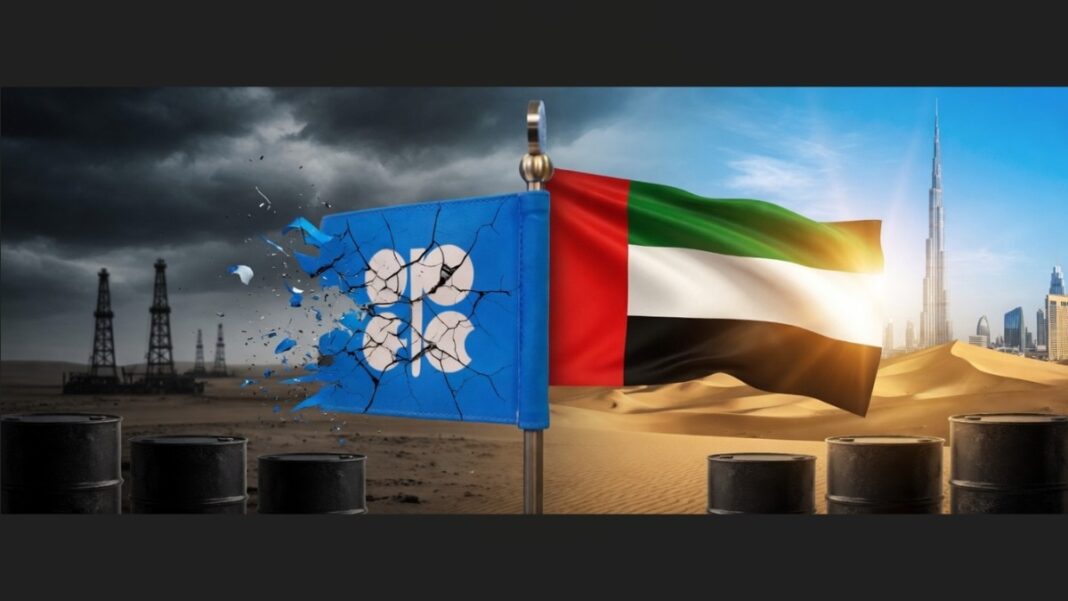
The UAE did not send a memo. It did not call a meeting. It simply left. On 1 May 2026, one of OPEC’s most powerful members walked out of the world’s most influential oil cartel, blindsiding fellow members and, most strikingly, Saudi Arabia, the group’s de facto leader and closest regional ally. It was the geopolitical equivalent of walking out of a group project and not responding to any messages. The immediate question is obvious: why? And the follow-up, for 1.4 billion Indians watching petrol prices climb, is even more urgent: does this finally mean relief?
A cartel built on eating less
OPEC functions on a simple but ruthless logic. Member countries agree to limit how much oil they produce, which keeps global supply tight and prices elevated. It is a coordination game, and it works only as long as everyone plays along.
The UAE played along for decades. But quietly, it was also building one of the most formidable oil operations on the planet. Abu Dhabi National Oil Company expanded capacity to nearly 4.85 million barrels per day, with plans to reach 5 million barrels per day by 2027, backed by a 150 billion dollar investment programme through 2030. OPEC’s quota for the UAE in May 2026 sat at roughly 3.4 million barrels per day.
That gap, between what the UAE could produce and what OPEC allowed it to produce, became impossible to justify.
Energy Minister Suhail Al Mazrouei confirmed the decision was taken independently and was not discussed with any other OPEC member. Not even Saudi Arabia. The UAE, he said, needed flexibility over its own production decisions. Translation: the group’s rules were costing the country billions.
The worst possible moment to leave
The timing sharpened everything. The Strait of Hormuz, through which nearly one fifth of the world’s oil and liquefied natural gas supply passes, faced disruptions since late February 2026. Global oil markets were already rattled. Brent crude traded above 110 dollars per barrel. The cartel needed unity. Instead, it got a resignation.
The UAE’s exit does not just weaken OPEC numerically. It removes one of the group’s most credible enforcers of production discipline. If a country this significant no longer considers OPEC’s rules worth following, others with growing capacity and similar frustrations may begin asking the same question.
What this means for India
India is not a bystander in this story. The UAE has consistently ranked among India’s top five crude oil suppliers, accounting for approximately 10.6 per cent of India’s oil imports in the first eleven months of the 2025 to 2026 financial year. Geographically, the UAE is one of India’s closest suppliers, which means lower freight costs, shorter delivery times and more reliable logistics compared to Atlantic Basin alternatives.
Free from OPEC quotas, ADNOC could raise production well beyond 4.5 million barrels per day. For India, that translates into greater spot crude availability and potentially more competitive pricing terms. As sanctions continue to complicate Russian crude imports, India needs stable, politically reliable alternatives. The UAE fits that requirement precisely.
India’s petrochemical ambitions also stand to benefit. The country is investing aggressively in integrated refining and petrochemical complexes, and stable feedstock supply from the UAE would directly support that expansion.
Is fuel shock over?
Not yet. In the short term, Brent above 110 dollars reflects geopolitical disruption, not cartel policy. That pressure does not ease overnight.
But the structural shift matters. If UAE output rises gradually over the next 12 to 18 months, and if other producers follow its lead, more oil enters a market that has been deliberately kept tight for years. More supply means downward pressure on prices.
The cartel’s grip was already loosening. OPEC’s share of global production had been declining for years even before this. The UAE’s exit did not cause that decline. It simply confirmed it, loudly and without apology.
The oil cartel era is not over. But for the first time in a long while, its end looks like a real possibility rather than a distant theory.


