
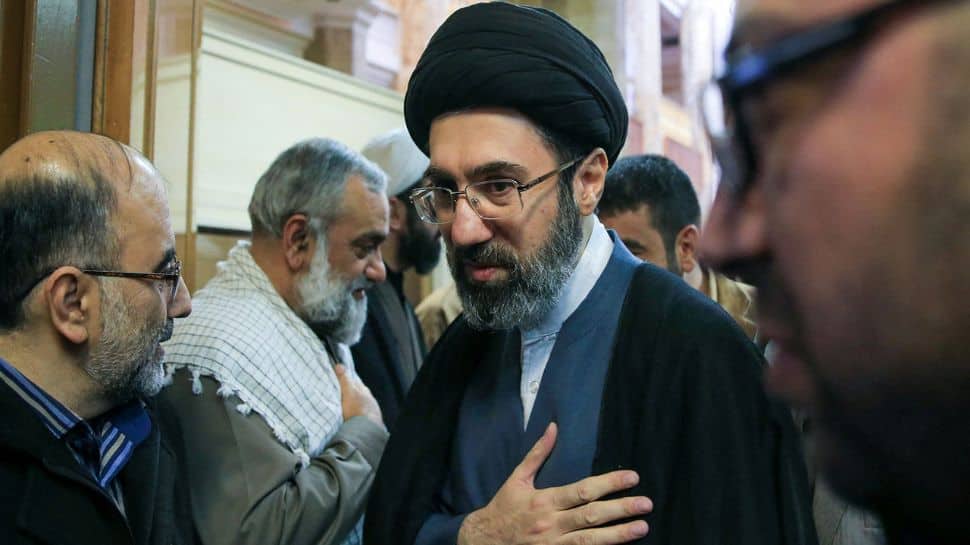
Iran’s Supreme Leader Mojtaba Khamenei on Thursday asserted that Tehran would safeguard security in the strategically important Strait of Hormuz and respond to what he described as hostile actions in the region, amid rising geopolitical tensions following the country’s recent confrontation with the United States and their ongoing struggle for influence over the key maritime route.
Mojtaba Khamenei has released a fresh written statement, that was publicly broadcasted on Iranian states television on Thursday. In a big announcement, Mojtaba said that Tehran will protect its “nuclear and missile capabilities”, as a national asset, despite US President Donald Trump’s pledge to continue the naval blockade in the Strait of Hormuz until a nuclear deal is finalised with Tehran.
As per NDTV, Mojtaba Khamenei sharply criticised Americans, saying the only place they belong to in the Persian Gulf is “at the bottom of its waters”.
“By God’s help and power, the bright future of the Persian Gulf region will be a future without America, one serving the progress, comfort and prosperity of its people,” Khamenei said in the statement.
The statement further reads, “We and our neighbours across the waters of the Persian Gulf and the (Gulf) of Oman share a common destiny. Foreigners who come from thousands of kilometres away to act with greed and malice there have no place in it, except at the bottom of its waters.”
Mojtaba Khamenei also asserted that the United States had been defeated in its war against Iran. Labeling the US and Israel as “bullies in the region”, he said Washington faced “disgraceful defeat” in its plans and that a “new chapter” is now unfolding for the Persian Gulf and the Strait of Hormuz.
His remarks come as Iran’s oil industry faces mounting pressure from a US Navy blockade that is preventing its tankers from reaching open waters. At the same time, benchmark Brent crude for June delivery surged to as high as $126 per barrel in trading on Thursday, as Iran continues to exert control over the Strait of Hormuz, the narrow entrance to the Persian Gulf through which nearly a fifth of the world’s traded crude oil and natural gas flows.
Despite a fragile ceasefire, the United States and Iran remain locked in a tense standoff over the strait. The US blockade aims to curb Iran’s oil exports, cutting off a vital source of revenue and potentially forcing Tehran to scale back production due to limited storage capacity.


