

The night sky is preparing for a cinematic transformation. On March 3, 2026, a total lunar eclipse will sweep across the horizon, but it will not be the usual dusty red transition.
Observers in India and around the globe are in for a rare visual treat as the Moon takes on a navy blue and deep crimson hue during the first lunar eclipse of the year.
WHY DOES THE MOON TURN RED DURING AN ECLIPSE?
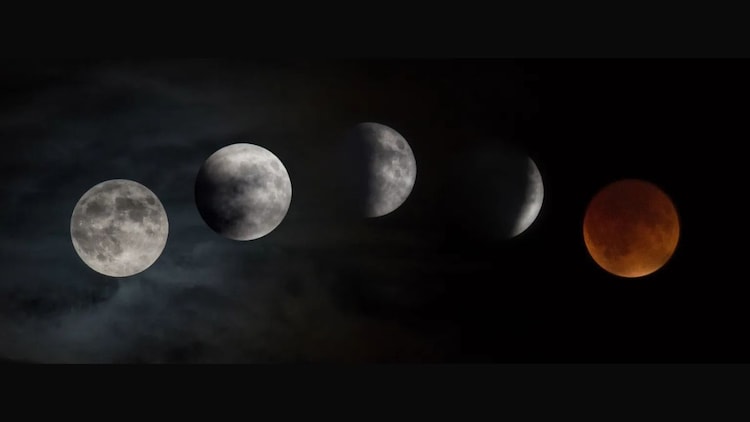
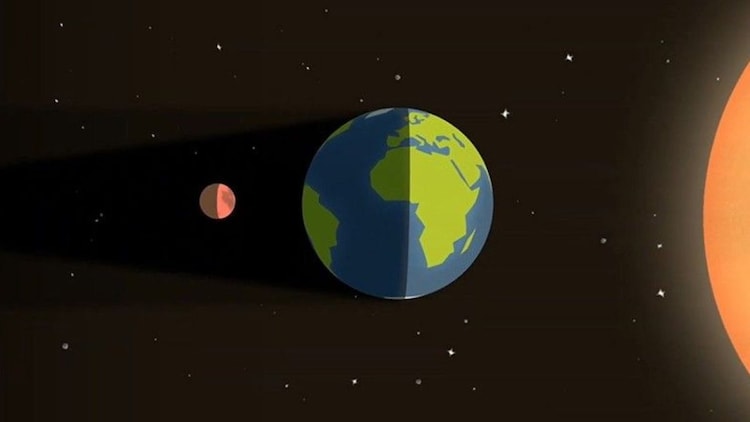
To understand the blue, we must first look at the red. During a total lunar eclipse, Earth moves directly between the Sun and the Moon.
Our planet blocks direct sunlight, but the atmosphere acts like a giant lens. It bends the sunlight around the edges of the Earth.
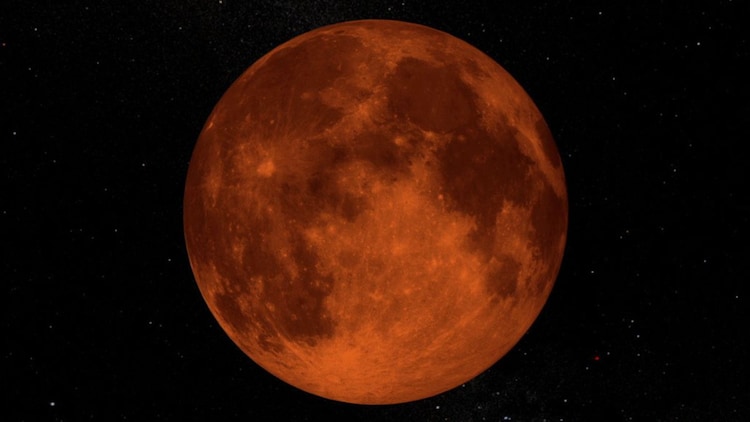
This is known as Rayleigh scattering, the same reason why our sky is blue and sunsets are red. As light travels through our thick atmosphere, shorter wavelengths like blue and violet are scattered away.
Only the longer red wavelengths pass through, casting a sunset-like glow on the lunar surface. This phenomenon is often called a Blood Moon.
WHAT IS SO UNIQUE ABOUT THE MARCH 2026 ECLIPSE?
While the Moon enters the umbra, or Earth’s dark central shadow, during every total lunar eclipse, the 2026 event is scientifically distinct because of the Moon’s specific path.
According to Nasa, the Moon will skim through the upper edge of the umbra. This means the light hitting the Moon travels through the upper stratosphere rather than the lower, dustier layers of the atmosphere.
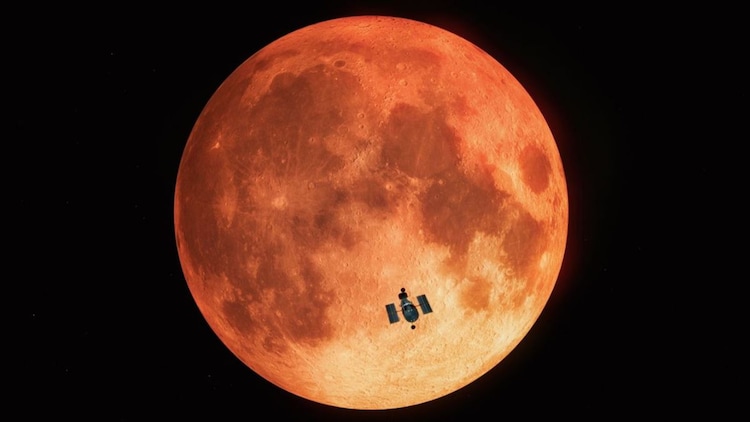
Atmospheric scientist Richard Keen from the University of Colorado explains that light passing through the upper stratosphere penetrates the ozone layer directly, according to spaceweather.com.
This year, because the Moon is positioned so perfectly at the shadow’s fringe, the blue light filtered by ozone will not be overwhelmed by the deep reds of the lower atmosphere.
It creates a rare high-contrast visual that is usually too faint to see with the naked eye.
HOW DOES THE OZONE LAYER ADD A NAVY BLUE STRIPE?
The secret to this year’s navy blue tint lies in the Chappuis absorption bands.
Named after the French chemist James Chappuis, these bands represent a specific range of light wavelengths where ozone molecules absorb yellow, orange, and red sunlight, acting as a filter that leaves only a distinct navy blue glow behind.
While the lower atmosphere scatters blue light, ozone behaves differently.
Ozone is incredibly efficient at absorbing red light. When sunlight passes through the upper reaches of our atmosphere, the ozone layer filters out the red, allowing only the blue light to remain.
This creates a distinct turquoise or navy blue fringe at the edge of Earth’s shadow.
During the peak of the eclipse at 5:03 pm IST, this blue band will be visible where the red and dark shadows meet.
IS THERE SCIENTIFIC PROOF FOR THIS COLOUR SHIFT?
There is concrete proof for this phenomenon. Researchers have used satellite data and ray-tracing models to simulate how ozone affects lunar colour.
These studies show that without ozone, the Moon would only ever be red. By using spectroscopy, scientists have confirmed that the blue light matches the chemical signature of ozone molecules.
This 72-hour celestial window provides a visual map of our planet’s health, showing the invisible shield that protects us from solar radiation.
The 72-hour window refers to the three-day period surrounding the eclipse when scientists use the Moon as a mirror to measure the chemical health of our stratosphere.
During this time, the alignment allows for precise data collection on ozone density and atmospheric clarity that is otherwise impossible to capture from the ground.
In these fleeting hours, the Moon ceases to be just a satellite and becomes a glowing report card for the planet, proving that while we may be small, our impact on the sky is written in neon blue for the entire galaxy to see.




