First Direct Detection of Star Explosion Beyond Solar System

Key Takeaways

  • First-ever direct detection of a coronal mass ejection (CME) from a star beyond our Solar System
  • The violent eruption occurred on a red dwarf star 130 light-years away
  • Event was powerful enough to strip away planetary atmospheres, threatening habitability

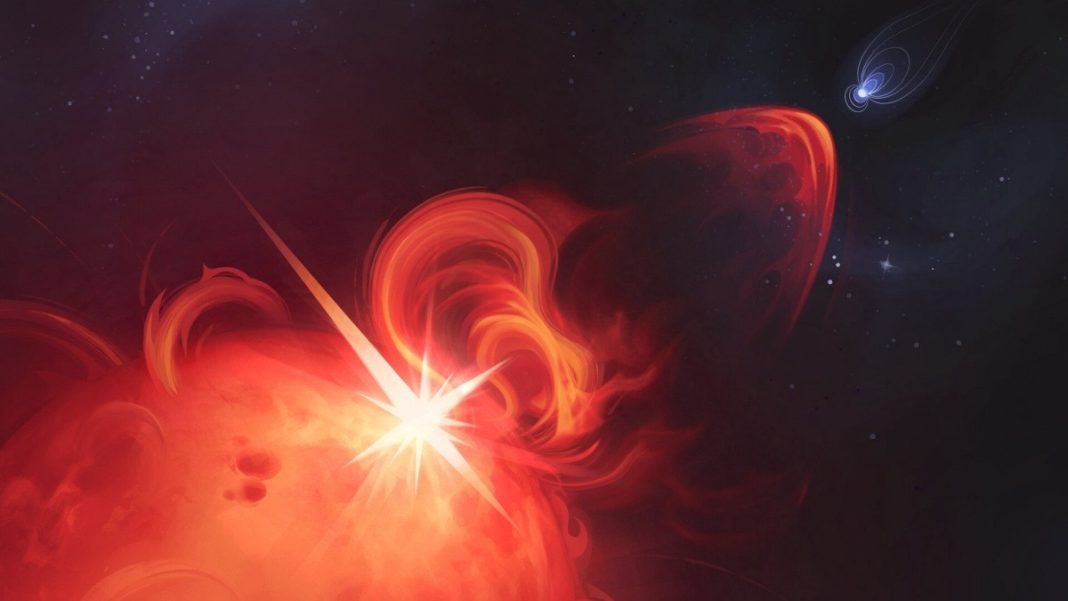
In a historic astronomical breakthrough, scientists have captured definitive evidence of a sun-like explosion on a distant star 130 light-years from Earth. This marks the first direct observation of a coronal mass ejection occurring outside our Solar System.

The discovery was made using the European Space Agency’s XMM-Newton space observatory and the Low Frequency Array (LOFAR) radio telescope. It confirms that stars beyond our Sun can unleash similar violent eruptions capable of stripping away entire planetary atmospheres.

Decades-Long Search Ends

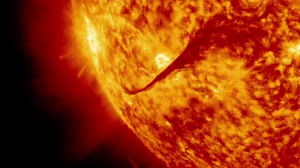
Coronal mass ejections are massive expulsions of plasma and magnetic fields from a star’s surface. While common on our Sun where they drive space weather and create auroras, astronomers had never directly witnessed one erupting from another star until this detection.

“Astronomers have wanted to spot a CME on another star for decades,” said Joe Callingham, lead author of the study published in Nature. “Previous hints existed, but this is the first time we’ve definitively seen material escape into space.”

How Scientists Detected the Stellar Eruption

The research team identified an intense, short-lived radio signal generated as the CME raced through the star’s magnetic atmosphere. The emission was far too powerful to exist within a stellar magnetic bubble, confirming that material had truly broken free into space.

The source star was identified as a red dwarf – a small, cool star type known for high magnetic activity. The eruption reached astonishing speeds of approximately 2,400 kilometers per second, exceeding even the most powerful solar CMEs observed on our Sun.

Implications for Alien Life

This discovery carries significant consequences for the search for extraterrestrial life. Red dwarfs constitute the majority of stars in our galaxy and frequently host Earth-sized exoplanets within their habitable zones.

However, if these stars regularly produce massive CMEs like the one detected, they could strip away the atmospheres of otherwise potentially habitable worlds, rendering them barren.

LOFAR’s high sensitivity enabled the radio detection while XMM-Newton provided crucial X-ray data about the star’s temperature and activity levels.

“Neither telescope alone would have been enough — we needed both to prove it was really a CME,” said co-author David Konijn of ASTRON.

“This work opens a new frontier for studying stellar space weather,” said ESA researcher Henrik Eklund. “The next step is understanding how such eruptions affect the long-term survival of planetary atmospheres, and by extension, the potential for life itself.”

The findings open new avenues for understanding and its impact on throughout our galaxy.
Latest

Western disturbance to hit India, but plains to keep getting hot on Friday

Despite the incoming system, temperatures across north and central India are forecast to remain high. Meteorologists warn that the limited rainfall will not be

Send Grace and Rocky: Young stars like our Sun seen dimming outside Solar System

Planets orbiting such stars may have a better chance of retaining their atmospheres and developing conditions suitable for life.

Isro confirms 36 Indian rocket parts fell on Earth after launch in 2025

India is making considerable progress in ensuring that its satellites are not adding to the increasing levels of space debris. Instead, these satellites entered

Nasa flies close to Sun, uncovers new clue to how solar storms are born

The Parker Solar Probe has uncovered a surprising clue about how solar storms form, revealing new particle behaviour that could improve space weather prediction

Desert planets beyond our Solar System may be far less likely to support life

Scientists estimate that there are billions of planets orbiting stars outside our solar system, with more than 6,000 confirmed exoplanets discovered so far.

Topics

Who the freak needs these extra MPs?

India doesn't need 307 more MPs to crowd a bigger chamber. What India needs at this moment is the right policies to drive growth, and not more policymakers. It

Schools in Kerala, MP and other states change timings, declare holidays amid heatwave

States take action to safeguard students from extreme heat

Kendriya Vidyalaya students score 90%+ in CBSE, share success mantra

With CBSE declaring the Class 10 results, students across India are celebrating their scores and planning their next academic steps. At PM SHRI Kendriya Vidyala

Aadi Abadi factor: How delimitation, women voters shape Tamil Nadu poll narrative

Women voters emerge as pivotal in Tamil Nadu's heated election scene

Markets open flat as geopolitical tensions ease, but caution remains

The BSE Sensex was trading at 78,030.99, up 42.31 points or 0.05% at around 9:43 am. The Nifty 50, however, slipped marginally by 6.85 points or 0.03% to 24,189

Kerala SSLC Results in May, plus two on May 25, confirms education minister

Kerala SSLC and Plus Two Result 2026 dates have been officially announced, giving students clarity on when to expect their scores. The state has also rolled out

Who is Girija Ji? PM Modi meets veteran educationist after 30 years, praises her work

Prime Minister Narendra Modi’s Nagercoil visit blended politics and personal warmth as he reunited with veteran educationist Gomatam Veeraraghavan Girija afte

Lebanon ceasefire: Who said what? Bibi vows troops will stay; Trump hails talks ‘very exciting’ – How Iran reacts?

Iranian Parliament speaker Ghalibaf asserts that Lebanon must be included in any peace agreement between Iran and the U.S., emphasizing its importance for regio
spot_img

Related Articles

Popular Categories

spot_imgspot_img