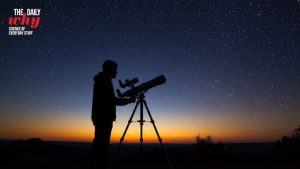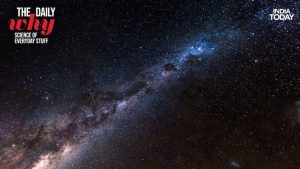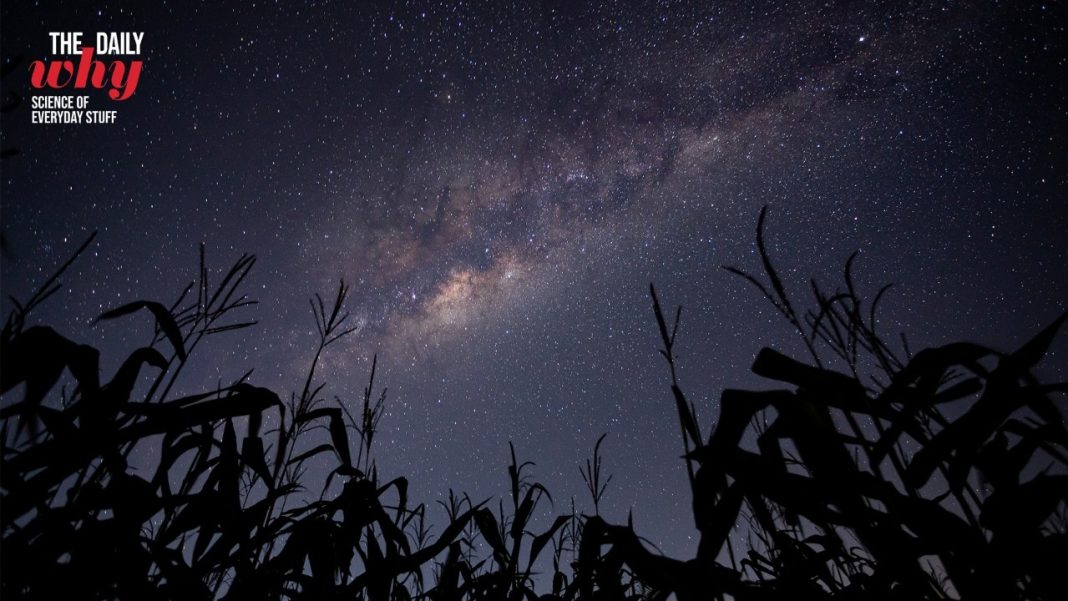
When you look up at the night sky, you see a scattering of stars against a pitch-black backdrop. But if the universe contains billions of galaxies, each packed with billions of suns, space should be a glowing tapestry of light.

Logically, every single point in the sky should hit a star, making the night as bright as day. Yet, we are surrounded by a vast, silent void.
This new series from India Today Science explores the why and how behind everyday phenomena we notice, question, and often overlook. Each edition breaks down the science behind familiar experiences in simple terms. Today, we look at the cosmic mystery of the dark night sky.
The concept of a forest is the best way to visualise an enigma that has kept astronomers awake for centuries. Imagine standing in a forest so dense that no matter which direction you turn, your eyes hit a tree trunk.
The universe is like that forest, packed with stars in every direction, implying the night sky should be a solid sheet of light. Yet, that is not what we see.
This contradiction is known as the Olbers Paradox, named after the German astronomer Heinrich Wilhelm Olbers. It highlights the strange conflict between the expected brightness of an infinite universe and the actual reality we observe.
Despite these trillions of glowing suns scattered throughout the cosmos, the space between them remains a cold, pitch-black void.
The answer to why space is not blazing with light involves the age of the universe and the way light travels through the expanding universe.
WHY IS SPACE BLACK?
The primary reason space appears dark is that the universe has a beginning. According to Nasa, the universe is approximately 13.8 billion years old. Because light takes time to travel, we can only see stars that are within a certain distance.
Light from more distant stars simply has not had enough time to reach our eyes yet. In our forest analogy, it is as if the forest is so young that the light from the furthest trees is still on its way to us.
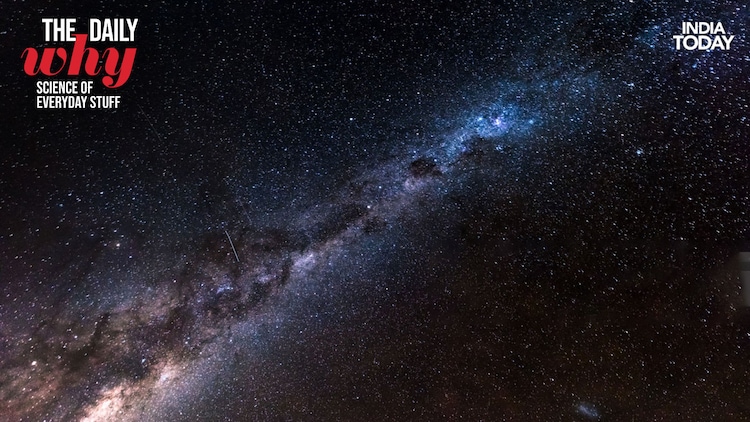
Therefore, we see empty black gaps between the stars instead of a wall of light. If the universe were infinitely old, those gaps would eventually fill with light, but for now, the cosmic news of those distant stars has not arrived at our doorstep.
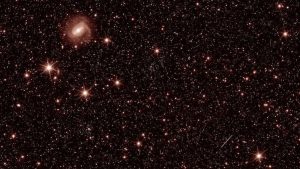
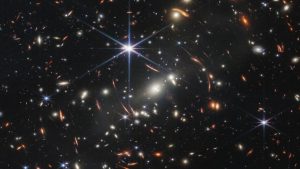
Research into the Hubble Ultra Deep Field, the deepest, most distant portrait of the visible universe ever captured by the Hubble Space Telescope, confirms that while the sky looks empty, a tiny patch of dark space actually contains thousands of galaxies, many of which are too far for their light to have fully saturated our sky.
HOW DOES THE EXPANSION OF THE UNIVERSE MAKE SPACE DARK?
Even for the light that does reach us, there is another cosmic trick at play. The universe is not static; it is expanding. As space stretches, it also stretches the light waves travelling through it.
When light from a distant galaxy is stretched, its wavelength increases. This shift moves the light from the visible spectrum into the infrared and microwave range. This is called redshift.
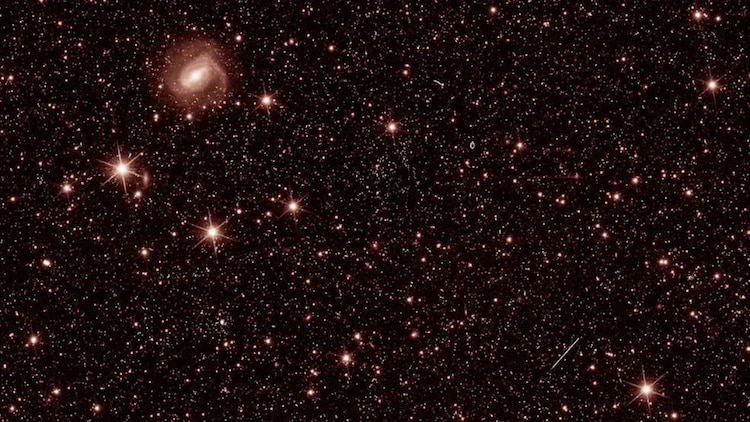
While the sky might actually be filled with this ancient light, our human eyes are not built to see it. It is there, but it is invisible to us, leaving the sky looking like a black vacuum.
A seminal paper published in 2016 in The Astrophysical Journal highlights how the number of galaxies in the observable universe is far greater than previously thought, yet their light is shifted so far into the infrared range that space remains dark to the naked eye.
WHY CAN WE NOT SEE ALL THE LIGHT IN SPACE?
If we could see in the microwave spectrum, the entire sky would indeed be glowing. Modern telescopes, such as the James Webb Space Telescope, can peer into these dark patches and find the hidden light of the earliest stars.
One of the most famous proofs of this is the Cosmic Microwave Background radiation. This is the faint afterglow of the Big Bang that fills 100 per cent of the sky.
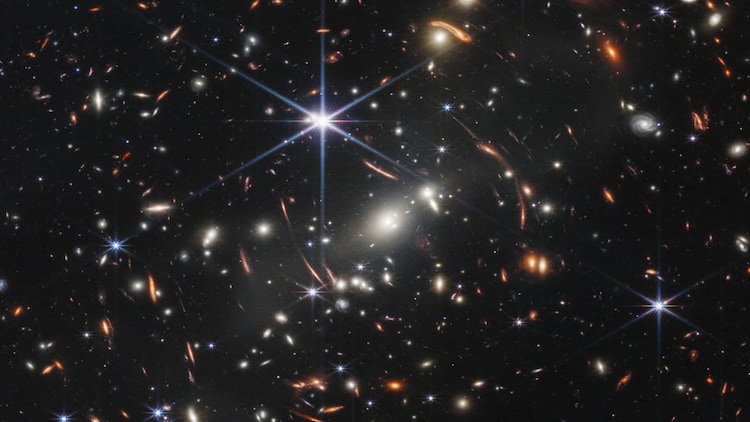
To our eyes, it looks like a black void, but to scientific instruments, it is a fossil record of the very first light in existence.
In simple terms, space is dark because the universe is expanding and is not old enough for all the light to have arrived here yet.
It is a haunting reminder of the sheer scale and youth of the cosmos we inhabit.
#TheDailyWhy