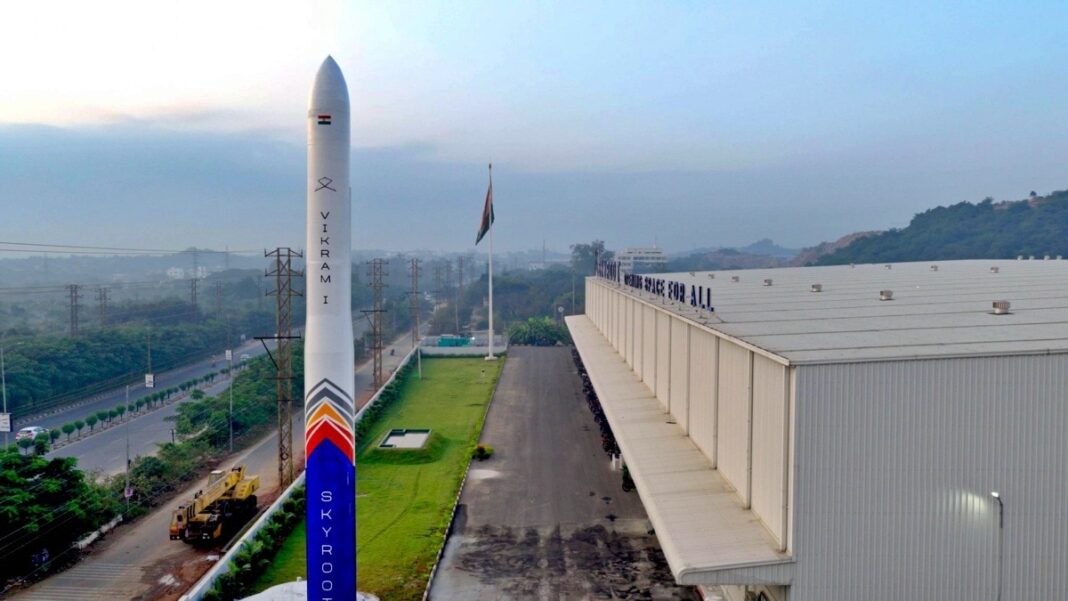
India’s private space sector is on the cusp of a historic milestone, as Skyroot Aerospace prepares to launch Vikram-1, the country’s first privately developed orbital rocket, within the coming weeks.
The vehicle has been flagged off for its journey to the Satish Dhawan Space Centre, marking the start of final integration and launch operations.
Officials at Skyroot said the flag-off signals a critical transition from development to deployment. “This marks the beginning of the integration and launch campaign at the spaceport,” the company told IndiaToday.in, adding that all hardware components of the Vikram-1 rocket will now be transported to Sriharikota for final assembly.
The announcement comes after the successful completion of all qualification tests, a major milestone that validates the rocket’s systems under simulated mission conditions.
These tests ensure that the vehicle’s propulsion, avionics, structural elements, and stage separation mechanisms are ready to perform as intended during launch.
WHEN WILL SKYROOT LAUNCH VIKRAM-1?
At Sriharikota, India’s primary launch hub operated by the Indian Space Research Organisation, teams will now undertake the complex process of integrating the rocket stages, payload systems, and ground support interfaces.
This phase also includes comprehensive checks, countdown rehearsals, and mission simulations ahead of the final launch.
Vikram-1 is designed as a small satellite launch vehicle, aimed at serving the rapidly growing global market for cost-effective and responsive space access. Named after Indian space pioneer Vikram Sarabhai, the rocket is expected to place payloads into low Earth orbit, offering flexible launch options for commercial and institutional customers.

Skyroot’s progress reflects the broader transformation of India’s space ecosystem following recent policy reforms that have opened the sector to private participation.
The company has already demonstrated its capabilities with earlier suborbital missions, and Vikram-1 represents its first attempt at an orbital launch.
Industry experts say the upcoming mission will be closely watched, as it could position India among a select group of countries with active private launch providers.
Success would not only validate Skyroot’s technology but also strengthen India’s standing in the competitive small satellite launch market.
While the company has indicated that the launch is expected within weeks when the launch window opens, a precise date has not yet been announced. Final scheduling will depend on readiness checks, weather conditions, and coordination with range operations at Sriharikota.
If successful, the Vikram-1 launch will mark a defining moment, signalling the arrival of private orbital launch capability in India and opening a new chapter in the country’s space journey.