In a world where geopolitics shapes business outcomes, a policy announcement made thousands of kilometres away on an usual morning of trade can quietly redraw global supply chains, and possibly disrupt decisions announced overnight by any government or its ministry. A tariff order by Trump or multiple versions of it, that continues to keep global markets on the edge owing to the US President’s constant flip flops is a perfect example of this scenario. A diplomatic rupture say in the case of the US-China trade policy, or a sanctions update in the case of India-US trade deal can create ripples through boardrooms or government corridors within minutes.
For business executives and policymakers, the challenge is no longer access to information. The real challenge in today’s uncertain world, where every move is watched by eagle-eyed social media users, is interpreting a mountain of developments before the markets, investors and competitors react.
This strategic shift has created a fertile ground for tools like TAG AI that promises to decode geopolitical developments in real time.
The rise of TAG AI
TAG AI, an upcoming geopolitical decision intelligence platform, developed by The Asia Group, is designed to help organisations monitor political and regulatory developments across Asia. TAG AI simulates the latest developments that could influence business and government strategy, and also allows leaders to make better judgments at a faster pace, and at scale.
TAG AI sits at the intersection of technological ambition and strategic necessity, and aims to merge data science with global policy analysis. What stands out is the fact that it is constantly monitored by human analysts with expertise, and doesn’t curate inputs from any social media platforms to ensure that the final output isn’t based on unreliable information sources.
Geopolitics has been assessed through consultancy-led analysis, research reports, and diplomatic briefings for years. While these methods remain valuable, the real struggle is to match the speed at which political events unfold in modern times. Trade disputes, technology export restrictions and rapidly shifting alliances have created a constant stream of policy signals that companies and governments must interpret almost immediately without getting overwhelmed.
TAG AI attempts to solve this problem by functioning less like research archives, and more like operating systems designed to build a strategy at a global scale that is easily available at one place and accessible 24X7.
The tool is ingested with vast volumes of data — ranging from regulatory filings and policy speeches to economic indicators and diplomatic statements combined with news reports from vetted sources all over the globe. A team of human experts monitor these inputs at each level and classify each of these inputs. It is then processed using machine-learning models designed to detect patterns and emerging risks. The result is not simply information, but contextual analysis, a top product feature The Asia Group likes to showcase as – the CI score – on their social handles.

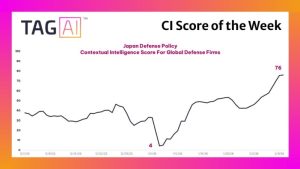
As the graphical illustration suggests, TAG AI’s Contextual Intelligence Score detected a shift in geopolitical dynamics following Japanese Prime Minister Sanae Takaichi’s historic election win, signalling improved prospects for global defence firms. As her victory became likely, the score rose reflecting an increased confidence in a more assertive defence posture — including higher spending and modernisation. It is important to note that the score had dropped and even signalled a risk a few weeks back after an earlier policy action by China over export controls on rare-earth minerals.

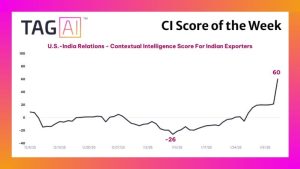
Another example from the recent India-US trade deal developments was highlighted by The Asia Group’s Contextual Intelligence Score on its LinkedIn page where it tracked a significant shift in U.S.– India relations ahead of the major trade deal announcement. The algorithmic score moved from negative territory earlier in the year — reflecting heightened tariff pressures — to strong positive readings as diplomatic signals and high-level engagements indicated improving ties, culminating in the announcement of the trade deal.
TAG AI’s real-time intelligence metric demonstrates that it is possible to give users an early signal of changing conditions that competitors might miss.
At the technological level, TAG AI operates across at least three layers. A data ingestion layer continuously collects real-time inputs from public and proprietary sources. Above it sits an artificial intelligence layer that applies natural language processing and predictive modelling to interpret policy documents and developments, and rates for any risks.
In order to improve algorithmic results and add political context that machines could overlook, the tool also integrates inputs from humans with regional expertise from all over the world as part of its third layer.
This design reflects a shift in enterprise AI where automation excels at processing data at scale, while humans with expertise help in understanding a complex topic with ease. Geopolitics in today’s times is shaped as much by history and informal power structures, as by formal policies.
TAG AI’s features
The core capabilities of TAG AI increasingly resemble enterprise analytics dashboards, but with global policy as the primary dataset.
The Contextual Intelligence (CI) Score quantifies how geopolitical and policy developments are shifting risk and opportunity for specific countries, sectors, or strategic themes.
It can track political events in real time, send instant alerts to users when regulatory environments shift, and map networks of influence among government agencies, political actors and industry stakeholders.
It also includes conversational interfaces that allow users to query geopolitical scenarios in plain language via their chatbot, referred to as TAGbot, that effectively turns complex policy analysis into an interactive process. By analysing historical policy behaviour alongside real-time signals, TAG AI can simulate how trade disputes, elections or diplomatic tensions might unfold.
For multinational corporations, this offers the ability to stress-test supply chains or investment strategies before committing capital.
For governments, it opens possibilities for forecasting economic vulnerabilities and identifying strategic opportunities.
For India, the emergence of TAG AI arrives at a historic moment as it attempts to position itself simultaneously as a manufacturing hub, a digital services powerhouse (The week-long AI summit), and a strategic geopolitical actor.

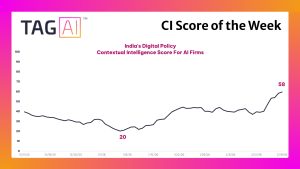
The most recent example of the CI score relates to India’s Digital Policy where the score shows a drop to 20 following regulations from India’s IT ministry aimed at curbing AI-generated misuse, deepfakes and data safety. But as the India AI Impact Summit 2026 unfolded in New Delhi this week, the score climbed steadily to 58 on February 19 following the commitments from the senior leadership in embracing AI. India’s messaging this time clearly offered policy and financial incentives, thereby openly signaling to global AI firms that they can invest and operate at scale without worrying about regulatory overload.
Is this the future?
Despite its promise, TAG AI has its own set of challenges. Global and political decisions are usually influenced by individual leadership styles, domestic alignments and cultural dynamics that can be at most times difficult to quantify. Algorithms trained on historical data may struggle to anticipate unprecedented political events or sudden shifts in diplomatic relations. Relying too much on such data can be considered a risk.
Dashboards can create an illusion of certainty owing to blind spots amongst experts, encouraging decision-makers to treat probabilistic forecasts as definitive outcomes.
“While probabilistic forecasting is something that this dashboard is not intended to provide, it does enable decision-makers to ask, explore, and anticipate where things could go down the road. This can be done in collaboration with experts at TAG, who have decades of experience in assessing the impact and implications of potential future scenarios, ” Uzair Younus, partner and chief product officer at The Asia Group said.
TAG AI a digital narada?
In Indian mythology, the famous character Narada moved effortlessly between worlds — from royal courts to celestial assemblies — carrying not just information, but insight. He understood that power shifts first in whispers: in tone, in intent, in subtle alignments long before battles are fought or treaties are signed.
Today, those whispers travel through policy drafts, trade data, diplomatic signals and market tremors. The difference is speed. The volume is overwhelming. The consequences are global.
If Narad were alive in the age of algorithms, would he be watching dashboards, tracing patterns, and flagging inflection points before they harden into crises or opportunities, instead of strumming a veena in a king’s court.
Will TAG AI allow its users to play digital Narada with its contextual intelligence tool that offers not just prediction, but preparedness; not just noise, but also adds meaning. We will know.