
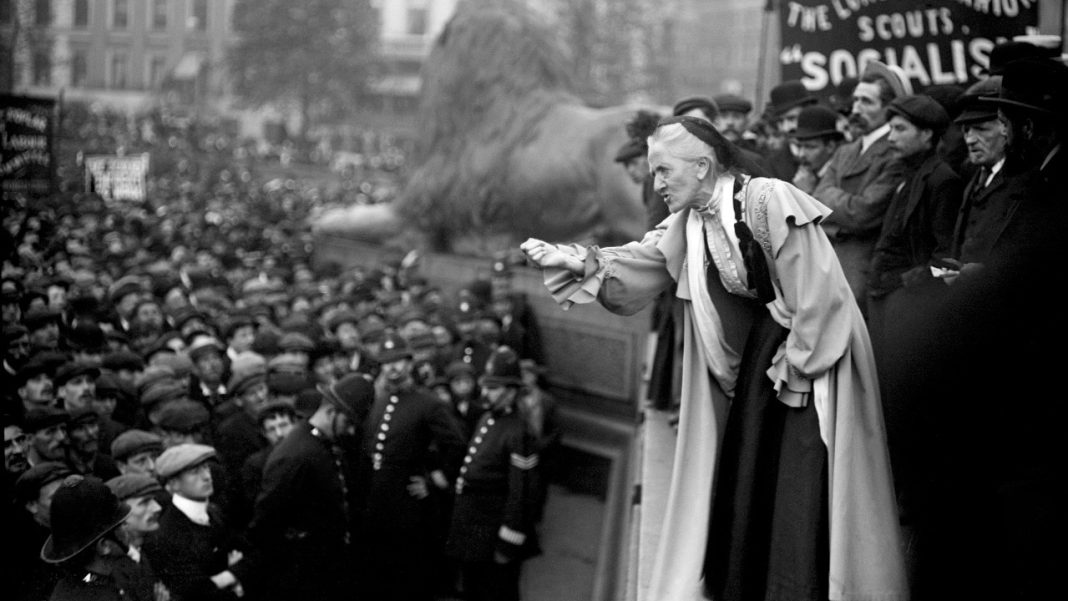
On a cold evening in London in the early 1920s, a white-haired aristocrat stood before a restless crowd and did something almost unthinkable: she denounced the British Empire, not in whispers, not in private letters, but in public.
Her name was Charlotte Despard.
And she was British.
At a time when imperial pride ran high, and the sun was not supposed to set on the Empire, Despard chose to speak about India, not as a colony to be governed, but as a nation denied its freedom. The same woman who had been jailed in Britain for demanding voting rights for women was now challenging her own government’s moral authority over millions of Indians.
India’s freedom struggle, she believed, was not a distant rebellion. It was a question of justice.
FROM SUFFRAGETTE TO ANTI-IMPERIALIST
Born in 1844 into an Anglo-Irish family, Despard had privilege, education, and influence. She could have remained comfortably within the circles of British high society. Instead, she chose agitation.
As a leading suffragist, she was imprisoned multiple times for campaigning for women’s right to vote. Those prison terms radicalised her. She began to see patterns: the same establishment that silenced British women also ruled India without consent.
To Despard, empire and patriarchy were intertwined systems of control.
When news of colonial repression in India, particularly the 1919 Jallianwala Bagh massacre, reverberated across Britain, she did not stay silent. She spoke at public meetings condemning British brutality. She aligned herself with Indian nationalists and supported calls for self-rule.
In doing so, she crossed an invisible line.
FIGHTING THE EMPIRE FROM ITS CAPITAL
Unlike many revolutionaries, Despard did not fight from the streets of Bombay or the fields of Punjab. She fought from London, the very heart of imperial power.
She used platforms in Britain to question colonial policies. She connected the Irish struggle, the suffragette movement and India’s demand for independence, framing them as interconnected battles against domination.
Her speeches embarrassed the British establishment. When a well-known British aristocrat criticised imperial rule, it weakened the carefully curated image of a “civilising mission”.
Surveillance followed. Suspicion followed. But so did influence.
India’s freedom movement was not only shaped by protests on Indian soil; it was shaped by arguments, debates and dissent within Britain itself. Despard was part of that internal fracture.
WHY INDIA FORGOT HER
Indian textbooks understandably foreground Indian heroes. But that often means foreign allies fade into the margins.
Despard was not Indian by birth. She did not march in Dandi or court arrest in Delhi. Her activism unfolded in drawing rooms, lecture halls and protest platforms in Britain.
Yet political change in a democracy is also influenced by public opinion at home. By amplifying Indian voices within Britain, she contributed to the moral and political pressure that gradually made the empire harder to defend.
Her story complicates a simple narrative of coloniser versus colonised. It reminds us that even within oppressive systems, there were dissenters, people who chose conscience over comfort.
A FREEDOM STRUGGLE WITHOUT BORDERS
Today, as global solidarity movements shape debates on justice, Despard’s life feels strikingly contemporary. She understood that struggles are interconnected. That rights denied anywhere weaken rights everywhere.
India’s fight for freedom was not confined to its geography. It echoed in London halls, Irish meetings and feminist platforms. It found unlikely allies.
Charlotte Despard did not need India’s freedom to improve her own life. Supporting it cost her reputation, strained her social standing and invited scrutiny.
She chose to do it anyway.
In the grand narrative of independence, her name may not headline chapters. But in the quiet, persistent pressure that reshaped imperial politics, she stood firmly on the side of freedom — even when it meant standing against her own flag.


