
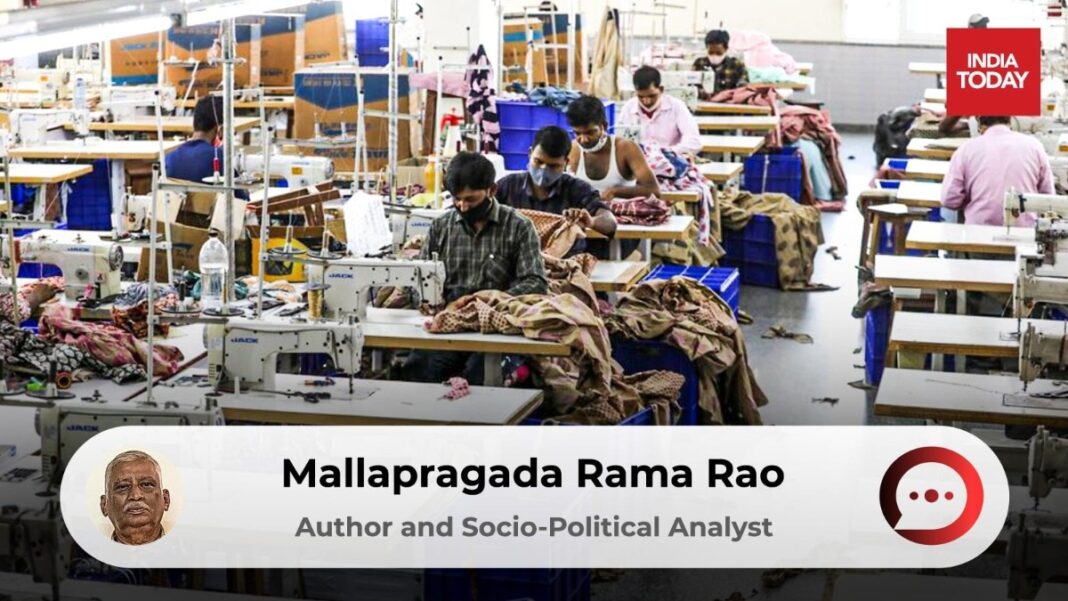
I have said this before: Inspector Raj is a reality. Managements sustain it. And, as wind feeds the rain, a section of enforcement officers across departments ends up siding with such employers. That, too, is an uncomfortable truth.
This special inspection brought both into sharp focus.
It was a packaging factory. I had informed them in advance, as required, but I arrived a little earlier than scheduled, as I often did. After introducing myself, I sensed something was off.
Workers began rushing out, as if forewarned. I ordered the main gate to be closed.
Before examining records, I walked through the premises. There were clearly far more workers on the floor. Yet the monthly and weekly attendance and wage records listed only 18 names.
Even among them, two were not covered under the ESI Act.
The firm had four partners, but only one was based in the city where the factory was located. The other three, as per records, resided in another city. Only a manager-cum-accountant and a supervisor were present at the time of my inspection.
I was certain there had to be some written record through which the employers tracked the actual workforce. That was why I insisted on seeing where the names missing from the official registers were recorded. After some hesitation, they produced a register maintained by the watchman.
That register told a different story.
On the previous day, it recorded 51 names, including the watchman. Even that was incomplete. Five hamalis whom I had personally seen unloading goods were missing. In effect, about 40 workers had been kept outside the legal framework at the time of my inspection.
Our inspector’s report stated that only 20 workers fell under the ESI Act. Yet the same day’s records showed 18 names in the main register, but 57 in the watchman’s register. The contradiction was glaring.
Out of curiosity, I checked the inspection book of the Inspector of Factories. It was revealing for what it lacked: routine entries, mechanical endorsements, and a silence where scrutiny should have been.
Our inspector had also claimed that two workers were outside the ESI Act because they earned more than Rs 6,500 per month. In reality, the highest-paid employee—the manager-cum-accountant—earned only Rs 2,435.
The records told a deeper story.
The 1998–99 ledger showed Rs 3,10,877.17 under “Job Work Charges,” of which Rs 1,83,865.42 was clearly wages. Hamali wages of Rs 51,655 were buried under “Hamali Charges.”
Another Rs 1,16,001.75 was shown as paid to an outside entity under the same head. Further amounts appeared under “Machinery Repairs” and “Machinery Maintenance.” How much of this was actually wages could only be known from vouchers—which were, conveniently, unavailable.
Some records were later produced, the scrutiny of which revealed that contributions had not been paid on wages amounting to Rs 4,07,869. It was clear that a substantial number of workers had been kept outside the ESI framework. The true number of such workers is almost impossible to establish. Wage vouchers rarely carry worker details. Supporting records are selectively withheld. Documents are said to be with auditors. Time, meanwhile, runs out.
I submitted my report with the sober realisation that when the system quietly aligns to deny workers their lawful rights, little can be done by individuals.
POSTSCRIPT
Generous to customers—unjust to many workers.
For the past few months, we have been buying our groceries from a large provisions store—purely out of self-interest.
We had earlier relied on a neighbourhood shop for nearly a decade. But a visiting friend, glancing at one month’s bill, suggested trying a larger store a few kilometres away that also offered home delivery.
A quick comparison showed savings of nearly 12%. That was reason enough to switch.
While walking through the store, habit took over. I asked a few employees whether they were covered under the ESI and EPF Acts. The answers were familiar: a few were covered, many were not.
Before leaving, I spoke to one of the partners at the counter. I requested him to extend statutory coverage to all his employees.
He responded with a gentle nod and a polite smile.
(Views expressed in this opinion piece are those of the author)
Read earlier parts in the series:
Part 1: The end of Inspector Raj: A reform that assumes too much
Part 2: When employers evade, enforcement looks away
Part 3: On paper, compliant: How labour laws are quietly undermined


