
Astronaut on Space Station captures rare comet flying over Earth. See pic

Sometimes the universe surprises you when you are not even looking for it.

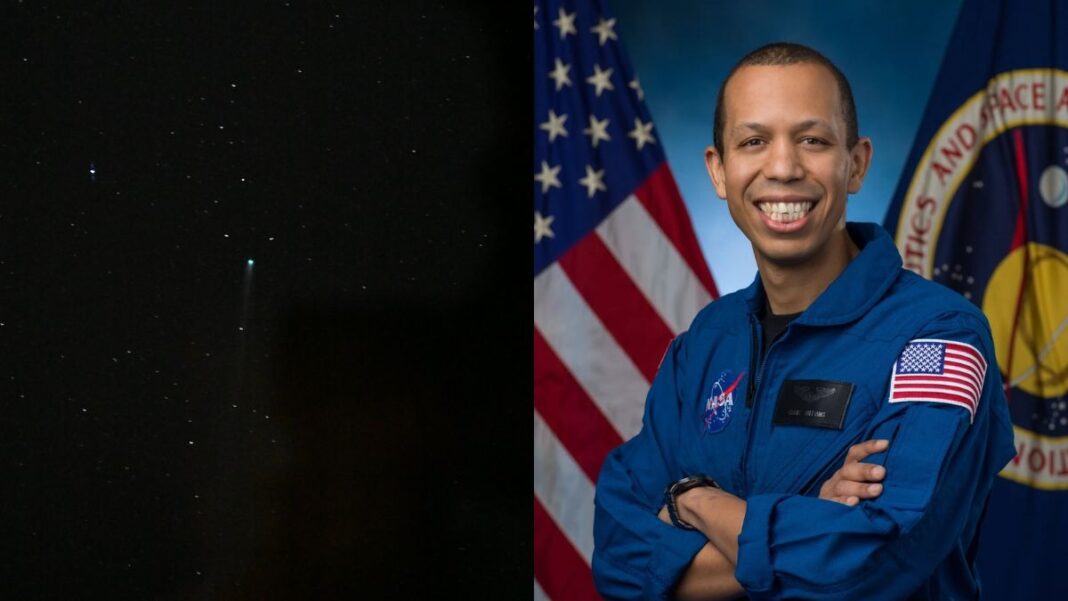
Nasa astronaut Chris Williams was aboard the International Space Station (ISS) on a fairly routine sky-watching mission, trying to photograph meteors from the Lyrid meteor shower.

The Lyrids are an ancient annual spectacle.
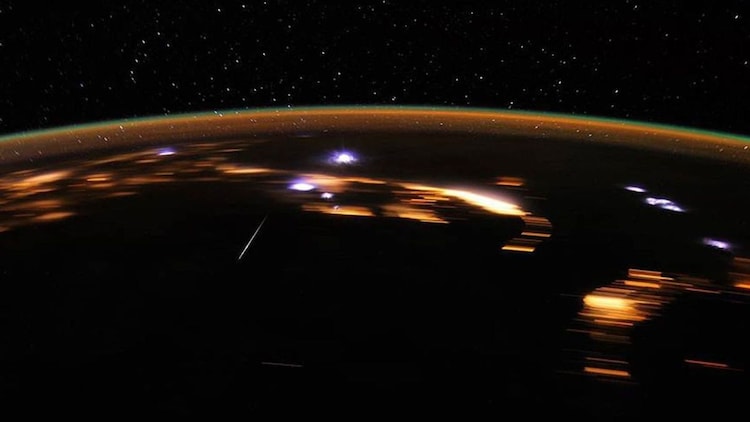
Lyrids meteor shower. (Photo: Nasa)

Lyrids meteor shower. (Photo: Nasa)

Every April, Earth passes through a trail of debris left behind by Comet C/1861 G1 Thatcher, a comet that was last seen in 1861.

The tiny fragments of that old comet enter our atmosphere and burn up as streaks of light.

Williams, peering out through the Cupola, the station’s stunning dome-shaped observation window, was hoping to catch some of those streaks on camera. What he captured instead was something far more dramatic.

Framed awkwardly near the base of the Canadarm2, the ISS’s iconic robotic arm, was the glowing tail of Comet C/2025 R3 PanSTARRS.

Williams had very nearly missed it. He managed to photograph it using a Nikon Z9 camera with a 200mm lens.

WHAT EXACTLY IS COMET C/2025 R3 PANSTARRS?

Think of a comet as a giant dirty snowball, or a clump of ice, rock and dust that travels around the Sun on a long, looping path.

Comet C/2025 R3 PanSTARRS is what scientists call a hyperbolic Oort cloud comet, which means it originates from the outermost, most distant region of our solar system. It has never visited the inner solar system before.
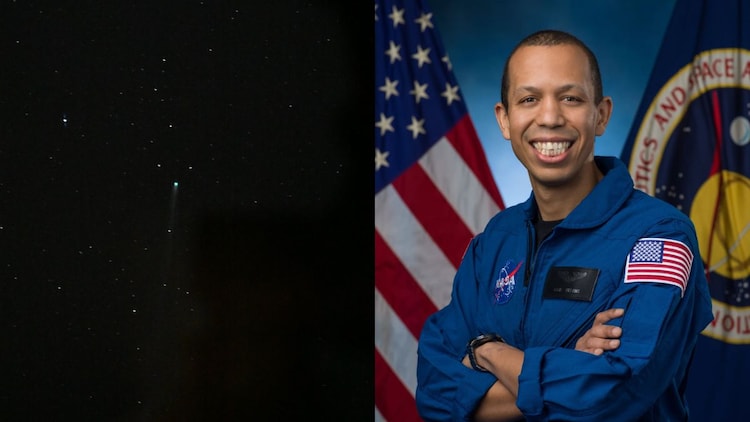
Nasa astronaut Chris Williams accidentally captured a comet from aboard the Space Station. (Photo: X/@Astro_ChrisW)

Nasa astronaut Chris Williams accidentally captured a comet from aboard the Space Station. (Photo: X/@Astro_ChrisW)

The comet was first spotted on September 8, 2025 in images from the 1.8-metre Ritchey-Chretien telescope at Haleakala, Hawaii, as part of the PanSTARRS survey, at a faint apparent magnitude of about 20.

This is invisible to the naked eye. The PanSTARRS project, as Williams explained in his post, uses two telescopes with wide fields of view to photograph large portions of the night sky every night, comparing new images to old ones to flag anything that has moved or appeared fresh.

HOW BRIGHT DID THE COMET GET?

On April 11, 2026, the comet was spotted with the naked eye, with an estimated magnitude of 5.1.

Its nucleus, the unseen frozen core, is likely just a few kilometres across.

As the Sun warms it, neutral gas forms a glowing cloud called a coma, which glows light green.

Solar radiation then ionises some of that gas, and the solar wind, a constant stream of charged particles from the Sun, pushes it away into a long, wispy blue ion tail.

The comet reached perihelion, its closest point to the Sun, on April 19, 2026, passing at a distance of roughly 74.6 million kilometres from it.

Its closest approach to Earth will happen on 26 April 2026, at a distance of roughly 73.2 million kilometres.

WILL THE COMET EVER RETURN?

Almost certainly not. Its future trajectory shows it being ejected from the solar system entirely.

This is a once-in-a-civilisation visit, and Williams caught it on camera from 400 kilometres above the Earth.

Latest

North to sizzle in heatwave, northeast to experience thunderous Wednesday

Temperatures across northwest and central India are expected to climb by another 3–5C before finally dipping towards the end of the month. But before that, he

Plants not just feel, they can hear the rain too, confirms new research

MIT scientists have discovered that rice seeds can sense the sound of rain and germinate up to 40 per cent faster as a result. The study reveals how sound waves

2026 could see a super El Nino and record-breaking global temperatures

La Niño is one of the phases of the El Niño–Southern Oscillation (ENSO) – a natural climate phenomenon. It usually occurs in the Pacific Ocean, influencin

Dead zone in Akashganga: The region where Milky Way galaxy stops making new suns

Scientists have identified the precise edge of the Milky Way's star-forming disc by studying the ages of over 1,00,000 stars. The boundary sits roughly 35,000 t

Earth Day: We finally know why some people care about climate change, others don’t

As the world faces worsening impacts of climate change, understanding what moves people could be the difference between a movement that grows and one that remai

Topics

UP Board 10th, 12th Result 2026: Here’s how to download marksheet on DigiLocker

UP Board Results 2026 will be declared at 4 pm today for Class 10 and 12 students. Here’s a simple guide to download your marksheet via DigiLocker instantly.

Dr Reddy’s jumps nearly 7% as Sensex falls: Why is the pharma stock rising?

Shares of Dr Reddy’s Laboratories surged sharply on Thursday, bucking a weak broader market and emerging as one of the top gainers on the Nifty 50.

Karnataka SSLC Result 2026: How to check marks via SMS, App and offline methods

Explore multiple ways to access your Karnataka SSLC 2026 results

Sensex tumbles 650 points: Why is the stock market falling?

Stock markets remained sharply lower in early trade on Thursday as crude oil above $100, global uncertainty and broad-based selling in financial and IT stocks w

Sensex, Nifty sink as crude oil prices reach $100; IndiGo down 2%

The S&P BSE Sensex was down by 625.09 points to 77,891.40, while the NSE Nifty50 lost 173.90 points to 24,204.20 as of 9:26 am. 

KSEAB Karnataka SSLC Result 2026 today: List of official websites and DigiLocker

Karnataka School Examination and Assessment Board (KSEAB) will announce the SSLC Result 2026 today on the official website. Students who appeared for the Class

Russian oil waiver decision followed requests from vulnerable countries: Bessent

The US extended a Russian oil waiver after requests from over 10 vulnerable nations, keeping supplies flowing to India where imports remain near record highs, h

Data war next? Iran-linked report flags cable cut risk in Strait of Hormuz

Iran-linked Tasnim report warns undersea cable damage in Strait of Hormuz could trigger major internet outages across Gulf, highlighting growing risks to critic
spot_img

Related Articles

Popular Categories

spot_imgspot_img

