
After 40 days of bombing Iran in one of the deadliest aerial campaigns of the 21st century, President Donald Trump is back to being a ‘Peace President’. On April 18, he once again reiterated his role in ending eight conflicts. This statement is a swing away from his April 7 post where he threatened to end Iran’s civilisation. The first round of peace talks with Iran in Islamabad on April 11 were inconclusive. A two-week ceasefire with Iran expires on April 22. Trump has despatched a delegation for a second round of peace talks in Islamabad— Vice President JD Vance, special envoy Steve Witkoff and his son-in-law Jared Kushner.
Iran has blockaded the Strait of Hormuz, through which one-fifth of world energy supplies passes through. The US responded on April 8 with a blockade of Iranian ports and energy exports.
“At the centre of the war is a fact that cannot be negotiated away: Iran either retains a nuclear capability on the threshold of weapons, or it does not. There is no stable middle ground that satisfies both sides,” the scholar Robert Pape wrote on his Substack site on April 18. The US cannot allow the Strait of Hormuz to be controlled by Iran. (An April 18 statement by Foreign Minister Abbas Ali Araghchi stating the strait was open ‘on the coordinated route’, controlled by the IRGC, was misinterpreted as Iran having reopened the strait).
The US cannot allow Iran to retain its nuclear weapons capability nor control the Strait of Hormuz by imposing tolls. This zero-sum condition deadlocking talks.
But how did Iran get the centrifuges to enrich uranium?
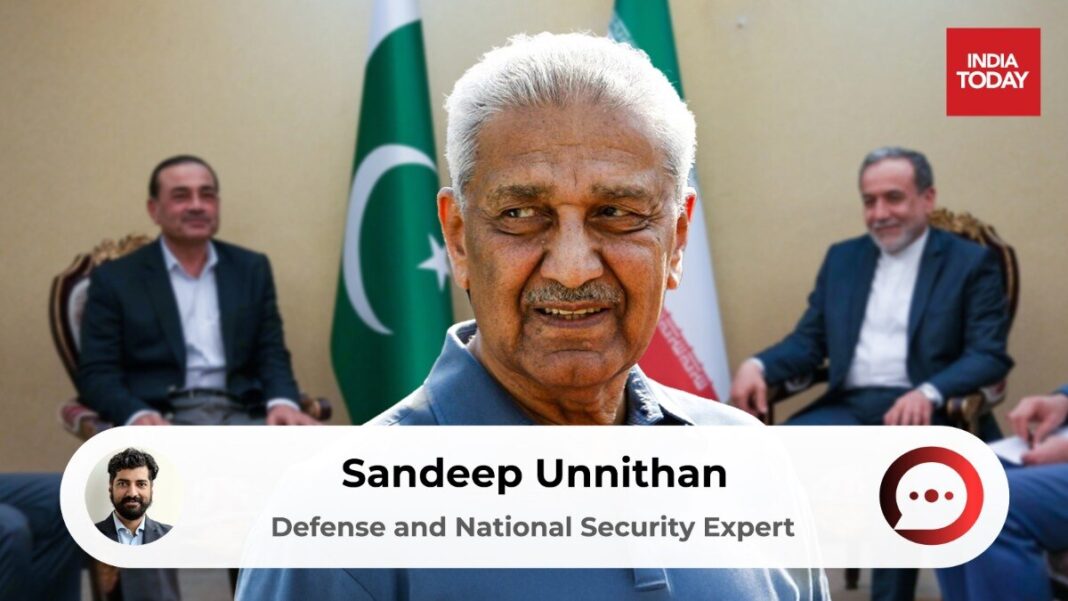
This is the story that inserts a sense of perfidious irony into the upcoming Islamabad Summit. In 2004, a tailor’s shop in the Pakistani capital rocketed to world attention. That year, Libyan dictator Muammar Gadaffi surrendered his nuclear weapons programme to UN weapons inspectors. Many bomb blueprints were handed over, as they had arrived, in the shopping bags of Good Looks Fabrics and Tailors, Islamabad. The story swiftly unravelled. AQ Khan, the disgraced Pakistani nuclear scientist and bomb maker, was a customer at the shop in Islamabad’s Melody Market. Evidently, he had used the suit bags to pack the Chinese blueprints for a 12-kiloton Chinese fission device, the CHIC 4, tested on October 27, 1966. Those bags outlined a three-decades-old story of nuclear proliferation – Chinese weapons designs, transferred to Islamabad, who then hocked them to anyone who could pay for them.
This ‘Nuclear Walmart’ was uncovered less than a year after the US and its allies invaded and destroyed Saddam Hussein’s Iraq allegedly because he was stockpiling Weapons of Mass Destruction (WMDs). The WMDs were clearly being trafficked a few thousand kilometres to the east. In 2004, Khan admitted to selling nuclear weapons technology to Libya, North Korea and Iran.
In 2005, Pakistan’s government confirmed the proliferation but shrugged away its scale. “Dr Abdul Qadir gave some centrifuges to Iran,” Information Minister Shaikh Rashid Ahmad said. “He helped Iran in his personal capacity, and the Pakistan government had nothing to do with it.”
Interestingly, Tehran was AQ Khan’s first destination. According to a 2005 chronology compiled by the Carnegie Endowment for International Peace, in 1987, Khan is believed to made a centrifuge deal with Iran to help build a cascade of 50,000 P-1 centrifuges.
In 2025, US B-2 bombers used GBU-57 bombs to try and target uranium enrichment centrifuges Iran kept at its two main underground sites – Natanz and Fordow.
Natanz had 50,000 centrifuges and Fordow, buried 60 metres deep inside a mountain, had 3,000 centrifuges.
Clearly, this transfer was far more than just the ‘some’ centrifuges that Rashid Ahmad claimed. The ‘rogue scientist’ label for AQ Khan was taken out of the same plausible deniability playbook Islamabad has always used to distance themselves from its terrorist proxies.
Khan’s proliferation began during the Zia years in the 1980s, a time when Pakistan was under direct military rule. It was unthinkable that a nuclear scientist, even one as well-connected as Khan, could hawk thousands of centrifuges, fly them abroad onboard Pakistan Air Force aircraft to Libya, Iran and North Korea.
The Carnegie Endowment chronology continues. In 1988, Iranian scientists are suspected of having received nuclear training in Pakistan. In 1989, Iran is suspected of receiving its first centrifuge assemblies and components. The shipped components are likely older P-1 centrifuge components Khan no longer had use for in Pakistan. “Through 1995, Khan is reported to have shipped over 2000 components and sub-assemblies for P-1, and later P-2, centrifuges to Iran.” In 1994 or 1995, ‘more advanced components for P-2 centrifuges are suspected to have arrived in Iran. BSA Tahir, a Sri Lankan businessman and Khan’s chief lieutenant, told Malaysian police that Iran paid approximately USD 3 million for these parts.’
Three decades later Khan’s network helped establish Iran as a threshold nuclear weapons state. The centrifuges have helped Tehran enrich uranium to about 60 per cent, 30 per cent less than it would take for a bomb. Iran has so far around 440 kgs of HEU enriched to around 60 per cent. Further enrichment would give it around six nuclear weapons of the CHIC 4 design.
But such perfidy is par for the course with General Headquarters (GHQ) Rawalpindi. In 2011, it sheltered Al Qaeda mastermind Osama bin Laden at a safe house just a stone’s throw away from its officer’s training academy in Abbottabad. GHQ protected Al Qaeda and the Taliban while pretending to aid the fight against them during the two-decade-long Global War on Terror (2001-2021).
There is thus a sense of macabre irony in the talks unfolding in Islamabad. It is the arsonist sitting down and helping to put out the fire. The fire is more than the one raging in West Asia and the one being exchanged between the US Navy enforcing a blockade of Iranian ports. The blaze of time is incinerating Trump’s deadline to end the war. The US President has three big events lined up this year – the May 14-15 summit meeting with President Xi Jinping in Beijing, the 250th anniversary of US Independence on July 4 and, critical for his political survival, the US mid-term elections on November 3.
Trump wants to exit the war with a win, and a big one at that. He wants a photo opportunity which will seal his place in history, perhaps as the first US President who did what six others before him could not— get a deal capping Iran’s nuclear capability. To add pressure on his ‘favourite Field Marshal’, Munir, Trump has even promised to land up at the Pakistani capital to be part of the peace deal.That statement is at once a giant carrot— Islamabad’s biggest foreign policy moment in the 21st century (George W Bush was the last President to visit Pakistan, in 2006) and a giant stick— if there’s no deal, Trump could swing back to what he once called Pakistan during his first term in 2018— of having got “nothing but lies and deceit” for the USD 33 billion in aid.
It is unlikely Trump knows of GHQ Rawalpindi’s role in building up Iran’s nuclear weapons capability or even cares about it.
Munir — the man whom Fox News outed as someone with deep ties to the IRGC — knows it. He also knows that Good Looks Fabrics and Tailors is just eight kilometres away from the location of the peace talks in the Serena Hotel. If he has a sense of humor. he might even suggest it as a location for the US delegation to get their suits stitched.


