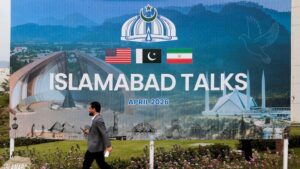
The collapse of the latest talks between the United States and Iran has once again pushed uranium enrichment to the centre of global attention. Negotiations broke down largely over one key issue: whether Iran should stop enriching uranium altogether, and for how long.
Washington demanded strict limits, including a long-term halt, while Tehran insisted that enrichment is its sovereign right.
To understand why this issue is so sensitive, it is important to first understand what uranium enrichment actually is.

WHAT IS URANIUM ENRICHMENT?
Uranium is a naturally occurring element, but most of it is not useful for nuclear reactions. Only a small portion, called uranium-235 (U-235), can sustain the chain reactions needed for nuclear energy or weapons.
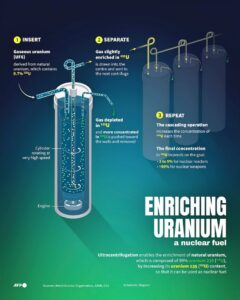
In its natural state, uranium contains less than 1% of this useful isotope. Enrichment is the process of increasing the proportion of U-235.
This is typically done using machines called centrifuges. Uranium is first converted into a gas and then spun at extremely high speeds. Because U-235 is slightly lighter than the more common uranium-238, the spinning process gradually separates the two.

This process is repeated thousands of times in cascades of centrifuges to achieve higher purity.
At low levels, enrichment is used for peaceful purposes. Nuclear power plants require uranium enriched to about 3-5%. Research reactors may use up to 20%. However, when enrichment levels rise beyond this, especially above 60%, the concern grows sharply.
WHAT IS WEAPONS-GRADE URANIUM?
Weapons-grade uranium requires about 90% enrichment.
This is where the line between civilian and military use begins to blur. The same technology used to produce fuel for electricity can also be pushed further to produce material for a nuclear bomb.
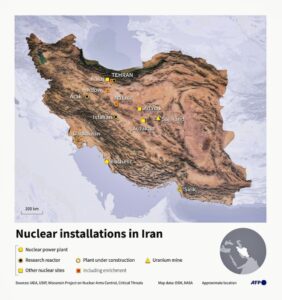
Iran is believed to have stockpiles enriched to levels far beyond civilian needs, bringing it closer to what experts call a “breakout capability,” the ability to quickly produce weapons-grade uranium.

Weaponisation, however, involves more than just enrichment. Once uranium is enriched to high levels, it must be converted into a solid core and shaped precisely. Conventional explosives are then arranged around it to compress the material and trigger a rapid chain reaction.
This reaction releases enormous energy, resulting in a nuclear explosion.
WHAT IS IRAN’S ENRICHMENT PLAN?
The current geopolitical tension stems from fears that Iran’s enrichment programme could eventually lead to this stage. The United States has demanded a complete halt or dismantling of enrichment facilities, arguing that even limited enrichment leaves the door open to weaponisation.
Iran, on the other hand, maintains that its programme is for peaceful energy and refuses to give up enrichment entirely.
The failure of the latest talks highlights how deeply divided the two sides remain. For the US and its allies, uranium enrichment is a pathway to potential nuclear weapons. For Iran, it is a matter of technological independence and national pride.
As diplomacy stalls, uranium enrichment remains both a scientific process and a geopolitical flashpoint, one that could shape the future of security in the Middle East and beyond.