
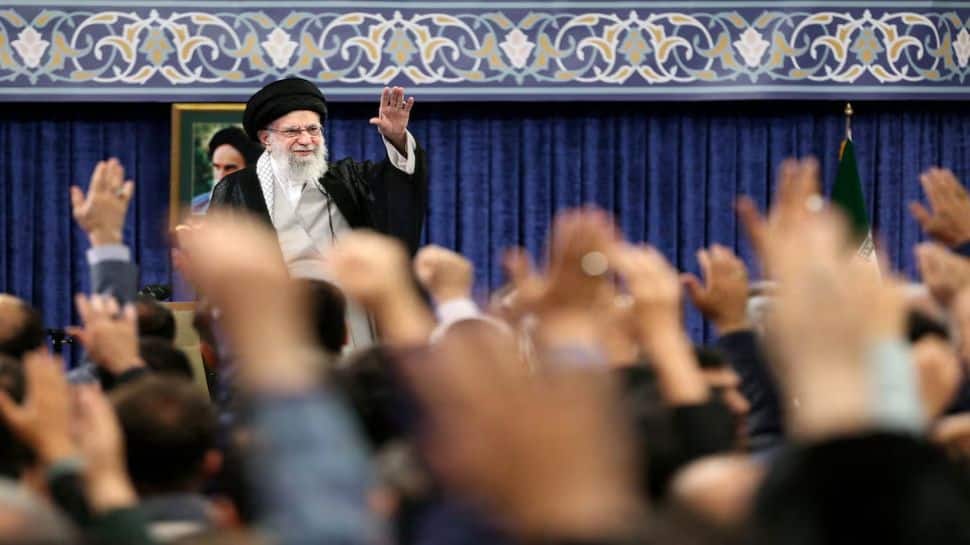
New Delhi/Tehran: Tehran: Iran’s Supreme Leader Ayatollah Ali Khamenei has been killed following a joint US-Israeli strike, according to Iranian state media. He was 86 years old. The announcement came shortly after US President Donald Trump had claimed that Khamenei was killed in an airstrike targeting his compound on Saturday.
Iranian news outlets reported that the “Leader of the Islamic Revolution” was “martyred” during the operation and described the event as a historic blow to Tehran. The US president had earlier stated that Khamenei and other senior Iranian officials “couldn’t escape US intelligence and the advanced tracking systems”.
Khamenei became Iran’s supreme leader in 1989 following the death of Ayatollah Ruhollah Khomeini, the figurehead of the 1979 Islamic Revolution. While Khomeini had provided the ideological vision to overthrow the Pahlavi monarchy, Khamenei built the institutions that allowed Iran to wield military and political influence both domestically and abroad.
Before his ascension, Khamenei served as Iran’s president during the brutal 1980s war with Iraq, a period that strengthened his distrust of the West. Analysts say this experience helped shape his two-decades long rule by strengthening his belief that Iran must always be alert to threats from outside and within.
Experts have described Khamenei as a wartime leader who viewed Iran’s survival through the lens of security and resistance. He transformed the Islamic Revolutionary Guard Corps (IRGC) from a paramilitary force into a dominant military, political and economic institution. He also championed a “resistance economy” to reduce reliance on the West and reinforce self-sufficiency despite sanctions.
He faced repeated challenges to his authority, including the 2009 Green Movement protests and the 2022 demonstrations over women’s rights. The unrest in January of this year was triggered by economic grievances. It quickly escalated into nationwide upheaval, directly challenging the survival of the Islamic Republic.
Analysts say his insistence on national independence came at a high cost, alienating parts of the population seeking reform and improved economic conditions.
Born in 1939 in Mashhad, Khamenei came from a religious Azerbaijani family. His father led a local mosque and his mother instilled in him a love of literature and poetry. He began Quranic studies at age four and later attended prominent Shia seminaries in Najaf and Qom, studying under noted clerics, including Khomeini.
He was repeatedly arrested by the Shah’s secret police for his political activism and exiled to remote areas before returning to join the 1978 uprising that helped topple the monarchy. After the revolution, he became Iran’s defense minister and later supervised the IRGC. In 1981, he survived an assassination attempt by the Mojahedin-e Khalq and subsequently became Iran’s first clerical president.
Following Khomeini’s death in 1989, Khamenei was appointed supreme leader, even though he had not reached the highest clerical rank at the time. He initially described the role as largely symbolic, but his leadership proved decisive. He rebuilt Iran after the war with Iraq, strengthened the IRGC, and created a structure for perpetual resistance against the West.
Khamenei also faced internal pressures from reformist movements, such as the landslide election of Mohammad Khatami in 1997. Observers say that he maintained tight control over the IRGC and expanded its economic and paramilitary reach to secure a loyal support base capable of countering reformist influence.
On the international front, Khamenei’s vision extended beyond Iran’s borders. He fostered what became known as the “axis of resistance”, channeling support to groups like Hezbollah, Hamas and the Houthis. This network was severely challenged in recent years following Israel’s offensive against Hamas, the fall of Assad in Syria and strikes targeting Iran’s nuclear programme.
Despite international sanctions and military pressure, Khamenei demonstrated a pragmatic side. He endorsed the 2015 nuclear deal, viewing it as a tactical compromise rather than normalisation with the United States, but returned to a more aggressive posture after the deal’s collapse under Trump.
His decisions often followed two approaches – resisting pressure from other countries and negotiating carefully when needed. These moves were meant to protect Iran’s independence and lessen the harm caused by sanctions.
The recent US-Israeli strike, which led to Khamenei’s death, came amid heightened tensions following months of conflict with Israel over nuclear facilities and regional influence. Trump’s address to the Iranian people called for regime change and urged citizens to seize the opportunity to take control of their government.
Khamenei’s legacy is defined by decades of consolidating power, resisting external pressure and building Iran’s military and political identity. Analysts suggest that his death leaves a vacuum in the country’s leadership and raises questions about succession, internal stability and the future trajectory of Iran’s domestic and foreign policies.


