
Just as Pakistan tried to play peacemaker in a volatile Middle East war, a quiet military deployment — and a louder leak — has cast doubt on how neutral it really is.
According to Drop Site News, secret documents reveal a previously undisclosed Saudi Arabia–Pakistan mutual defense pact that could pull Islamabad directly into the very conflict it was attempting to mediate between the United States and Iran.
The report comes after Saudi Arabia announced the arrival of Pakistani military forces, including aircraft, at King Abdulaziz Air Base, a move framed as boosting “operational readiness” but now seen in a far more consequential light.
Drop Site reports that the deployments stem from a defense agreement signed in 2025 that states any aggression against one country shall be considered an aggression against both, raising the possibility that Pakistan could be drawn into a broader regional war.
Pakistan had been hosting high-stakes ceasefire talks between Washington and Tehran when the Saudi announcement was made, a timing that appeared to undercut Islamabad’s role as a neutral mediator. The talks ultimately collapsed, with the US delegation leaving without a deal.
A PACT KEPT IN THE DARK
The details of the agreement had never been made public or reviewed by Pakistan’s parliament. According to the leaked archive, the pact builds on earlier military cooperation deals dating back to 1982, but significantly expands Islamabad’s obligations.
One amendment states that Pakistan is obligated to send its forces to Saudi Arabia upon request to deal with any threat to its security, sovereignty, territorial integrity and interests.
Despite the sweeping commitment, the documents suggest the agreement places no clear reciprocal military obligation on Riyadh, relying instead on Saudi financial support to Pakistan’s fragile economy.
“This is the first time Pakistan could be directly tied to defending Saudi Arabia in an active conflict,” the report indicates, highlighting internal concerns within Pakistan’s military establishment over the one-sided nature of the deal.
MEDIATION OR ENTANGLEMENT?
The revelations offer new context for Pakistan’s urgency in trying to broker a ceasefire. Islamabad maintains ties with both Iran and the United States but is also heavily reliant on Saudi financial backing.
Foreign Minister Ishaq Dar had earlier acknowledged the pact publicly, warning Tehran to “take care of our pact with Saudi Arabia,” signalling the delicate balancing act underway.
At the same time, Pakistan’s leadership has pushed to avoid direct involvement in the war, aware of the domestic and strategic risks. A conflict with Iran — which has significant public sympathy in Pakistan — could trigger internal unrest and complicate already tense regional dynamics.
OLD TIES, NEW RISKS
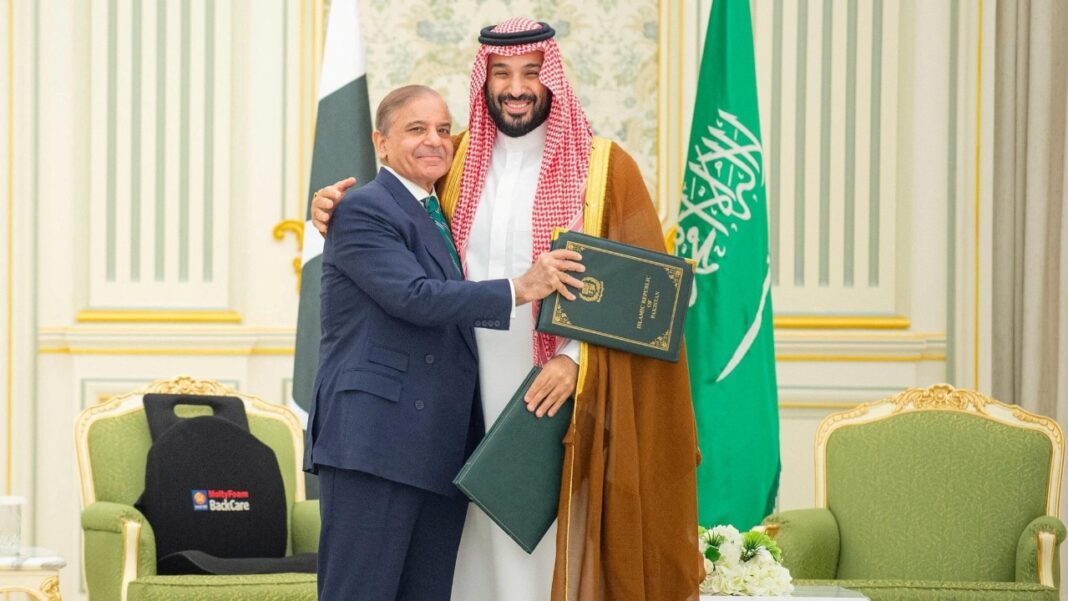
The pact’s roots trace back decades, but its latest iteration, signed by Saudi Crown Prince Mohammed bin Salman and Prime Minister Shehbaz Sharif in 2025, marks a turning point.
Unlike earlier agreements focused on training and equipment, the updated deal introduces a collective defense clause — a shift that analysts say aligns closely with long-standing Saudi concerns about Iran.
Yet even within Pakistan, the agreement has been contentious. Former Prime Minister Imran Khan reportedly hesitated to sign earlier versions, wary of committing the country to a foreign war.
The timing of the leak is significant. Iran has carried out strikes on Saudi energy infrastructure, while regional tensions have pushed up global oil prices and raised fears of a wider conflict.
Despite the deployment of Pakistani forces, analysts quoted by Drop Site say the move is largely symbolic for now, with limited direct impact on the battlefield. The pact is defensive in nature and does not obligate Pakistan to launch offensive operations against Iran.
Still, the political implications are far-reaching. A deeper involvement in the war could place Pakistan alongside a US- and Israel-aligned bloc — a stance likely to face strong domestic opposition.


