
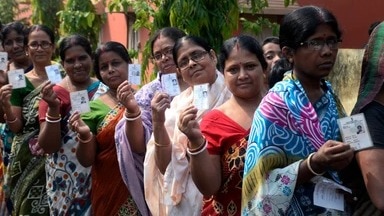
In West Bengal’s upcoming high-stakes Assembly polls, one factor could quietly decide the outcome – and it isn’t a party, a leader, or even an alliance. It is a voter bloc that has steadily grown in strength over the years: women. The state will vote in two phases on April 23 and 29.
Not B for BJP. Not T for TMC.
This election could well be defined by M – Mahila – as both Chief Minister Mamata Banerjee and Prime Minister Narendra Modi sharpen their strategies to win over Bengal’s women voters, who now form one of the most decisive and consistent electoral forces in the state.
WHAT PM SAID THIS WEEK
Just days ago, PM Modi addressed rallies in Purba Bardhaman and Murshidabad and his messaging was sharply focused on women voters. He said, “I have especially come to assure all the sisters and daughters of Bengal. BJP has announced Rs 3,000 per month for women.”
The promise of Rs 3,000 per month is central to the BJP’s pitch and is pitched as double the benefit currently provided by the state government, turning the contest into a direct welfare comparison between the Centre and the state.
But the outreach was not limited to cash transfers. The Lakhpati Didi scheme, launched in 2024, is a flagship initiative of the central government. The scheme aims to make three crore women financially independent by enabling them to earn over Rs 1 lakh annually.
One real example is the Mukhyamantri Majhi Ladki Bahin Yojana in Maharashtra, which provides Rs 1,500 monthly to women and is widely credited with the BJP-led Mahayuti’s huge victory in the 2024 Assembly polls.
At a rally in Birbhum, PM Modi further elevated the narrative, calling the Bengal election a fight for women’s dignity and safety. Referencing the RG Kar Medical College rape-murder, he said, “This election is for the dignity and honour of our daughters and women.”
The BJP’s candidate selection in Panihati, where Ratna Debnath – the mother of the RG Kar victim – has been fielded, also adds symbolic weight to the campaign messaging. In Cooch Behar, PM Modi additionally promised 33 per cent reservation for women in Parliament and state assemblies from 2029. Together, these form a three-part pitch: cash, safety and representation, the BJP’s targeted outreach to Bengal’s women voters.
THE NUMBERS THAT EXPLAIN EVERYTHING
To understand why this matters, one must look at the electorate itself. West Bengal has over 6.75 crore voters, of whom 3.44 crore are women and 3.60 crore are men. Women make up nearly half the electorate, making them decisive in closely contested elections.
Turnout data shows their consistency. In 2021, women’s turnout stood at 81.75 per cent, slightly higher than men’s at 81.37 per cent. This is not an isolated trend but part of a steady pattern over the years, where women’s participation has remained high and often slightly ahead of men.
This consistency translates into political power. In multiple constituencies, women voters outnumber men, making them the defining factor in seat outcomes. In 2021, this voter base played a crucial role in shaping the final result in favour of the ruling party.
HOW MAMATA BUILT THIS WALL
So, how has Mamata Banerjee maintained such strong support among women voters? The answer lies in a combination of political presence and structured welfare delivery. Her padyatras and grassroots engagement create direct emotional connect, where she is seen meeting women in their neighbourhoods and addressing their concerns personally. This imagery of accessibility has reinforced her political brand over the years.
However, the foundation of this support is institutional. A CSDS post-poll survey found that Trinamool Congress is the only major party in India that consistently receives more votes from women than men. In 2016, nearly 52 per cent of TMC’s vote share came from women voters. This loyalty has not been accidental but built incrementally through targeted welfare schemes and sustained political messaging.
LAKSHMIR BHANDAR, THE SCHEME THAT CHANGED EVERYTHING
At the centre of this welfare architecture is Laxmir Bhandar. Launched in 2021, it began as a direct monthly transfer of Rs 500 to women beneficiaries. Over time, the amount was increased repeatedly, reaching Rs 1,500 for general category women and Rs 1,700 for SC and ST beneficiaries.
The scheme now carries a significant fiscal commitment, with the state government allocating around Rs 15,000 crore this year alone. Alongside it, other welfare programmes such as Rupashree, which provides Rs 25,000 at marriage to over 22 lakh women. Kanyashree, another women-centric scheme, has supported nearly one crore girl students with over Rs 16,554 crore in expenditure and further deepened this welfare network.
Taken together, these are not isolated schemes, but a structured political framework aimed at consolidating women’s support for the ruling party in Bengal.
THE NATIONAL PLAYBOOK
What is unfolding in Bengal mirrors a broader national trend. Across India, women voters have emerged as decisive electoral actors over the past several years. In Madhya Pradesh, Ladli Behna played a major role in shaping the electoral outcome. In Maharashtra, women-focused welfare schemes, including the Ladki Bahin Yojana, delivered unexpected results that defied many pre-poll predictions. In Bihar as well, PM Modi has acknowledged women as silent but decisive voters.
At the national level, initiatives like Drone Didi, which trains women self-help groups to use drones in agriculture, reflect a broader strategy of combining welfare with economic empowerment. The consistent political approach has been to directly engage women through financial and livelihood support, bypassing traditional political intermediaries. While this model has succeeded in several states, Bengal remains a key battleground where its effectiveness is still being tested.
THE FAULT LINE. MONEY VERSUS SAFETY
The political contest in Bengal now revolves around two competing narratives. Mamata Banerjee’s argument is rooted in continuity and delivery — that existing monthly transfers like Rs 1,500 offer tangible, immediate benefits backed by a proven track record. Her strategy rests on long-term trust built through sustained welfare distribution.
The BJP, on the other hand, is betting on a shift in voter priorities, arguing that sandeshkhali-west-bengal-mamata-banerjee-2590893-2024-08-30″ target=”_self”incidents like RG Kar and Sandeshkhali have fundamentally altered perceptions around women’s safety and governance. Senior leaders like Suvendu Adhikari have repeatedly claimed that women in Bengal remain unsafe despite having a woman chief minister, using these incidents as central evidence.
This sets up a defining question for the electorate: in 2026 Bengal, does the woman voter prioritise financial support or personal safety and dignity?
THE SILENT VOTER
One of the most critical characteristics of Bengal’s women voters is their silence. They are often described as silent voters who do not openly declare political preferences, neither in surveys nor in social settings, making them one of the most unpredictable voting blocs in the state.
The 2021 election highlights their impact clearly. Around 50 per cent of women voted for the TMC compared to 37 per cent for BJP, creating a significant 13-point gap. Among men, the gap was much narrower. This gender difference was one of the key reasons behind the final outcome.
For the BJP, the challenge is not necessarily to win over women outright, but to reduce this gap. For the TMC, the task is to preserve it. The difference between these two scenarios effectively determines the outcome of the election.
MAHILA VOTERS HOLD KEY TO 2026 VERDICT
In Bengal, the idea of the “M-Factor” has long been associated with Maa, Maati, Manush – the political identity crafted by Mamata Banerjee over the years. But in 2026, that definition is being reshaped.
A fourth “M” has taken centre stage – Mahila. And both PM Modi and Mamata Banerjee are going all out to win over this decisive vote bank.
With 3.44 crore women voters, nearly half the electorate, the battle is no longer just about ideology or party loyalty. It is about who connects better with women – through welfare, safety, dignity or trust.
They will cast their votes on April 23 and April 29. And on May 4, they won’t just decide a government – they will decide the direction of Bengal’s politics.
Everything else, in this election, is just background noise.
Elections 2026 | West Bengal Election | West Bengal Election Constituencies | West Bengal Election Schedule


