After a brief post-pandemic rebound, population growth in the United States has slowed sharply, and nowhere is that stagnation more revealing than in New York. Fresh estimates from the US Census Bureau show that between July 2024 and July 2025, New York State added just 1,008 residents, effectively flatlining after years of volatility driven by Covid, migration surges and interstate departures.
At the heart of the slowdown is immigration. A “historic decline” in net international migration has reduced the number of newcomers arriving nationwide, and in New York, a state long defined by immigration, the drop has been particularly stark. At the same time, domestic outmigration continues to drain residents to other states, even as births narrowly offset deaths.
A national slowdown, a state at a standstill
According to the Census Bureau’s Vintage
2025 estimates, the US population grew by 1. 8 million people, or 0. 5%, between July 1, 2024 and July 1, 2025. That marks a significant slowdown from the previous year, when the country added 3. 2 million people and grew by 1. 0%, the fastest annual growth rate since 2006. It is also the slowest growth since the early period of the Covid-19 pandemic, when population growth fell to a historically low 0. 2% in 2021.
“The slowdown in US population growth is largely due to a historic decline in net international migration, which dropped from 2.7 million to 1.3 million in the period from July 2024 through June 2025,” said Christine Hartley, assistant division chief for Estimates and Projections at the Census Bureau.
“With births and deaths remaining relatively stable compared to the prior year, the sharp decline in net international migration is the main reason for the slower growth rate we see today. ”
That national picture is amplified in New York.
Between July 2024 and July 2025, the
state’s population grew by just 0. 005%, 1,008 people, bringing its total to just over 20 million. Since the 2020 Census count of 20,203,696, New York remains down by roughly 120,000 to 201,000 residents depending on the revised baseline, the largest net population decline of any state since 2020.
Only seven states have experienced a net population drop since the last census: West Virginia, Mississippi, Louisiana, Hawaii, Illinois, California and New York. On a proportional basis, New York’s roughly 1% decline since 2020 exceeds the 0.8% and 0.5% declines recorded in Illinois and California, respectively. Only West Virginia and Hawaii, both down 1.5%, have lost a larger share of their census-era population.
Meanwhile, growth has been concentrated elsewhere. Since 2020, Texas has added about 2.6 million residents and Florida about 1.9 million. In the latest year alone, Texas grew by 391,243 residents and Florida by 196,680.
Immigration: From record highs to a sharp fall
New York’s recent demographic story has hinged on immigration. For generations, people have come to New York City for its vast job market, established immigrant communities, and support systems, including its right-to-shelter policy, that have long made the city a first stop for those seeking opportunity, even as rising costs begin to strain that tradition.
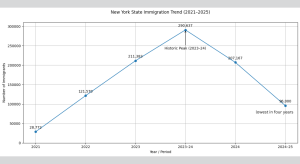
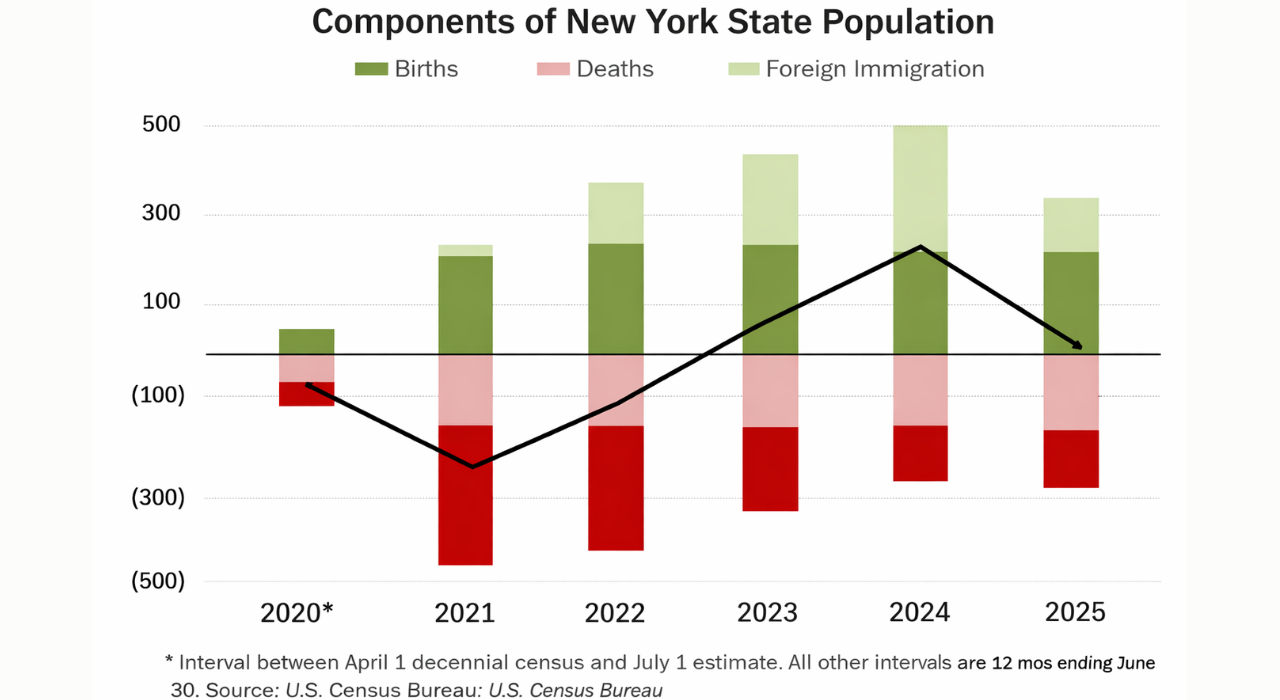
Following an initial post-Covid drop of roughly 368,000 residents in the two years after April 2020, the state experienced a surge in foreign migration. Revised Census data show that in 2023–24, New York took in more than 290,637 foreign migrants, the highest single-year total for at least a century. In 2024, 207,167 immigrants moved to the state; in 2023, 211,383; in 2022, 121,570. By contrast, 2021 saw just 28,772 new arrivals, an outlier shaped by pandemic restrictions.
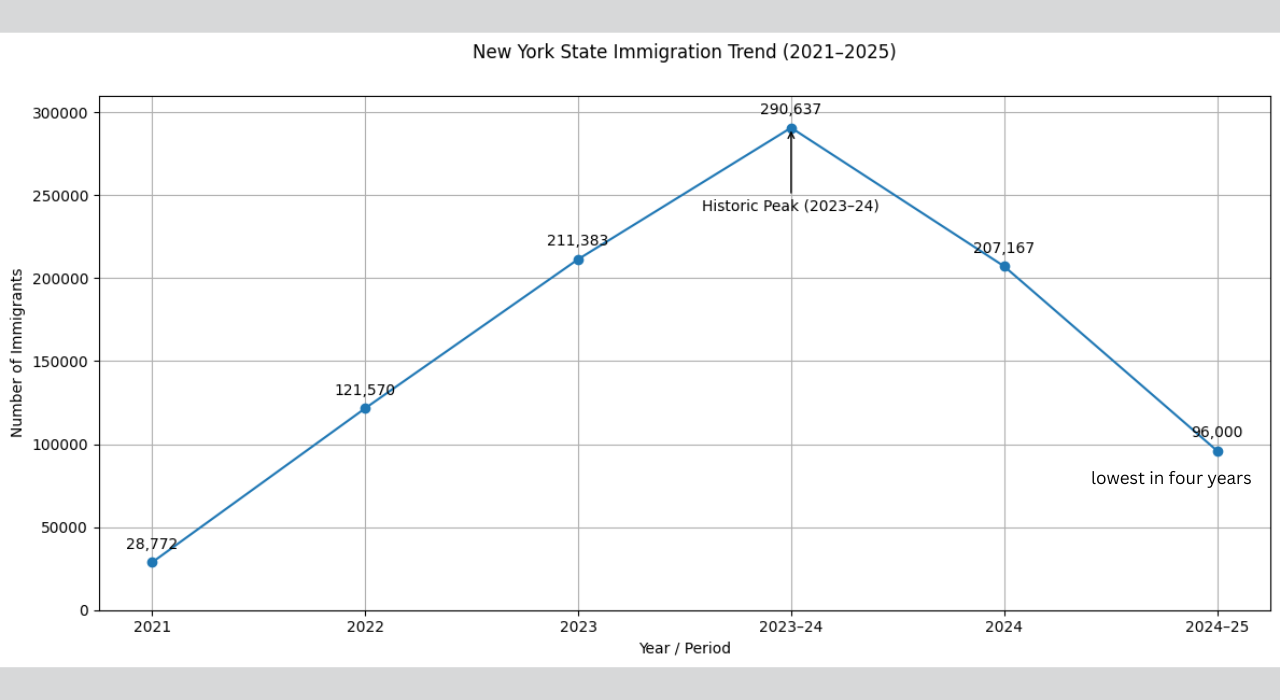
But from July 2024 to July 2025, the inflow dropped sharply. Roughly 96,000 immigrants moved to New York State during that period, a two-thirds decline from the previous year and the lowest influx in four years.
The decline mirrors national trends. Nationwide, net international migration fell from 2.7 million to 1.3 million in the same 12-month period.
Several factors are at play.
Border crossings surged in 2023, with 3. 2 million people recorded at the southern US border. Starting in 2022, governors including Greg Abbott of Texas and Doug Ducey of Arizona bused thousands of migrants from the Texas-Mexico border to sanctuary cities like New York, Chicago and Los Angeles starting in 2022, likely contributing to the surge in immigrant population during 2022–24.
But advocates say a mix of affordability pressures and practical barriers are now pushing some newcomers to leave. Sky-high rents, a tight housing market, limited affordable units, and, for many recent arrivals, delays in securing legal work authorization are making it difficult to put down roots.
“I’ve firsthand heard from so many people that it’s so expensive to live here, and these are new New Yorkers who came here and were dropped off here, living at shelters, trying to make it,” Tania Mattos, executive director of Unlocal, told The City.
Unlike previous years, she added, finding work without a Social Security number or work authorization card has become more difficult.
Although many want to stay, some immigrants are effectively forced to leave for more affordable areas.
Often, that means moving to non-sanctuary cities, where they face higher risks of harassment or detention by Immigration Enforcement agents. “They have to move to places like Idaho, or other locations that are economically better for them,” Mattos said.
Economists warn of the economic consequences of a sustained slowdown.
“New York cannot afford to lose immigrants from our communities and our economy,” said Emily Eisner, an economist at the Fiscal Policy Institute, told The City.
“International immigration into New York State constitutes a huge driver of the state’s economic growth. Without an annual influx of immigrants, New York’s population tends to fall, threatening the state’s tax base and economic strength.”
Eisner added: “Immigrants supply essential labor to the economy, such as construction work, food services, healthcare, childcare, and home care. Without robust immigration into the state, prices on these essential goods and services will soar, and the economy will contract.”
David Kallick, director of the Immigration Research Institute, echoed that concern, telling The City: “When newcomers arrive from around the country and around the world, they bring in a steady flow of new energy and new ideas.”
“Shutting that dynamo down will have negative impacts on all of us. Especially as the state population ages, we are going to sorely miss this new energy.”
As of 2024, around 4.6 million New York State residents are foreign-born, with roughly 3.1 million living in New York City.
Domestic outmigration and the ageing state
Even as international arrivals picked up, New York continued to lose residents to other parts of the country.
According to the census data, between July 2024 and July 2025, New York lost 137,000 residents to other US states. Over the five years since 2020, the state’s cumulative domestic migration loss has topped 1 million, second only to California in absolute terms. Relative to its population base, New York’s rate of domestic decline remains the highest of any state in the 2020s.
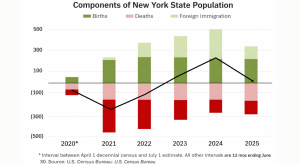
In the most recent year, overall migration, combining international and domestic flows, resulted in a net loss of 42,000 people. That was narrowly offset by “natural increase”: 203,000 births minus 160,000 deaths, producing a gain of 43,000.
In effect, births balanced migration losses almost exactly, leaving the state in near-perfect demographic equilibrium, but only just.
Experts suggest that much of the population loss is concentrated in ageing rural counties upstate, while migration churn is more pronounced in New York City and its suburbs.
The Census Bureau’s latest estimates do not yet include county-level breakdowns.
With international migration slowing further amid tighter border controls and deportations, and with housing markets thawing in southern states that have attracted many former New Yorkers, the risk of renewed decline looms.
For centuries, New York has defined itself as a gateway city. European settlers arrived in 1624; generations of immigrants followed. Today’s data suggest that without sustained immigration, the state’s demographic and economic foundations become far more precarious.