
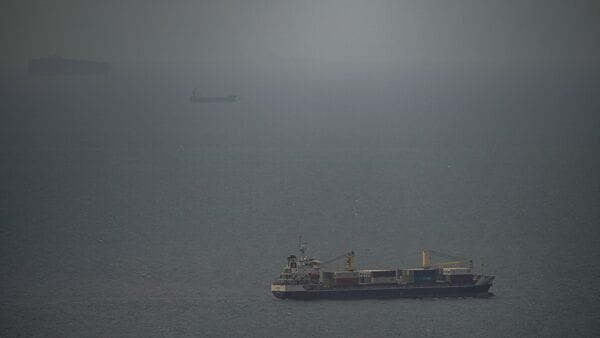
Iran’s Islamic Revolutionary Guard Corps (IRGC) on Wednesday said that its naval forces seized two container ships attempting to cross the Strait of Hormuz, which has been effectively shut since the war began on 28 February, AFP reported.
The development comes despite US President Donald Trump announcing he was extending the ceasefire to allow more time for peace talks, after Tehran refused to send a delegation to Islamabad, Pakistan, for the second round of talks.
In a statement, IRGC said, “The Islamic Revolutionary Guard Corps naval force this morning identified and stopped in the Strait of Hormuz two violating ships,” and added, “The two offending ships… were seized by the IRGC’s naval forces and directed to the Iranian coast.”
It further said that the ships “allegedly operated without authorisation, repeatedly violated regulations, manipulated navigational aid systems, and sought to covertly exit the Strait of Hormuz, endangering maritime security”. According to AP, the two seized ships were now in the IRGC’s custody and were being taken to Iran.
Citing UK-based maritime security monitors, AFP reported that at least three commercial vessels reported incidents with gunboats in the Strait of Hormuz, a key global route for Gulf oil and gas, where the US and Iranian forces are competing for control.
While one of the ships has been identified as the Panama-flagged container ship MSC Francesca, the other was the Liberia-flagged Epaminodas. According to Marine Traffic, the last known positions of both these vessels were reported closer to the Iranian coast of the Strait of Hormuz, which lies northeast of Oman.
US blockade continues
The attack on vessels seeking to cross Hormuz comes as the US military is continuing with its naval blockade heading to and from Iranian ports. The blockade was announced by the US President and enforced on 13 April, a day after it was reported that the US-Iran peace talks in Islamabad failed, despite negotiations lasting over 21 hours.
Despite Iran opening the Strait of Hormuz for nearly 24 hours last week, Trump, in a Truth Social post, indicated that the US blockade would continue, a move that did not sit well with the Islamic Republic, which shut the Strait once again for commercial vessels. After the Strait was shut again, Tehran said that vessels must seek permission to enter or leave the Gulf via Hormuz, a narrow yet arterial waterway that accounted for roughly a fifth of the world’s oil and gas exports, along with other key commodities.
US-Iran peace talks in limbo?
The fate of US-Iran peace talks hosted by Pakistan remains unclear. After the first round of talks failed, Tehran accused the US of making excessive demands on the Strait of Hormuz and its nuclear program. The US, on the other hand, blamed Iran for choosing not to accept Washington’s terms.
US Vice President JD Vance’s visit to Pakistan was put on hold after Iran announced that it would not send any delegation for fresh talks until the military blockade on its ports ended.
A CNN report citing Iranian lawmaker Ahmad Naderi reiterated that no Iranian delegation has travelled to Pakistan for negotiations.
Watch: LIVE | IRGC Issues Stark Warning: ‘People May Choose Revenge Targets’ If Truce Collapses | Trump
Iran acknowledges ceasefire extension
According to AP, Iran’s Foreign Ministry spokesperson Esmail Baghaei acknowledged the extension of the ceasefire. However, speaking to Iranian state television, Baghaei did not clearly say if Tehran was ready to attend a new round of talks.
“Diplomacy is a tool for securing national interests and security, and whenever we reach the conclusion that the necessary and reasonable conditions exist to use this tool to achieve national interests and to consolidate the achievements of the Iranian nation in thwarting the enemies’ malicious objectives, we will take action,” he reportedly said.


