
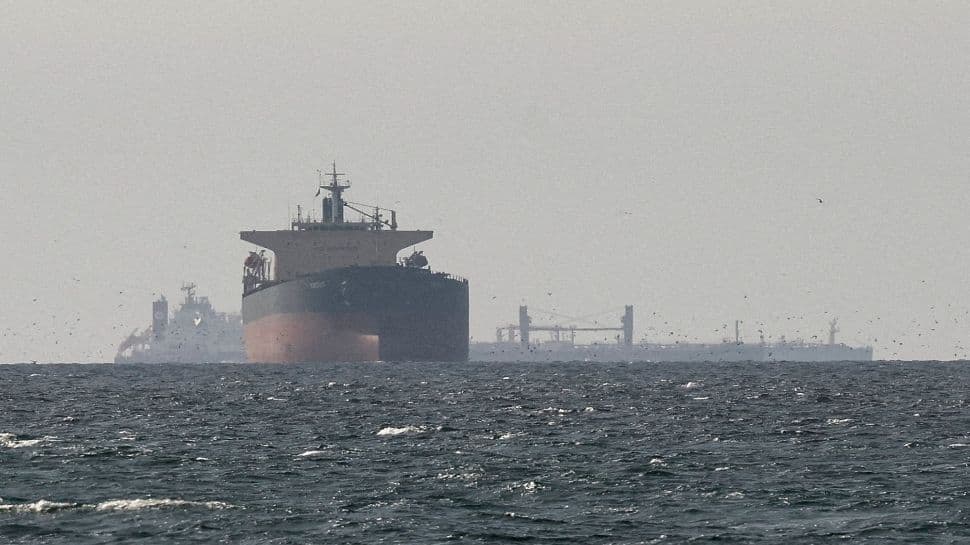
China Oil Supply Routes: The US blockade targeting vessels calling at Iranian ports did not completely stop traffic through the Strait of Hormuz. Shipping data cited by Reuters showed that at least eight vessels, including three associated with Iran, crossed the waterway on April 14. One of them, the sanctioned tanker Rich Starry, transported methanol from the United Arab Emirates (UAE) to China.
However, the data painted a more cautious picture. Before the US-Israel war against Iran began on February 28, more than 130 ships crossed the strait every day. After the blockade, traffic dropped to much lower levels.
This raises an important question. If cargo is still moving through Hormuz, has China reduced its dependence on the world’s chokepoints, or does the real vulnerability lie elsewhere?
Why Hormuz is only the first step
The Strait of Hormuz is not the end of the journey for China. It serves only as the first gateway.
Oil leaving the Persian Gulf must still cross the Indian Ocean before reaching the Strait of Malacca. From there, shipments move into the South China Sea and finally reach Chinese ports.
This means that even if ships pass safely through Hormuz, the risk does not disappear. It simply moves to the next chokepoint. Disruptions in West Asia and Southeast Asia therefore form a single chain. One narrow passage leads to another.
China’s long-standing ‘Malacca dilemma’
Chinese policymakers have worried about this dependence for years. The concern is often described as the “Malacca dilemma”.
The numbers explain why this concern persists. Around 62 percent of China’s oil imports move through the Strait of Malacca and the South China Sea. Roughly half of its oil supply follows this maritime route every day.
Beijing has tried to diversify its supply routes, but sea lanes still form the backbone of its energy system.
Pipelines have helped, but sea routes still dominate
Over the past two decades, China has built multiple alternatives to reduce dependence on sea routes. These include pipelines through Myanmar, energy corridors across Central Asia, larger imports from Russia and infrastructure projects under the Belt and Road Initiative.
These options have added flexibility. However, they have not matched the scale or cost efficiency of maritime oil transport.
Sea routes still handle the largest share of imports.
Myanmar pipeline – A direct bypass with limits
One of China’s most direct alternatives is the Myanmar-China oil pipeline, which started operations in 2017. It allows crude oil to be unloaded on Myanmar’s western coast and transported directly into China’s Yunnan province, entirely avoiding the Strait of Malacca.
Citing CCTV, the country’s state media reported that the pipeline has a capacity of 22 million tonnes per year.
While this route helps reduce risk, it accounts for only a small portion of China’s total crude oil imports. The scale is limited compared with maritime shipments.
Russia and Central Asia – Useful buffers
China has also expanded energy cooperation with Russia and Central Asia. The Power of Siberia pipeline, which began operations in 2019, carried 38.8 billion cubic metres of gas for China in 2025, according to Reuters.
Meanwhile, the Central Asia gas pipeline network, which runs from Turkmenistan through Uzbekistan and Kazakhstan, has a designed capacity of 60 billion cubic metres annually. Chinese government data shows that the network has delivered more than 500 billion cubic metres of gas since 2009.
These corridors strengthen China’s energy security. However, they mainly supply natural gas. Crude oil, which forms a larger share of Beijing’s energy imports, still travels primarily by sea.
Gwadar Port – Strategic but not yet a major oil route
Developed under the China-Pakistan Economic Corridor, Pakistan’s Gwadar port is considered another alternative. The port is located near the entrance of the Persian Gulf and, in theory, offers a shorter land route into western China.
In practice, Gwadar is still developing as a logistics hub. Infrastructure challenges and transport costs have limited its use for large-scale oil movement.
At present, it adds another option but does not replace existing routes.
Domestic energy push
China has also worked toward reducing import dependence by expanding domestic energy production. According to the International Energy Agency, Beijing’s clean energy investment crossed $625 billion in 2024, nearly double the levels seen in 2015.
The country also achieved its 2030 wind and solar capacity targets six years ahead of schedule.
This expansion reduces reliance on imported fuels over time. However, oil is essential for transport, manufacturing and petrochemicals. As a result, maritime imports continue to play a major role.
What one tanker actually shows
The passage of the Rich Starry through Hormuz has drawn attention. Some observers pointed to it as evidence that China can continue operations despite the blockade.
The details suggest a narrower conclusion. The tanker was not heading to an Iranian port, which meant it did not fall under blockade restrictions. At the same time, overall traffic through Hormuz was well below normal levels, showing caution among shipping companies due to higher insurance costs and operational uncertainty.
A few ships crossing the strait does not indicate full resilience. It shows that limited movement is still possible.
Alternatives exist, but no complete exit
China’s pipelines, ports and domestic energy investments have improved its energy security. These measures have created buffers and diversified supply routes.
However, maritime transport still offers the largest capacity and is the most efficient way to move crude oil. Sea lanes therefore continue to serve as the backbone of China’s energy supply chain.
Why Malacca still matters
The disruption around Hormuz does not show that China has solved its Malacca dilemma. Instead, it shows how the challenge has evolved.
Beijing now has more options than before. Its exposure has reduced compared to earlier years. But as long as most crude oil travels from the Gulf to East Asia by sea, the vulnerability continues.
Hormuz may be the immediate flashpoint, but Malacca still influences the long journey that follows.


